 By Samuyl Joshi
With the growth of global digital business, international SMS, OTP verification, voice notifications and enterprise messaging have become essential communication infrastructure for cross-border e-commerce, internet platforms, fintech and SaaS companies.
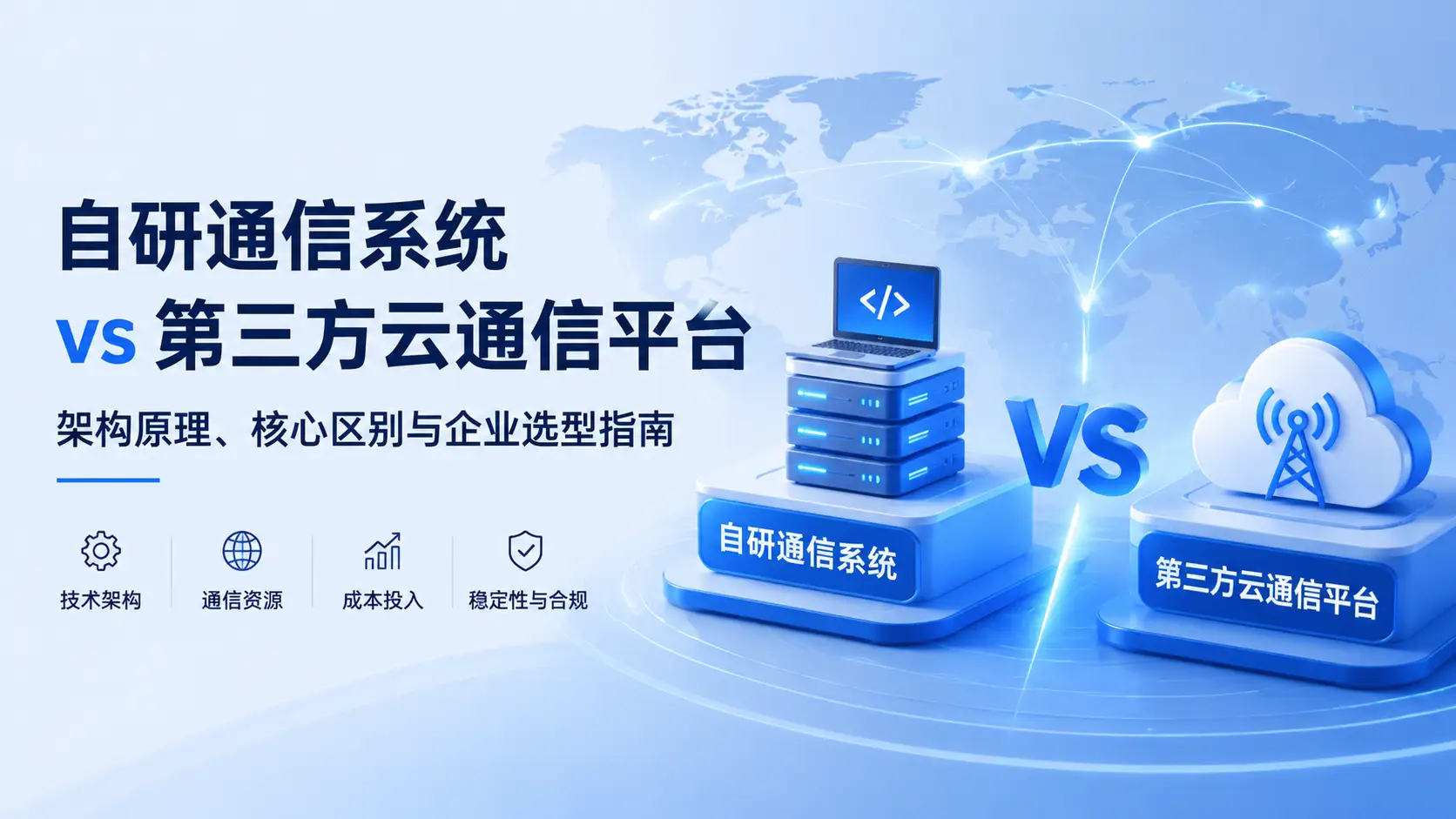
When enterprises build communication capabilities, they usually face two choices: build a communication system in-house or integrate with a third-party cloud communication platform.
Both can deliver messaging and voice services, yet they differ significantly in underlying architecture, resource management, technical autonomy, development investment and long-term operation.
This difference is especially important for enterprises that need to cover multiple countries and regions. A communication system must not only send and receive messages, but also handle carrier resource access, routing and scheduling, delivery reports, traffic control and local compliance rules.
This article analyzes the core differences between self-developed communication systems and third-party cloud communication platforms, and discusses how enterprises should choose at different business stages.
A self-developed communication system refers to a communication software platform and related technical architecture that an enterprise designs, builds, deploys and maintains according to its own business requirements.
Its core is that the enterprise owns the major technical implementation of the communication system, including business processing logic, routing rules, data management and the operation and maintenance system.
A relatively complete enterprise-grade communication system typically includes the following modules:
1. Communication Access Layer
Connects to carriers, international SMS gateways, voice resource providers and other communication resources to establish underlying links.
2. Business Processing Layer
Handles SMS sending, OTP verification, voice calls, message queue processing and other business logic.
3. Routing and Scheduling Layer
Selects the appropriate communication link based on target country, carrier, number type, business type, channel status and cost strategy.
4. Data Management Layer
Stores and manages customer information, sending records, message status, account balance, communication statistics and related business data.
5. System Management Layer
Provides user permissions, API configuration, account management, business monitoring, log analysis and system operation features.
Technical Autonomy
The enterprise can design the core architecture and business processing logic independently.
High Customization
Enterprise can build dedicated features for different business scenarios.
Strong System Control
Enterprise can adjust routing rules and data management strategies as needed.
Higher Development Investment
Requires continuous investment in development, testing, security and operation resources.
Longer Build Cycle
From architecture design to production launch, a complete development and testing process is required.
A self-developed communication system is more suitable for enterprises with a mature engineering team, long-term communication business needs and strong technical management capabilities.
A third-party cloud communication platform is a communication service system built and operated by specialized communication providers.
Enterprises do not need to build a complete communication infrastructure from scratch. They integrate SMS, voice and other communication services offered by the platform through API interfaces, SDKs or management consoles.
In the case of an international cloud communication platform, the provider typically aggregates carriers and communication resources across multiple countries and regions, offering unified communication access to enterprises.
API Service Layer
Provides standardized communication interfaces that allow enterprise business systems to integrate quickly.
Resource Management
Aggregates carriers and communication channels across different countries and regions.
Intelligent Routing
Selects communication links based on country, carrier and channel status.
Message Processing Engine
Handles message submission, queue processing, scheduling and status management.
Data Feedback System
Provides sending status, delivery reports and failure reason information.
Operation Console
Supports account management, balance management, sending statistics and business monitoring.
Fast Integration: Enterprises can enable communication features through standard APIs.
Resource Aggregation: The provider manages communication resources across countries and regions.
Lower Entry Barrier: No need to build the full communication system independently.
Centralized Operation Responsibility: The provider mainly maintains the platform infrastructure and core systems. Enterprises still need to operate their own business systems and interface integrations.
Extensibility Depends on the Platform: The communication capabilities, routing configuration and customization options an enterprise can use depend on the provider technical openness.
From a practical enterprise application perspective, the main differences between the two communication models focus on system construction, technical control, resource management and operating costs.
| Dimension | Self-developed / Third-party Platform |
|---|---|
| System Construction | Enterprise builds in-house / Provider delivers a mature platform |
| Technical Architecture | Enterprise designed / Designed by the platform provider |
| Development Cycle | Relatively long / Usually short |
| Initial Investment | High development and infrastructure cost / Usually access and service fees |
| Feature Customization | Large room for self-development / Limited by platform openness |
| Communication Resources | Enterprise purchases and connects / Provider aggregates or supplies |
| Routing Management | Self-developed and configured / Depends on platform openness |
| System Maintenance | Enterprise responsible / Platform provider responsible for platform |
| Data Control | Enterprise designs management mechanism / Depends on provider data permissions and deployment |
| Business Expansion | Depends on development and resource integration / Depends on platform capability and provider support |
Note that the two models are not completely independent.
For example, an enterprise self-developed system can also call third-party communication resources. A third-party cloud communication platform may also expose dedicated routing, private deployment and deep customization options.
Therefore, when evaluating a communication platform, do not judge its technical capability solely by whether the system is built in-house. Also examine the underlying communication resources, routing control permissions and actual delivery capability.
System architecture determines how communication requests are processed, how links are selected and how final delivery status is reported.
A self-developed communication system is typically built by the enterprise itself, including the business processing engine and communication scheduling mechanism.
Enterprise Business System\n |\n v\nSelf-developed API\n |\n v\nMessage Processing Engine\n |\n v\nRouting and Scheduling\n |\n v\nCommunication Resource Provider\n |\n v\nCarrier Network\n |\n v\nTarget UserIn this architecture the enterprise can independently design:
The advantage is that the enterprise can deeply control the communication flow according to business characteristics, but system stability also highly depends on the enterprise own development, resource management and operation capability.
A third-party cloud communication platform typically uses a unified API access architecture.
The enterprise only needs to submit communication requests according to the interface specification, and the platform handles subsequent message processing and resource scheduling.
Enterprise Business System\n |\n v\nCloud Communication API\n |\n v\nPlatform Authentication\n |\n v\nMessage Processing Engine\n |\n v\nIntelligent Routing\n |\n v\nCommunication Channel\n |\n v\nCarrier Network\n |\n v\nTarget UserAfter messages are sent, the platform also handles delivery reports, failure feedback and related data aggregation.
For international SMS business, the platform must also consider carrier rules, number types, sending limits and local compliance requirements in different countries.
This architecture reduces the workload of building an underlying communication system from scratch, and is suitable for enterprises that want to quickly launch international communication services.
For international communication business, a communication system is not simply about passing messages to carriers. What truly affects business quality is the platform resource aggregation capability, message processing capability and exception handling mechanism.
Evaluation is recommended from the following six dimensions.
Check whether the provider has SMS and voice resources in the target countries and regions, and whether coverage exists across different carriers. For cross-border business, the number of covered countries is only the baseline. Confirm the actual available carriers, number types and supported business scope.
Check whether the platform supports multi-channel management, country and carrier-level routing configuration, channel priority, channel failover, failure handling and traffic control with concurrency management. Routing strategy directly affects how requests are distributed, and is an important basis for evaluating platform technical capability.
For enterprises that need to integrate communication capability into CRM, ERP, e-commerce or own business platforms, focus on whether the API documentation is complete. This includes authentication, request parameters, response code definitions, asynchronous callbacks, error handling and rate limits.
International SMS business needs to distinguish between submission status and final delivery status. The platform should provide clear Delivery Reports (DLR) to help enterprises analyze success, failure, carrier rejection and other exceptions. Note that a carrier delivery status does not necessarily mean the user has read the message.
Evaluate API availability, concurrency handling, message queue mechanism, logging, permission management and data protection. For time-sensitive businesses such as OTP verification, also evaluate interface response, message processing latency and exception recovery.
Different countries and regions have different rules for SMS sending, marketing content, user authorization, sender identity and number registration. For example, US A2P 10DLC involves brand and campaign registration. Other markets may require Sender ID registration, template review or marketing messaging rules. Enterprises should confirm specific compliance requirements for the target market rather than applying one country rules to all markets.
Neither model is universally better. Enterprises should decide based on business scale, technical readiness, budget and long-term planning.
1.
Has a mature software and communication engineering team.
2.
Has a large-scale and persistent communication business.
3.
Requires high control over routing and core systems.
4.
Needs complex business process customization.
5.
Has long-term development and operation investment capacity.
1.
Wants to launch international SMS or voice services quickly.
2.
Lacks an independent communication platform engineering team.
3.
Needs to aggregate communication resources across multiple countries and regions.
4.
Wants to reduce upfront infrastructure and development investment.
5.
Focuses more on access efficiency, stability and operational support.
Some mid-to-large enterprises can adopt a hybrid architecture. The enterprise builds its own business management system, customer management module and core business logic, while using a third-party cloud communication platform for underlying resource access and message transmission. This approach balances the control of the enterprise own business system with the resource aggregation efficiency of the third-party platform.
For enterprises expanding into international markets, a communication platform must not only deliver messages, but also aggregate cross-country resources, provide unified interface management and support business expansion.
YaningAI focuses on international cloud communication services and provides international SMS and related enterprise communication solutions aligned with global business requirements.
Enterprises can evaluate resource access, API integration and multi-market communication needs based on their own business scenarios.
In solution evaluation, focus on:
Selecting the right communication architecture reduces the complexity of system building and business access, and provides a stable communication foundation for global growth.
The biggest difference is how the system is built and who controls the technology. A self-developed system is built and maintained by the enterprise, allowing deep control over architecture and business logic. A third-party platform is built and operated by a specialized provider, and the enterprise accesses communication capability through APIs and similar methods.
Not necessarily. System stability depends on architecture design, infrastructure quality, communication resource quality, failure handling and operation capability. A mature third-party platform may have more comprehensive monitoring and multi-channel management, while a self-developed system requires the enterprise to build these mechanisms itself.
Usually yes. Enterprises can integrate SMS and voice capability into their own business systems through REST API or other interfaces provided by the platform. The exact interface types, authentication methods and supported features depend on the provider technical documentation.
If the enterprise has a mature communication engineering team and needs highly customized resource and routing management, a self-developed system can be considered. If the enterprise wants to quickly access resources across multiple countries and regions, a third-party cloud communication platform is usually the more direct choice.
Some platforms support intelligent routing and multi-channel scheduling, selecting links based on target country, carrier, channel status and predefined strategy. The actual capability depends on the platform exposed routing configuration and underlying resource management.
There is no standard integration period. The actual time depends on API documentation completeness, business system architecture, interface development effort, testing process and communication resources plus compliance requirements in the target market.
Yes. An enterprise can keep its own business management system and core business logic, and use the third-party platform for communication resource access. This hybrid model suits enterprises that want to keep control of the business system while leveraging external communication resources.
Evaluate target country coverage, carrier resources, channel stability, API capability, routing, delivery reports, data security, compliance support and technical service capability. Do not choose based on a single SMS price alone.
When expanding into global markets, communication system selection affects not only current business access efficiency, but also future resource expansion and long-term operation.
Whether you are planning a self-developed communication system or want to quickly access international SMS and enterprise communication services through a third-party cloud platform, selecting the right technical architecture and communication resources is crucial.
YaningAI helps enterprises connect global communication resources and makes cross-regional business communication more efficient.
If you are looking for international SMS services, OTP channels or enterprise-grade cloud communication access solutions, contact the YaningAI team.
Contact us now to get an international cloud communication solution tailored to your business scenario.