
 By Samuyl Joshi
International SMS cross-border transmission is not simply sending a message from one country to another. It involves number identification, carrier matching, transmission route selection, network scheduling and status receipts, among other stages.
International SMS routing is one of the core technologies of an international cloud communication platform. By consolidating communication resources across countries and regions, and combining destination carrier, route quality, network status, transmission cost and business priority, the platform selects a suitable transmission path for every message. When a route becomes congested or abnormal, dynamic scheduling and failover mechanisms can adjust the transmission strategy.
This article explains in detail how international SMS cross-border transmission routing works, covering technical architecture, routing algorithms, route scheduling and high availability design.
International SMS cross-border transmission routing means that a cloud communication platform automatically matches and selects a suitable SMS transmission route based on the destination number, country and carrier ownership, business type, route status and routing policy, and delivers the message to the destination carrier network.
Unlike ordinary SMS sending, international SMS usually involves communication resources across multiple countries and regions. Mobile carriers, network access methods, SMS resource suppliers and regulatory requirements differ from market to market, and the same international message may have several optional transmission paths.
For example, when an enterprise sends a verification code to a user in Indonesia, the platform may have multiple available routes. The routing engine combines the destination carrier, route quality, current concurrency and business policy to select a suitable path instead of simply choosing a route at random.
A complete international SMS routing system usually needs the following capabilities:
Number Ownership Identification
Identify the country and region of the destination number and the available carrier information.
Routing Rule Matching
Screen candidate transmission routes based on country, carrier and business type.
Dynamic Quality Evaluation
Adjust scheduling priorities based on route history and real-time operating metrics.
Multi-Route Load Balancing
Allocate sending tasks reasonably across different communication resources.
Failure Detection and Switching
Identify abnormal routes and execute reasonable switching strategies based on failure types.
Full-Chain Status Tracking
Record SMS submission, upstream responses and available carrier receipts.
Together these capabilities determine the routing efficiency and transmission stability of an international cloud communication platform.
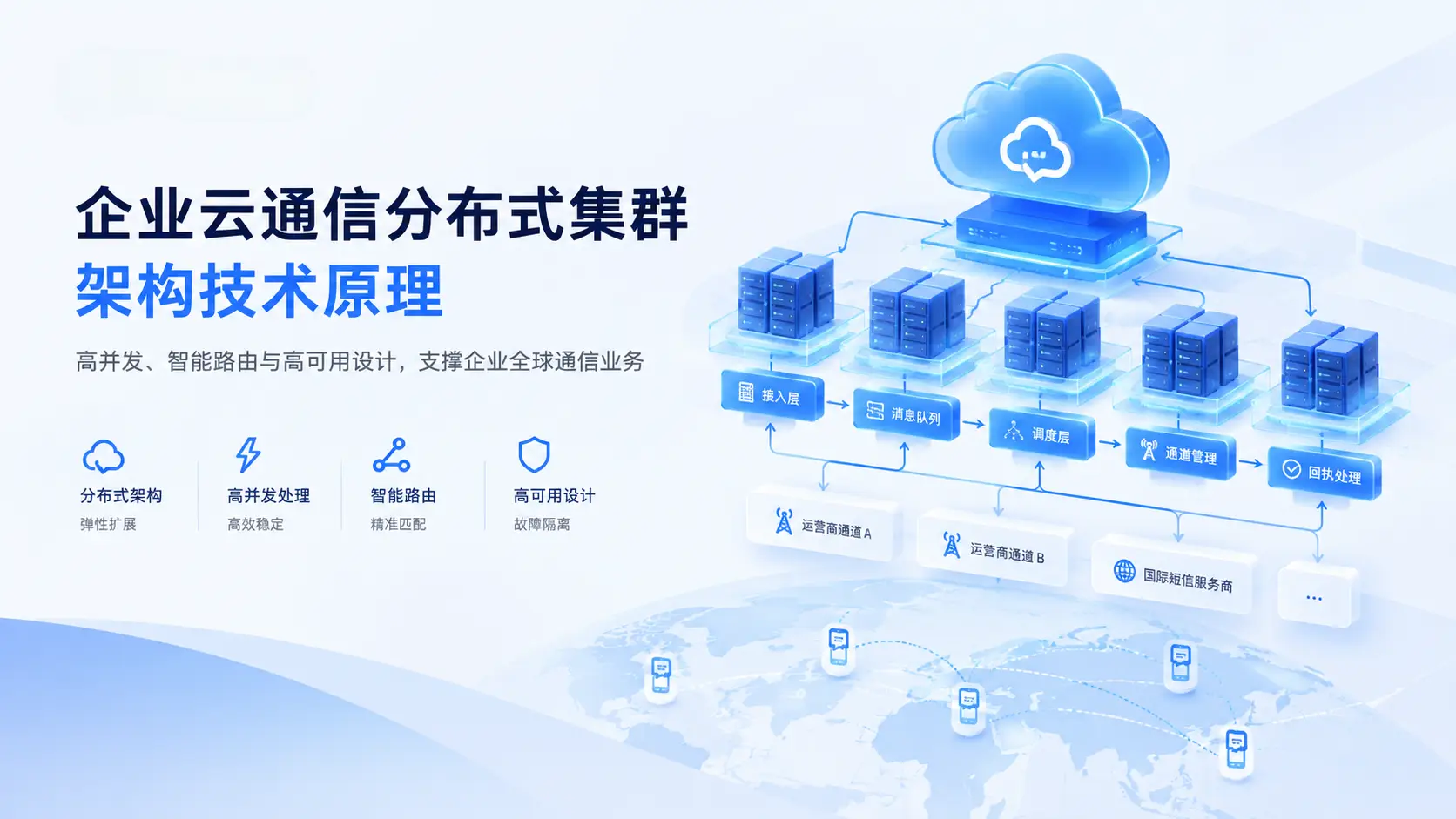
From an implementation perspective, international SMS cross-border transmission usually adopts a layered architecture that decouples enterprise request access, message processing, number identification, routing and route sending.
Complete international SMS transmission chain:
Enterprise Business System
    │
    ▼
HTTP API / SMPP Access
    │
    ▼
Message Validation and Standardization
    │
    ▼
Country and Carrier Identification
    │
    ▼
Smart Routing Engine
    │
    ▼
Multi-Route Resource Scheduling
    │
    ▼
International Communication Network
    │
    ▼
Destination Carrier
    │
    ▼
User Mobile Phone
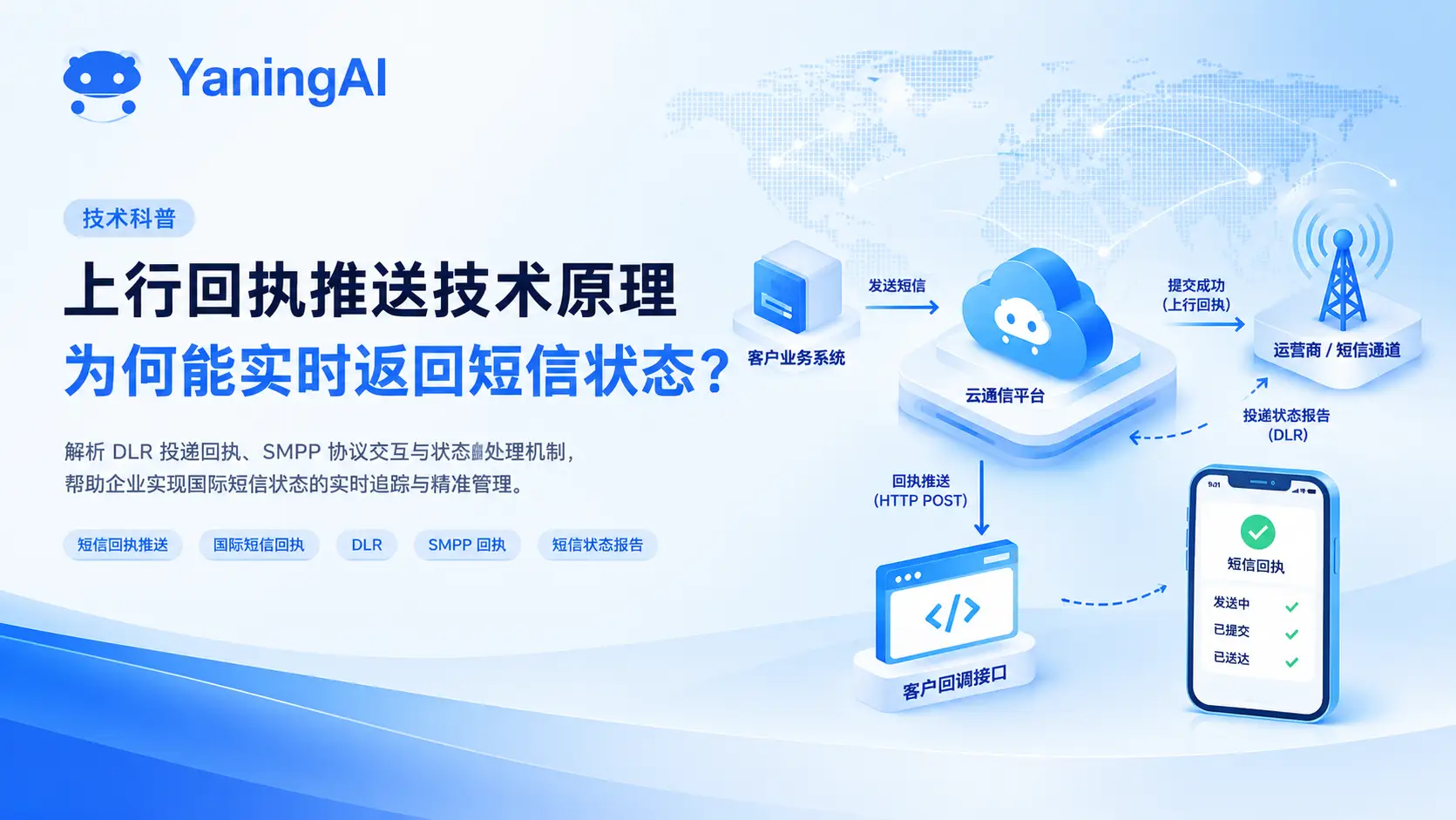
During message transmission, the platform also receives upstream status receipts, updates SMS records through the status processing module, and pushes the results to the enterprise business system.
Enterprises can access the international cloud communication platform through HTTP API or SMPP.
After an enterprise business system submits an SMS request, the platform first performs identity authentication, parameter validation, number format checks, content compliance checks and sending permission verification.
After validation, the system generates a unique message identifier for the SMS and converts the request into a unified internal data structure.
A unified access layer shields the interface differences of different enterprise business systems, allowing enterprises to manage SMS sending across multiple countries and regions through one standard interface.
In high concurrency scenarios, if all SMS requests go directly into sending threads, resource competition and processing bottlenecks easily occur.
Therefore, cloud communication platforms usually adopt message queues for asynchronous processing.
After messages enter the queue, the sending cluster consumes them according to task type, priority, destination market and route resource status.
For example, verification code SMS can be assigned a higher task priority, while ordinary notifications and marketing SMS control sending speed according to their own business policies.
Decoupling access from sending through a message queue buffers traffic peaks and improves the overall concurrency capacity of the system.
Number identification is the prerequisite stage of international SMS routing.
The system usually first identifies the country code from the international phone number format, then combines number ranges, carrier ownership data and available HLR query capabilities to determine the mobile network the number may belong to.
For example:
Destination number country code → Country identification → Number range matching → Carrier ownership identification → Output routing conditionsNote that traditional number range identification does not necessarily reflect the carrier the user is actually using today. In markets that support number portability, the platform should, where data sources and query conditions allow, combine real-time or updated number ownership information for judgment.
HLR queries also do not return valid results for every country and number; practical use depends on local resource coverage.
Accurate number identification helps the platform reduce wrong route selection and improves the effectiveness of international SMS route matching.
The routing engine is the core of the entire international SMS transmission system.
Based on the number identification result, the platform screens qualifying candidate routes from the routing resource pool, then selects the final sending path by combining priority, weight, real-time quality and cost strategies.
For example, a country may have three available SMS routes configured:
The routing engine must judge whether each path supports the destination carrier, business type and current sending volume, and determine the final scheduling result according to real-time route status.
A routing system should not select routes by SMS price alone, nor judge route quality by fixed priority alone; it should consider actual transmission performance comprehensively.
After the routing engine completes path selection, the message enters the corresponding route sending module.
The platform submits the SMS to communication resource suppliers through upstream interfaces or protocols such as HTTP and SMPP, and the related communication networks handle subsequent transmission.
Different routes may use different access protocols, message encodings, sending rates and receipt formats, so the platform needs a route adaptation layer for protocol conversion, status mapping and parameter processing.
This design reduces the impact of upstream resource differences on the enterprise access layer.
International SMS smart routing is not a single algorithm but a combination of multiple rules and scheduling mechanisms.
Country and carrier routing is the foundation of international SMS scheduling.
The system matches preconfigured routing rules through country codes and carrier ownership information.
For example:
| Routing Condition | Scheduling Target |
|---|---|
| Indonesia + Carrier A | Route A |
| Indonesia + Carrier B | Route B |
| Indonesia + Unknown carrier | General candidate route |
| Philippines + Carrier A | Route C |
After an SMS enters the platform, the system matches the corresponding rule by destination number and screens candidate routes with the relevant coverage capability.
Static routing has clear rules and high execution efficiency, suitable for building basic country and carrier routing relationships.
However, static routing cannot reflect real-time route quality changes in time, so it usually needs to work with dynamic scheduling mechanisms.
The platform can set scheduling priorities for different routes.
For example:
| Route | Priority | Purpose |
|---|---|---|
| Route A | 1 | Default preferred path |
| Route B | 2 | Backup path |
| Route C | 3 | Supplementary resource |
The system prefers high-priority paths that meet the conditions and are in normal status.
When the primary path has a clear failure or keeps triggering quality anomaly thresholds, its priority can be lowered or scheduling suspended according to configuration, and other qualified resources can be used instead.
It should be emphasized that priority is only a manually configured scheduling condition and does not equal actual route quality. The platform also needs to evaluate real operating data of each path regularly.
SMS route quality may change across time periods, countries and carrier network environments.
For example, the same path may run normally during ordinary hours but experience network congestion, submission delays or carrier exceptions during business peaks in the destination market.
To address this, a smart routing system needs to continuously collect route operating metrics.
Key monitoring metrics include:
Based on these metrics, a dynamic route quality scoring model can be built.
For example:
Route composite score = delivery quality × weight + stability × weight + latency performance × weight + cost performance × weight
Each metric should first be standardized into a unified scoring range before participating in the composite calculation.
When the score of a route keeps declining, the routing engine can appropriately reduce its scheduling weight; after quality recovers and re-enablement conditions are met, it can be added back to the candidate resource pool.
The key to dynamic routing is not frequent path switching but identifying route changes from real data, avoiding unnecessary routing oscillation caused by short-lived occasional anomalies.
When multiple international SMS routes meet the sending conditions at the same time, weighted load balancing can distribute traffic.
For example:
| Route | Configured Weight | Theoretical Traffic Share |
|---|---|---|
| Route A | 60 | 60% |
| Route B | 30 | 30% |
| Route C | 10 | 10% |
Where route capacity, sending rates and other business constraints allow, the system allocates sending tasks according to weights.
Compared with a single active-standby architecture, weighted load balancing lets multiple paths send simultaneously and reduces traffic pressure on any single path.
In actual operation, weights should not stay fixed for long. The system can adjust weights based on route quality, real-time congestion and available capacity for a more reasonable allocation of communication resources.
International SMS cross-border transmission involves multiple network nodes; upstream suppliers, gateways and carrier networks may all become abnormal.
The routing engine therefore needs anomaly detection and fault isolation capabilities.
Common anomalies include:
The platform can identify route anomalies through heartbeat detection, timeout monitoring, error code analysis and sliding time windows.
After a path triggers circuit-breaking conditions, the system can stop assigning new tasks to it and select other available routes according to policy.
Duplicate SMS sending also needs attention here.
If the upstream explicitly returns a submission failure and it can be confirmed that the SMS was not accepted, the path can be switched based on the failure reason.
But if the request times out, the platform cannot judge whether the upstream has accepted the SMS, so it must not assume sending failed and blindly resend, otherwise duplicate messages may occur.
Therefore, automatic switching must be combined with unique message identifiers, idempotency control, submission state management and error code classification.
Different international SMS business types have different requirements for transmission timeliness, stability and cost.
A mature international cloud communication platform needs to implement differentiated routing strategies by business type.
Verification code SMS usually has a clear validity period.
If the message is delayed too long, it may lose its value even when finally delivered.
Verification code business therefore usually prioritizes the historical delivery performance of a path, submission response time, carrier restrictions and stability during peak hours.
At the same time, the platform can build a dedicated queue for verification codes so bulk notifications and marketing tasks do not occupy real-time business resources.
Business such as order notifications, payment reminders and account changes needs to focus on whether the message was successfully submitted and what receipts can ultimately be obtained.
The platform should record message status changes completely and provide queryable sending records, failure reasons and receipt times.
Note that successful upstream submission does not mean the user mobile phone has received the SMS. Enterprises should judge the final state based on actual receipt capabilities.
Marketing SMS usually involves large sending volumes, so route capacity, sending rates and unit cost matter.
However, low-price paths are not necessarily suitable for long-term production use.
Enterprises should choose suitable resources according to route quality in different countries and carriers, on the premise of complying with local communication regulations, user authorization and opt-out mechanisms.
Once enterprise SMS business covers multiple countries and regions, the routing system needs not only route selection capability but also the ability to handle high concurrent requests and maintain service continuity under abnormal conditions.
Design the routing engine as multiple independently running service instances, with requests distributed through load balancing.
When one instance fails, the others continue to provide services, reducing single point of failure risk.
Routing rules need unified management to ensure all instances use consistent business configurations.
The access service and the sending service are decoupled through a message queue.
After messages enter the queue, the sending cluster consumes them according to priority, route capacity and sending policies.
By adjusting the number of consumers and consumption rates, processing resources can be dynamically allocated under different traffic levels.
For frequently accessed country codes, carrier ownership, routing configurations and route status, caching technologies such as Redis can reduce database query pressure.
Dynamically changing route health status should have reasonable expiration and update mechanisms to prevent the system from making wrong decisions based on stale status.
Different countries and carriers may impose different restrictions on sending frequency and concurrent capacity.
The platform needs rate limiting rules across route, carrier, country and customer dimensions.
When a path reaches its sending limit, queue buffering, lower consumption rates or switching to other qualifying resources can avoid upstream congestion.
Every SMS needs a unique message identifier that associates the enterprise request, internal message, route selection, upstream submission and status receipts.
Operations staff can quickly locate through the message identifier:
A complete full-chain monitoring system improves operational efficiency and problem locating for international SMS systems.
For enterprises with global business coverage, a single SMS route usually cannot meet the business needs of all countries and carriers.
Communication resource coverage differs by country, and the network performance of the same path may also vary across time periods.
Multi-route smart routing mainly solves four problems:
First, expand resource coverage.
By consolidating communication resources across countries and regions, adaptability to different carrier networks improves.
Second, reduce the impact of single-path failures.
When a path becomes abnormal, other qualifying resources can be used according to policy.
Third, optimize transmission quality.
Through quality data analysis and dynamic scheduling, long-term dependence on unstable paths is avoided.
Fourth, optimize communication costs.
While meeting business quality and local compliance requirements, communication resources with different cost structures are allocated reasonably.
Note that multi-route does not mean all paths are interchangeable. Different routes may have different country coverage, carrier access, sender identity and business restrictions; actual switching must satisfy the corresponding transmission conditions.
When choosing an international SMS provider, enterprises should not focus only on the number of covered countries and the per-message price.
What matters more is whether the platform has a mature routing system and can provide real, traceable route quality data.
| Evaluation Dimension | Key Points to Examine |
|---|---|
| Routing capability | Fine-grained routing by country, carrier and business type |
| Scheduling mechanism | Priority, weights and dynamic quality scheduling |
| Route resources | Multi-country coverage and backup route capability |
| Failure handling | Anomaly detection, circuit breaking and reasonable switching |
| Concurrency performance | Message queues, asynchronous sending and traffic control |
| Status receipts | Upstream submission status and obtainable final receipts |
| Data monitoring | Statistics by country, carrier and route dimension |
| Compliance management | Numbers, content, sender identity and local regulatory requirements |
Pay particular attention to the difference between submission success rate and final delivery rate. Receipt coverage and status definitions may differ across routes; enterprises should understand the statistical criteria and evaluate path quality through real business tests in target markets.
International SMS cross-border transmission involves number identification, carrier matching, route selection, route scheduling, failure handling and status receipts, among other technical stages.
A mature international SMS routing system needs not only multi-country communication resource management but also dynamic quality evaluation, load balancing and high availability architecture to support message transmission in different business scenarios.
As enterprises continue to expand overseas, international SMS routing technology is evolving from traditional fixed route configuration toward multi-route coordination, real-time quality awareness and intelligent resource scheduling.
YaningAI is committed to providing international SMS and cloud communication services for global enterprises. Through API / SMPP access, multi-country communication resource management and flexible routing capabilities, it helps cross-border e-commerce, fintech and internet platforms build a stable, efficient and manageable global messaging system.
International SMS routing means a cloud communication platform automatically selects a suitable SMS transmission route based on the destination country, carrier ownership, route quality and business policy. Multi-route management and dynamic path selection improve the stability of international SMS transmission and resource utilization efficiency.
International SMS is usually submitted to a cloud communication platform through HTTP API or SMPP. After the platform completes number identification, route matching and route selection, the SMS is submitted to upstream communication resources and delivered to the destination user through the related carrier networks. During sending, the platform can also receive available status receipts and update SMS records.
Smart routing usually considers destination country, carrier, business type, path priority, real-time route status, historical delivery performance, transmission latency and cost, and selects a suitable path from qualifying candidate routes.
Multi-route load balancing distributes SMS tasks across multiple qualifying paths, preventing a single route from bearing excessive traffic pressure. When some paths become abnormal, the platform can adjust traffic allocation according to policy, improving resource utilization and system fault tolerance.
Yes, but judgment depends on the anomaly type. If the upstream explicitly returns a submission failure and it can be confirmed the message was not accepted, switching to a backup path can follow the configuration. If the request only timed out and the submission result is uncertain, status confirmation and duplicate sending risks must be handled first; blind retries are not allowed.
No. Successful submission usually means the upstream communication platform accepted the SMS request and does not necessarily mean the SMS reached the user mobile phone. The final delivery status must be judged based on receipt capabilities of the upstream and carriers, noting that receipt definitions and coverage may differ across routes.
Evaluate comprehensively based on target country, carrier coverage, resource authorization, business type, actual delivery performance and cost. Direct and aggregated resources each have suitable scenarios; path quality cannot be judged by access form alone and should be verified through real business tests and receipt data.
Focus on country and carrier coverage, multi-route management, smart routing strategies, route quality monitoring, failover capability, status receipt completeness and local communication compliance. For time-sensitive business such as verification codes, real business tests in target markets are also recommended.