 By Samuyl Joshi
As cross-border e-commerce, fintech and internet platforms continue to expand, enterprises place ever higher demands on international SMS sending, identity verification, business notifications and message status tracking. Communication requests must not only be processed quickly but also withstand traffic spikes, downstream route rate limits, network fluctuations and anomalies in some service nodes.
The core of enterprise cloud communication distributed cluster architecture is to split request access, message processing, task scheduling, route sending and status receipts into services that can run and scale independently, working together through message queues, load balancing, fault isolation and monitoring.
For an international SMS platform, this architecture helps the system scale horizontally according to business load and keeps partial failures within a limited scope. However, whether the system can truly reach the expected concurrency and reliability also depends on message persistence, database performance, carrier route capacity and exception recovery mechanisms.
This article explains how enterprise cloud communication distributed clusters work from the perspectives of technical architecture, message processing flow, concurrency control, smart routing and high availability design.
Enterprise cloud communication distributed cluster architecture means deploying the different business capabilities of a cloud communication platform on multiple service nodes, which process communication requests through the network, task queues and a unified scheduling mechanism.
Traditional monolithic systems often place interface access, message processing, sending logic and status updates in relatively centralized programs. As business volume grows, multiple stages may compete for CPU, memory, database connections and other resources; once a key process or server fails, the entire sending chain may be affected.
A distributed architecture instead separates responsibilities and isolates resources, so different modules can scale and be maintained independently.
For example, an international SMS platform usually needs to handle the following tasks:
These stages have different requirements for processing capacity, response latency and data consistency. A layered, decoupled cloud communication distributed architecture therefore allows each stage to be optimized in a targeted way.
It should be clear that distributed does not mean more services is always better. Architecture design should be based on business scale, failure boundaries, maintenance cost and data consistency requirements, avoiding unnecessary service splits.
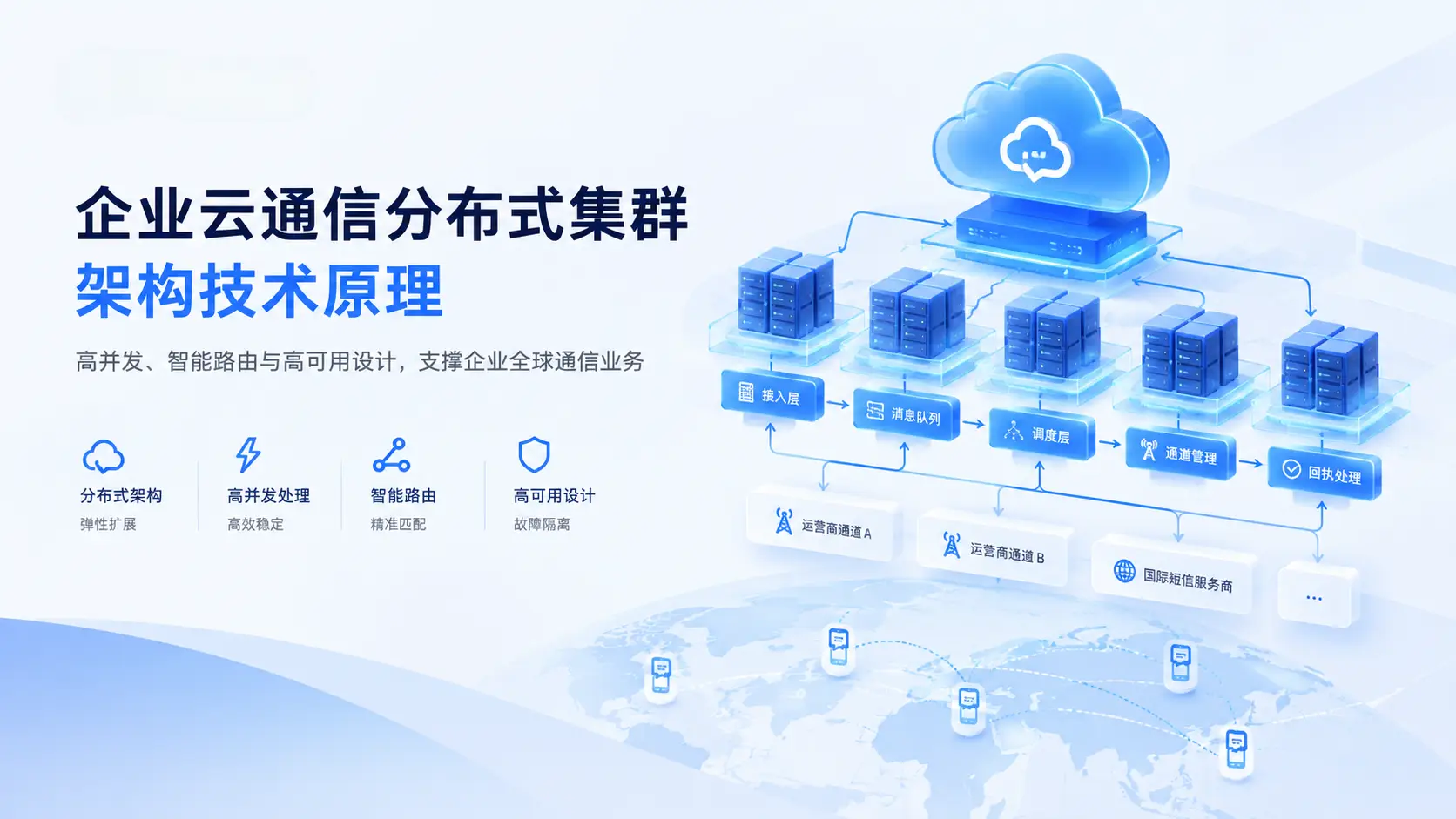
A typical enterprise cloud communication platform can organize its internal services with a layered architecture.
Cloud communication distributed cluster architecture overview:
                 Enterprise Customers and Business Systems
                          │
                 HTTP API / SMPP Access
                          │
                 Load Balancing and Access Cluster
                          │
               Identity Authentication / Parameter Validation / Rate Limiting
                          │
                  Message Persistence and Queue
                          │
                    Distributed Scheduling Cluster
                          │
                    Smart Routing Engine
                          │
              ┌───────────┼───────────┐
              │           │           │
          SMS Route A  SMS Route B  Email Service
              │           │           │
              └───────────┼───────────┘
                          │
                 Downstream Communication Network and Providers
                          │
                     Asynchronous Status Receipts
                          │
                Receipt Processing / Status Update / Push
                          │
                  Query, Monitoring and Statistical Analysis
The diagram shows a logical architecture. In actual deployment, one module may consist of multiple nodes, or multiple logical modules may run together in the same service instance.
The access layer is the entry point between enterprise business systems and the cloud communication platform, mainly responsible for protocol access, identity authentication, parameter validation, permission verification and traffic limiting.
For HTTP APIs, the platform usually distributes requests to different access nodes through load balancing. For persistent connection protocols such as SMPP, it also needs to manage connection state, session resources, heartbeat detection and connection recovery.
The access layer should stay stateless or minimize local state dependency so that nodes can be added as business grows.
At the same time, interface responses need to clearly indicate the current processing stage. For example, a successfully received request does not mean the downstream carrier has accepted it, let alone that the message has reached the end user.
After a request passes basic validation, the platform can generate a message ID, persist the necessary business data and hand the pending task to the message queue.
The message queue isolates the difference between front-end request traffic and downstream sending capacity.
For example, a cross-border e-commerce business may submit a large number of order notifications within a short period during a promotion. If requests wait synchronously for downstream route processing, response time is easily affected by supplier network and processing speed.
With a message queue, the platform can first accept qualifying tasks and then consume them gradually according to actual downstream capacity, thereby smoothing traffic peaks.
However, a queue alone cannot guarantee that messages are never lost. The platform also needs to configure message persistence, producer acknowledgements, consumer acknowledgements and failure recovery correctly, and to handle duplicate consumption.
For highly reliable scenarios, patterns such as a transactional outbox can coordinate business database writes with message publishing, reducing the risk of inconsistency between task data and queue state.
The scheduling layer obtains messages from pending tasks and decides the processing order and sending path according to rules such as business priority, destination country, customer configuration, route status and sending rate.
When the scheduling service is deployed on multiple nodes, the task consumption scope must be divided properly, and concurrency must be controlled through task claiming, partitioned consumption or lease mechanisms to prevent multiple nodes from executing the same task.
For time-sensitive business such as verification codes, a higher task priority can be set; for large-volume marketing SMS, batch sending and rate control can be applied according to business deadlines.
The scheduling layer should also record task processing stages. When a node exits unexpectedly, the system must identify unfinished tasks and reassign them according to task state, rather than unconditionally resending all tasks.
The route layer connects to carriers, SMS aggregators or other communication services and submits messages according to the protocol requirements of each route.
The receipt layer handles status reports returned asynchronously by downstream services, completing message identifier mapping, status conversion, duplicate receipt handling and business data updates.
Since the status information supported by different countries, carriers and suppliers may vary, the platform should establish a unified internal status model while retaining the necessary raw receipt information for anomaly investigation and business reconciliation.
Taking an enterprise submitting an international SMS through HTTP API as an example, the complete processing flow usually includes the following stages.
Stage 1: Request Access and Parameter Validation.
The platform verifies customer identity, interface permissions, destination number, message content and related business parameters, and performs necessary rate limiting and risk control.
Stage 2: Generate a Message ID and Save the Task.
The platform generates a unique internal message identifier and records the customer, destination number, submission time, message content or content reference, and the necessary business attributes.
According to business requirements, the system also needs reasonable idempotency rules to identify requests that clients submit repeatedly after a timeout.
Stage 3: Task Enqueue and Distributed Scheduling.
After tasks enter the message queue, the scheduling service allocates them according to business priority and current processing capacity. The system continuously monitors queue backlog and task waiting time, identifying insufficient processing capacity in time.
Stage 4: Smart Routing and Route Matching.
The platform screens available routes based on the destination country, carrier coverage, route health, cost, sending rate and local compliance requirements, and determines the sending route according to the established policy.
Stage 5: Submit to Downstream Communication Services.
Sending nodes submit the SMS through SMPP, HTTP API or other interfaces supported by the supplier, recording the downstream message identifier, response result and key time information.
If a request times out, the platform cannot directly assume that sending failed. The downstream may have already received the message while the confirmation did not return in time. In this case, processing should follow supplier capabilities, query mechanisms and retry rules to reduce the risk of duplicate sending.
Stage 6: Receive Receipts and Update Status.
After receiving a downstream status report, the receipt service associates it with the internal message record and completes status conversion and the necessary callback push.
During this process, the platform should record interface acceptance, route submission, downstream report and terminal delivery states separately. A message can be marked as delivered only when corresponding downstream evidence exists.
High concurrency is not simply adding servers, but forming matching processing capacity among access, message processing, scheduling, the database and downstream routes.
1. Horizontal Scaling: Add Service Nodes Based on Bottlenecks
Horizontal scaling means increasing the overall processing capacity of the system by adding instances of the same service.
When API access nodes are overloaded, access instances can be added; when consumer processing speed is insufficient, queue consumers can be added; when receipt tasks increase, the receipt service can be scaled independently.
However, the real performance bottleneck must be confirmed before scaling. If the system is limited by database connections, queue partitions or carrier route rates, simply adding servers may not increase effective throughput.
2. Message Queues: Smoothing Traffic Spikes
A message queue decouples request reception from downstream sending, reducing the direct impact of traffic spikes on the system.
The platform needs to set reasonable queue capacity, retention policies and consumption rates according to business timeliness, task size and downstream processing capacity, and monitor backlog and the waiting time of the oldest task.
For expired verification codes and real-time transaction notifications, task validity periods and timeout rules should also be set so that expired tasks do not occupy sending resources for long periods.
3. Backpressure and Rate Limiting: Avoiding Downstream Overload
Backpressure is used to actively control upstream requests or task consumption speed when downstream processing capacity is insufficient.
For example, when an international SMS route is subject to a carrier sending rate limit, sending nodes should control submission frequency according to the route quota instead of continuously pushing requests beyond its capacity.
The platform can control request rates with token buckets, leaky buckets or concurrency windows, and configure sending policies for different customers, countries and suppliers.
4. Database Optimization: Preventing Status Processing From Becoming a Bottleneck
A communication platform continuously generates message records, status changes, receipt data and business statistics. If all operations are concentrated in a single database, it easily becomes the bottleneck in the processing chain.
Common optimizations include well-designed indexes, business-time partitioning, batch writes, hot and cold data separation, read-write separation, and moving report statistics out of the core sending chain.
For data involving account balances, billing and message persistence, transactions and recovery mechanisms should be designed according to actual consistency requirements, and cache should never be the only data source.
The goal of high availability architecture is not to claim that the system will never fail, but to minimize the impact of failures and allow the system to recover safely when nodes, networks or external routes are unavailable.
Core components such as access nodes, scheduling services, message queues, configuration services and databases all need a single point of failure assessment.
For critical dependencies, multi-node deployment, data replication, health checks and failover mechanisms can be adopted. For critical business, failure drills should also be conducted regularly to verify whether tasks can continue to be processed after a node fails.
Deploying multiple nodes is only the foundation of high availability; task takeover, state recovery and data consistency are equally important.
Network timeouts, connection interruptions and process exits in a distributed system may leave operation results in an unknown state.
The platform therefore needs to configure timeouts, a limited number of retries, backoff intervals and failed task handling according to error types.
For internal operations that can be safely repeated, idempotency keys, task state checks, unique constraints or deduplication records can prevent duplicate updates.
However, internal idempotency does not mean that SMS sending across carrier networks naturally provides exactly-once guarantees. If the downstream has accepted a message but the confirmation is lost, whether a retry is safe depends on whether the supplier offers idempotent submission or message query capabilities.
When a supplier keeps timing out, a specific route connection fails, or a service instance runs out of resources, the system must limit fault propagation.
Common approaches include connection pool isolation, concurrency limits, circuit breaking, degradation and dedicated task queues.
For an abnormal route, its scheduling weight can be temporarily reduced or new task allocation stopped. Before switching to a backup route, however, country coverage, Sender ID support, template requirements, business type and destination carrier rules must be checked; not every message can be switched directly.
For cloud communication platforms with a large global business scale, cross-availability-zone or cross-region disaster recovery can be built according to service levels and data requirements.
The design must define recovery time objective (RTO) and recovery point objective (RPO), as well as traffic switching, data recovery and task takeover strategies.
In particular, tasks in an unknown sending result state during a failure must be handled separately after recovery. Resubmitting all unfinished records directly may lead to duplicate sending and billing disputes.
For an international SMS platform, route quality affects not only message processing efficiency but also business delivery performance and communication costs.
Smart routing can screen candidate routes based on destination country, carrier coverage, customer policy, route price, historical delivery performance, response latency and real-time health status.
For example, when a route keeps timing out or failing abnormally, the platform can adjust its scheduling weight and, provided a backup route meets business rules, route subsequent messages to other available routes.
However, historical success rates must be judged together with sample size, statistical time window, business type and receipt completeness; route quality cannot be evaluated with a single metric.
Status receipts provide real operational data for route optimization. By recording submission results, receipt latency, failure reasons and route performance, the platform can identify anomaly patterns across countries, carriers and business types.
Only when scheduling, sending and receipts form a closed loop can smart routing improve continuously based on real business data, rather than selecting routes solely by static price or fixed route configuration.
After services are split, CPU, memory and network metrics of a single server are no longer enough to judge whether the communication chain is healthy. The platform also needs to combine technical monitoring with business monitoring.
The following metrics deserve particular attention:
Access layer metrics:
request volume, response latency, error rate, rate limiting count and connection anomalies.
Message queue metrics:
message backlog, consumption rate, task waiting time, retry count and dead letter task volume.
Sending layer metrics:
downstream submission success rate, route response time, connection status, actual sending rate and abnormal status distribution.
Receipt layer metrics:
receipt latency, receipt coverage, status update failures and the number of tasks in unknown status.
Business layer metrics:
sending volume, cost, delivery performance and failure reasons by country, carrier and route.
In logs and distributed tracing, a unified request ID, message ID and task ID should associate the processing records of each service so that the specific stage of an anomaly can be located quickly.
At the same time, phone numbers, message content, verification codes and customer information may involve sensitive data, so the necessary masking, access control, auditing and data retention policies should be configured.
When choosing a cloud communication provider, enterprises should go beyond price and interface capability and check, based on actual business scenarios, whether the platform has the following capabilities.
First, whether it can scale flexibly with traffic changes.
Understand whether key stages such as access, scheduling, message processing and receipts can scale independently, and whether scaling is limited by the database or downstream routes.
Second, whether it has a complete message tracking mechanism.
Enterprises should be able to query processing progress by message identifier and distinguish states such as interface acceptance, route submission and terminal delivery.
Third, whether it has failure recovery capability.
It is necessary to understand task recovery after node anomalies, duplicate consumption control, route switching and failed task handling mechanisms.
Fourth, whether it has route resources suited to the target market.
For international business, also examine carrier coverage in the target country, Sender ID registration requirements, template compliance support, sending rate limits and actual receipt quality.
Fifth, whether it provides observable and traceable operational data.
Sending records, error codes, status receipts and route statistics should support daily troubleshooting, business reconciliation and route optimization.
When evaluating a cloud communication platform, it is best to test against actual target countries, peak traffic and business types. Comparing a theoretical concurrency number alone cannot fully reflect how the platform performs in a real international communication network.
Enterprise cloud communication distributed cluster architecture is not simply deploying programs on multiple servers. It builds a communication processing system that can run continuously and scale gradually through service decoupling, reliable message processing, distributed scheduling, smart routing, fault isolation and full-chain monitoring.
For an international SMS platform, internal system stability is only part of the picture. Carrier route capability, network uncertainty, asynchronous status receipts and destination communication rules also determine the final business performance.
Only by combining cluster architecture and message processing mechanisms with real communication networks can a predictable and traceable communication service be maintained during business growth and exceptional conditions, providing a reliable technical foundation for enterprise global operations.
Enterprise cloud communication distributed cluster architecture deploys access, message processing, task scheduling, route sending and status receipts across multiple service nodes, which process communication requests together through the network and scheduling mechanisms. Its main purpose is to support horizontal scaling, reduce single point of failure risk and improve system maintainability.
It improves overall processing capacity mainly through horizontal scaling of access nodes, message queue decoupling, distributed task scheduling, downstream rate control and database optimization. Actual throughput is still limited by message processing efficiency, database performance and carrier route capacity in the destination country.
No. A distributed cluster mainly addresses internal processing, scheduling and failure recovery. Whether an SMS is ultimately delivered also depends on the downstream communication network, destination carrier status, number validity, content compliance and receipt capability. The platform should clearly distinguish interface acceptance, route submission and terminal delivery states.
A message queue improves task processing reliability but does not inherently guarantee that messages are never lost. The platform also needs reliable message persistence, producer and consumer acknowledgements, exception recovery, retries and duplicate consumption handling, and must verify consistency between database writes and message publishing.
The platform can use idempotency keys, task state checks, unique constraints and deduplication records to control internal duplicate processing. When the downstream submission result is unknown, it should also rely on the supplier idempotency capability or message query interface to decide whether a retry is safe. If the downstream supports neither query nor idempotency, the platform cannot guarantee absolute uniqueness of cross-network sending through internal mechanisms alone.
Focus on concurrency scaling capability, message persistence mechanisms, task recovery strategies, smart routing, route fault isolation, status receipt tracking and monitoring alerting. In addition, evaluate carrier coverage, route stability, Sender ID and content compliance support for the target countries of the business.
From verification codes and order notifications to cross-border business messaging, a communication platform must balance interface access efficiency, route selection, message status tracking and exception handling.
YaningAI focuses on international cloud communication services and can evaluate international SMS access and route matching solutions based on the target countries, business scenarios and integration requirements of the enterprise.
Providing the following business information helps evaluate integration requirements more accurately:
Contact the YaningAI technical team to discuss target country coverage, interface integration, route selection and message status tracking requirements.
Consult International SMS Integration