 By Samuyl Joshi
In international SMS business, a successful API submission does not guarantee that the user actually receives the message. Delayed OTP codes, filtered marketing messages and falling delivery rates in specific countries are all problems that cross-border e-commerce, fintech, gaming and online social platforms may encounter.
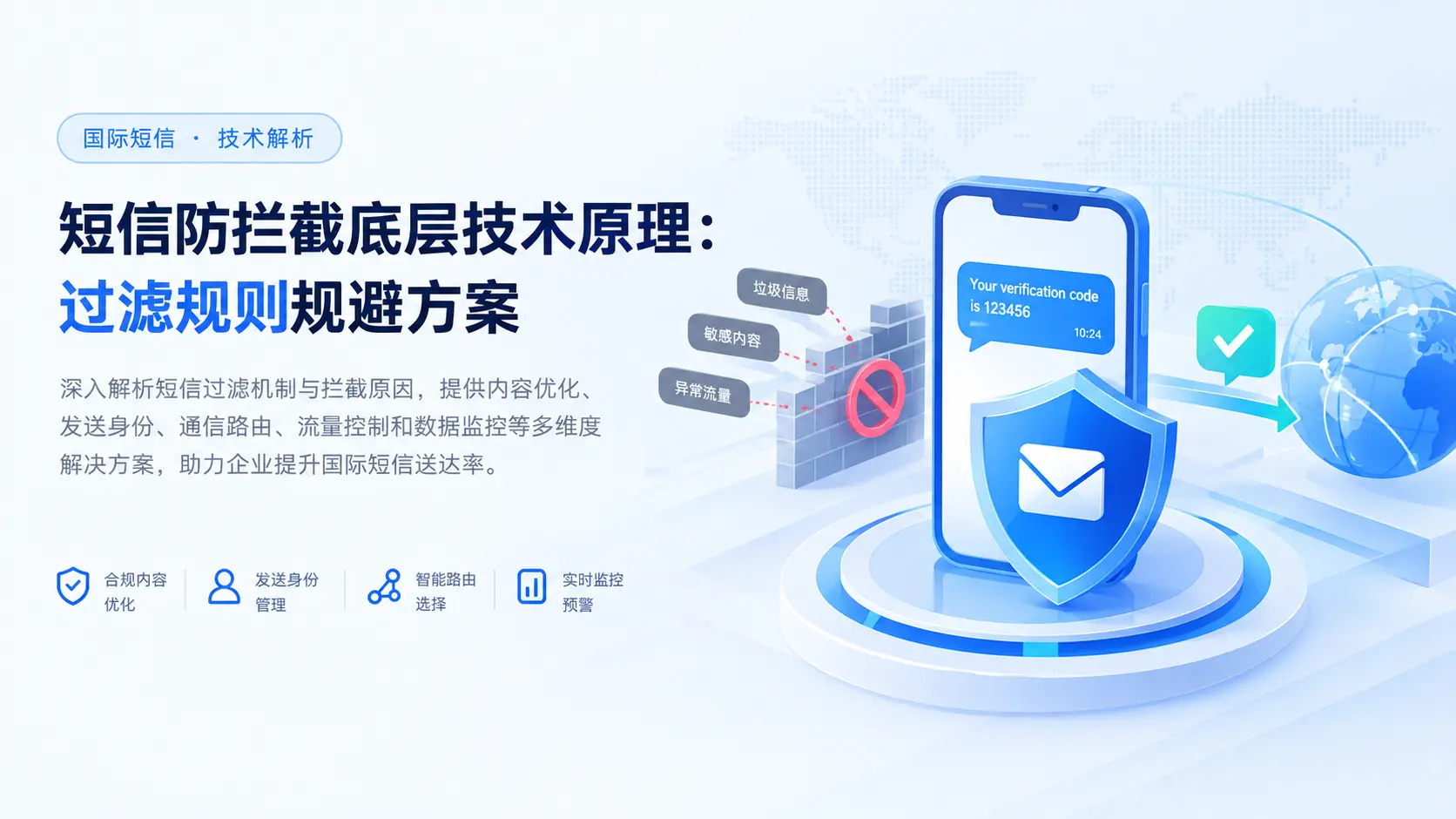
Why do SMS messages get blocked? How do carrier filtering systems work? And how should enterprises improve international SMS delivery rates?
Answering these questions requires analysis across several layers: filtering mechanisms, sending identity, communication routing, content compliance and sending behavior.
The core of SMS anti-blocking is not circumventing carrier risk controls, but reducing the risk that legitimate business messages are mistakenly filtered through compliant sending identity, well-formed content, stable communication routing and continuous data monitoring.
This article systematically explains the underlying technical principles of SMS filtering, the common reasons international messages get blocked, and delivery-rate optimization measures that enterprises can implement.
SMS anti-blocking generally refers to reducing the probability that legitimate messages are incorrectly filtered or fail in transit, through pre-send validation, communication link management, anomaly monitoring and troubleshooting.
For international SMS, a message may pass through the enterprise business system, a cloud communication platform, upstream communication networks and the target country carrier. Filtering policies, sending identity requirements and delivery receipt capabilities differ from country to country.
A typical enterprise SMS transmission path is as follows:
Enterprise Business System
     │
     ▼
SMS API Gateway
     │
     ▼
Cloud Communication Platform
     │
     ▼
International Communication Routing
     │
     ▼
Target Carrier Network
     │
     ▼
SMS Filtering System
     │
     ▼
User Handset
In real networks, filtering mechanisms may be deployed at different nodes and do not necessarily follow the exact order above.
When a message behaves abnormally, the first step is to determine where the problem occurs. A rejected API request, an upstream routing failure, carrier filtering and a handset receiving issue can all produce similar user feedback, yet the corresponding solutions are quite different.
An SMS filtering system usually analyzes multiple categories of information together, rather than deciding whether to allow a message based on a single keyword.
Some networks may also use rule engines, reputation scoring and automated risk identification. The specific implementation depends on the carrier and communication service provider, so it cannot be assumed that all countries use the same filtering model.
Message content is one of the important factors in filtering decisions.
If a message contains prohibited promotion, misleading promises, counterfeit brand information or high-risk URLs, it may trigger platform review or the relevant carrier filtering policy.
Enterprises should check in particular:
Note that a particular word is not necessarily a blocking keyword in every country. The result may be affected by business context, sending identity, target network and local policy.
The right direction for content optimization is to improve authenticity, recognizability and compliance, not to hide the original content through special symbols or character obfuscation.
Sender ID is one of the sender identifiers that users see when receiving a message, and different countries have different requirements for its use.
Some markets may require enterprises to complete brand registration, sending identity registration or business purpose review. If the sending identity is not authorized, the registered information does not match the actual content, or an unlicensed brand identifier is used, normal delivery may be affected.
Therefore, before launching overseas SMS business, enterprises should confirm whether the target country has Sender ID registration, number binding or specific business approval requirements.
Invalid numbers, incorrect country codes, duplicate numbers and recipient data without lawful sending authorization all increase the risk of failed delivery and complaints.
For international SMS business, it is advisable to check number format before submission, establish a data cleansing mechanism, and keep the necessary subscription, authorization and unsubscribe records.
Marketing SMS especially requires attention to the consistency between the authorization scope and the message purpose; it cannot be assumed that a user agrees to receive all promotional content simply because the user once registered an account.
A sudden surge of traffic within a short time, concentrated submission of duplicate messages, or improperly configured retry mechanisms can all raise network load or trigger relevant risk control policies.
For high-concurrency SMS systems, sending rates should be set according to route capacity, target carrier limits and business priority, and permanent failures or explicit compliance rejections should not be retried indiscriminately.
Traffic control can ease congestion, queuing and technical failures, but it cannot replace content compliance and sending authorization management.
Different countries, carriers and communication routes may differ in coverage, access method, carrying capacity, latency and delivery receipt support.
If anomalies are concentrated in a specific target country, carrier or route, the corresponding route status and upstream return information should be examined.
When selecting an international SMS service, enterprises should look not only at the per-message purchase price but also at route compliance, stability, delivery receipts and fault handling capability.
The fact that a route performed normally before does not guarantee that it will always perform the same way in the future.
When local regulatory requirements, carrier sending identity policies, content review standards and risk control policies change, existing configurations may need to be re-verified.
When the delivery rate drops suddenly, analysis should combine the start time of the anomaly, the target carrier, error codes and upstream feedback, rather than immediately assuming the problem lies in the message copy.
To continuously improve international SMS delivery performance, message quality, sending identity, user data, routing management and operational monitoring must all be addressed together.
Enterprises should design different SMS templates for different real business purposes.
OTP codes handle identity verification, transaction notifications report business status, logistics messages carry delivery information, and marketing messages promote products or services. The content requirements and user authorization conditions of these message types may differ, so templates should not be mixed or their actual purpose concealed.
At the same time, check URL safety, landing page consistency and brand information accuracy. For marketing SMS, unsubscribe handling and necessary disclosures should follow the rules applicable to the target market.
It is not advisable to try to bypass filtering detection through character replacement, inserted special symbols or frequent modification of sensitive words. Such methods cannot guarantee delivery, nor can they solve the underlying problems of unauthorized sending and non-compliant content.
An international SMS platform should maintain the mapping between sending identities and target countries and business types.
Before sending, confirm:
A standardized identity management process can reduce sending problems caused by mismatched configuration, unauthorized identity or inconsistent purpose.
High-quality recipient data is the foundation of stable sending.
Enterprises should regularly clean invalid numbers and duplicate data, check country codes and basic number formats, and ensure that commercial messages have the appropriate sending authorization.
In the business system, it is also possible to maintain authorization time, subscription channel, authorization scope and unsubscribe status, so that the message sending scope can be verified and traced.
For transactional messages such as OTP codes, reasonable trigger frequency, validity period and repeated request limits should be set to avoid abnormal traffic caused by malicious calls.
If the business system submits a large number of messages within a short time while the actual processing capacity of the platform or route is insufficient, task backlog, timeouts or temporary failures may occur.
Enterprises can improve system stability in the following ways:
Explicit permanent rejections or compliance blocks should not be handled by repeated resending or unauthorized route switching.
An international SMS platform needs to configure sending strategies according to the communication requirements of different markets.
It is advisable to maintain a country-level configuration checklist covering sending identity, business type, content requirements, user authorization, compliant routing, sending capacity and delivery receipt capability.
For markets such as India, Bangladesh, the Philippines, Thailand and Indonesia, a single sending configuration cannot simply be copied. Before launch, verify the locally applicable rules, registration requirements and carrier policies.
Country-level configurations should also be reviewed regularly. When delivery performance changes noticeably, the rules and route status of the relevant market should be checked first for updates.
SMS anti-blocking cannot rely on manual experience; it requires observable data to continuously verify the effect of optimization.
The following metrics should be monitored in particular:
With these monitoring data, enterprises can detect anomalies faster and judge whether the problem more likely comes from content, identity, route or the transmission system.
When an enterprise finds that the SMS delivery rate has dropped, it is advisable to troubleshoot in the following order.
Step 1: Confirm the Anomaly Scope
Check whether the problem occurs on a single number, a specific template, a certain route, a certain carrier or an entire target country.
Step 2: Verify the API Response and Upstream Status
Check the request response, message ID, timestamp, error code and upstream return result to determine at which stage the message stopped in transit.
Step 3: Check Sending Identity and Content Compliance
Verify the Sender ID or sending number status, template review records, business purpose and the sending requirements of the target market.
Step 4: Analyze Country, Carrier and Route Data
Compare request volume, failure rate and delivery latency across different time periods to look for anomalies related to a specific network or configuration.
Step 5: Request Upstream Investigation
Submit representative message IDs, target number information, sending time and error codes to the communication service provider or the relevant carrier to confirm whether there is a routing fault, filtering rejection or policy change.
Step 6: Fix and Verify the Effect
Implement fixes for the confirmed causes, and keep observing delivery rate, latency and complaint changes, avoiding conclusions drawn from only a few test messages.
Troubleshooting should be based on real logs and upstream feedback. Error code definitions differ across platforms; for example, Twilio error code 30007 identifies that a message was filtered, but this number cannot be applied directly to all SMS platforms.
For enterprises that continuously run international SMS business, it is advisable to incorporate delivery optimization into the cloud communication platform architecture rather than relying only on manual template edits.
1. Message Compliance Validation
Before a message enters the sending queue, checks are performed combining target country, sending identity, business type and content rules.
2. Intelligent Routing Management
Select a suitable communication route based on compliance requirements, route availability, actual carrying capacity and historical performance, while keeping traceable routing records.
3. High-Concurrency Scheduling
Manage sending tasks through queues, rate limiting, idempotency, deduplication and anomaly circuit breaking, reducing duplicate sends, queue backlog and technical failures.
4. Receipt and Anomaly Monitoring
Record API status, upstream responses and carrier receipts in a unified way, and build observable operational metrics and anomaly alerts by target market and route.
5. Rule and Audit Management
Keep template versions, configuration changes, sending identities and authorization records, making it easier to trace the cause of problems and conduct internal audits.
Together these capabilities form an enterprise-grade SMS delivery optimization system, helping technical teams locate problems faster and improving the operational stability of international SMS business.
Misconception 1: Modifying Sensitive Words Solves All Blocking
If the problem comes from unauthorized sending identity, non-compliant business content or route configuration, changing a few words cannot eliminate the root cause.
Misconception 2: A Successful SMS API Response Means the User Received It
API status usually only indicates the result of the corresponding stage. Determining whether the handset received the message still requires combining upstream status and available delivery receipts.
Misconception 3: The Cheapest International SMS Route Is the Best
The purchase unit price is only part of the cost. Enterprises should also consider route compliance, stability, receipt capability, failure handling efficiency and actual business cost.
Misconception 4: Switching Routes Permanently Solves SMS Blocking
If the problem comes from content, user authorization or sending identity, simply switching routes cannot solve the root cause. Confirm where the problem occurs first, then adopt a compliant solution.
Misconception 5: All Countries Can Share One Filtering Optimization Strategy
Communication rules and carrier requirements may differ significantly across markets. An international SMS platform needs country-level strategies and should continuously verify rule changes.
SMS anti-blocking is not about finding one set of filtering rules that works for every country; it is about reducing the risk that legitimate business messages are mistakenly filtered through content compliance, identity management, data governance, routing scheduling and real-time monitoring.
For enterprise-grade international SMS services, stable delivery performance depends on a complete technical chain: compliance validation before sending, route and traffic management during sending, and problem localization through status receipts and error analysis after sending.
Only by building a traceable, verifiable and continuously improvable delivery optimization system can enterprises better support scenarios such as overseas user registration, OTP verification, transaction notifications, logistics reminders and compliant marketing.
SMS anti-blocking reduces the risk that legitimate messages are incorrectly filtered through content compliance checks, sending identity management, communication route optimization and anomaly monitoring. Its focus is improving the reachability of legitimate business, not circumventing carrier risk controls.
Common reasons include content that does not meet target market policy, a Sender ID that does not meet registration requirements, poor recipient number quality, abnormal sending traffic, route problems and changes in carrier rules. The cause should be located by combining error codes, message records and upstream feedback.
Enterprises can optimize in six areas: standardizing message content, confirming sending identity authorization, improving number and authorization data quality, controlling sending rate, choosing compliant and stable routes, and continuously monitoring delivery rate and failure reasons.
API success may only mean the platform accepted the request and does not necessarily mean handset delivery. Check the upstream submission status, carrier receipt, error codes and message transmission records further to confirm at which stage the anomaly occurred.
It cannot be guaranteed. If the problem comes from sending identity, business authorization, non-compliant content or target market policy, changing words or switching routes cannot eliminate the root cause. Locate the cause first, then carry out compliant remediation.
First confirm the anomaly time and scope of impact, then check API status, failure reasons, sending identity, target carrier and route performance. If necessary, submit message IDs, timestamps and error information to the upstream provider to verify whether there is a network fault or policy change.
For businesses such as cross-border e-commerce, fintech, gaming, cross-border logistics and online social platforms, YaningAI provides international SMS communication services to help enterprises connect with overseas user reach scenarios.
Whether you are planning overseas OTP SMS or need to troubleshoot sending anomalies in a specific country, it is advisable to evaluate comprehensively from dimensions such as target market coverage, sending identity compliance, route stability, delivery receipt capability and technical support.
Contact YaningAI to learn about the international SMS solution suited to your target market and business scenario.
Consult International SMS Solutions