 By Samuyl Joshi
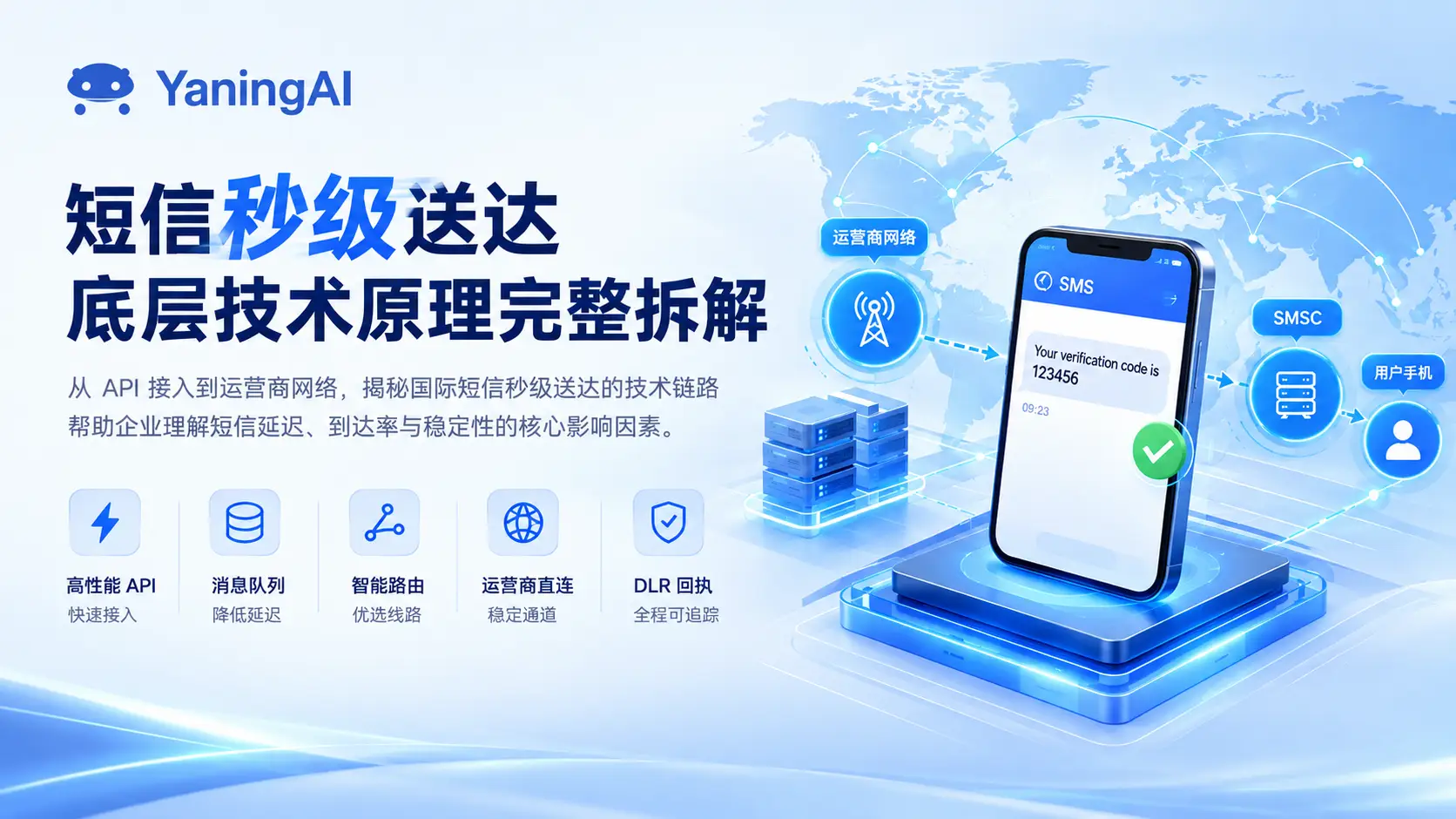
From the moment an enterprise business system initiates an SMS to the moment it appears on the user phone, the message does not go through a simple API call, but through a complete real-time communication link.
A typical international SMS sending link looks like this:
Business System → API/SMPP Interface → Cloud Communication Platform → Message Queue → Routing Engine → SMS Gateway → Operator Network → SMSC → User Phone → DLR ReceiptThe so-called "second-level SMS delivery" essentially relies on high-concurrency access, asynchronous message processing, intelligent routing, stable operator channels, proper traffic control and full-link monitoring to minimize waiting time at every stage.
For services such as verification codes, login verification, payment notifications and order reminders, SMS latency directly affects user experience and business conversion. Therefore, when choosing an international SMS provider, enterprises should not only look at SMS pricing, but also focus on the platform sending speed, delivery rate, channel quality, concurrency capability and link stability.
From a technical architecture perspective, an SMS usually goes through the following core stages:
User triggers service
      ↓
Enterprise business system
      ↓
HTTP / SMPP / CMPP interface
      ↓
Cloud platform access layer
      ↓
Message queue
      ↓
Message scheduling system
      ↓
Intelligent routing
      ↓
SMS sending gateway
      ↓
Local operator
      ↓
SMSC
      ↓
Mobile network
      ↓
User phone
      ↓
DLR status receipt
      ↓
Enterprise business system
If any node in this link becomes blocked, SMS latency may increase.
Therefore, second-level SMS delivery is not achieved by a single technology, but by the coordinated optimization of the entire communication system.
The first problem to solve for second-level SMS sending is how enterprise business systems can quickly submit messages to the cloud communication platform.
Common access methods for enterprises include:
Taking HTTP API as an example, the enterprise system usually submits the mobile number, message content, template and business parameters to the SMS platform.
POST /sms/send

{
    "mobile": "+880XXXXXXXXXX",
    "content": "Your verification code is 123456",
    "template_id": "OTP001"
}
After receiving the request, the platform needs to complete:
Authentication → Parameter validation → Number check → Template validation → Message enqueueTwo concepts need to be clearly distinguished here:
API response speed is not equal to final SMS delivery speed.
An API returning "submission successful" within a few hundred milliseconds only means the message has entered the platform processing link; it does not mean the user phone has received the SMS.
What really affects SMS sending speed is the entire communication link after the API.
If an enterprise sends a large number of messages in a short period of time, the platform must handle instantaneous traffic peaks.
For example:
Submit 100,000 SMS at once
            ↓
API access layer
            ↓
Message queue
            ↓
Multiple workers process concurrently
If all messages were sent directly and synchronously, the following problems could easily occur:
Therefore, large-scale cloud communication platforms usually adopt an asynchronous message queue architecture.
For example:
OTP queue
Notification queue
Marketing queue
Bulk SMS queue
Different services can adopt different priorities and processing strategies.
For real-time services such as verification codes, higher message priority can be assigned to reduce the impact of ordinary marketing SMS on real-time messages.
After messages enter the queue, they need to be continuously consumed by multiple workers.
For example:
Message Queue
      ↓
 ┌────┼────┬────┬────┐
 ↓    ↓    ↓    ↓    ↓
W01  W02  W03  W04  W05
Assuming a single worker can process 100 SMS/s, then:
1 Worker   ≈ 100 SMS/s
10 Workers ≈ 1,000 SMS/s
100 Workers ≈ 10,000 SMS/s
Actual system throughput is also affected by channel capacity, operator rate limits, network connections and business policies.
Therefore, to judge whether an SMS platform supports high concurrency, you should not only look at server configuration, but also focus on:
TPS, CPS, concurrent connections, queue processing capacity and channel throughput.
After an SMS enters the scheduling system, the next key question is:
Which channel should this SMS be sent through?
For example, when an enterprise sends international SMS to a certain country:
Target number
   ↓
Country identification
   ↓
MCC/MNC identification
   ↓
Operator identification
   ↓
Service type judgment
   ↓
Route quality evaluation
   ↓
Intelligent routing
The platform can comprehensively consider:
And finally select the appropriate sending route.
Therefore, SMS routing quality is an important factor affecting international SMS sending speed and delivery rate.
International SMS usually passes through different communication nodes.
A typical multi-level link:
Cloud communication platform
   ↓
Reseller A
   ↓
Reseller B
   ↓
Reseller C
   ↓
Local operator
   ↓
User
A shorter communication link may look like:
Cloud communication platform
   ↓
Local operator
   ↓
User
From a system engineering perspective, when the communication link is shortened, intermediate forwarding and queuing nodes are reduced, which helps control latency and improve link controllability.
However, direct connection does not necessarily mean faster delivery in all cases. Actual performance still depends on:
Local operator resources, channel congestion, content review, number status, network conditions and specific service types.
Therefore, when purchasing international SMS services, enterprises should focus more on actual operator coverage and route performance, rather than just the words "direct connection".
In international SMS services, SMPP is one of the more common protocols for SMS system integration.
Its typical communication structure is:
SMS Platform
     │
     │ SMPP / TCP
     ↓
SMSC / Operator Gateway
     │
     ↓
Mobile Network
     │
     ↓
Mobile Device
SMPP usually uses TCP persistent connections.
Compared with re-establishing a connection for every message, persistent connections reduce the extra overhead caused by frequent connection setup and teardown.
In high-concurrency SMS scenarios, overall throughput can be improved through multiple concurrent connections, window control and other mechanisms.
Taking SMPP as an example, an SMS platform usually submits messages to the SMSC through:
submit_sm
The simplified process is as follows:
submit_sm
    ↓
SMSC receives
    ↓
Message processing
    ↓
Operator network
    ↓
User terminal
After receiving the corresponding response, the platform can confirm whether the SMS submission request was accepted.
But a clear distinction must be made here:
Successful submission ≠ the user has received the SMS.
This is also a very important concept when analyzing SMS delivery rates.
DLR, or Delivery Receipt, is mainly used to feed back the subsequent status of an SMS.
Common statuses include:
The overall process can be understood as:
Enterprise submits SMS
      ↓
SMS platform
      ↓
Operator
      ↓
User phone
      ↓
Operator returns DLR
      ↓
Platform updates SMS status
Therefore, when evaluating an international SMS provider, enterprises should not only ask:
"Was the API request sent successfully?"
They should also further ask:
"Are complete and trackable DLR receipts provided?"
Only by distinguishing submission results from final delivery status can actual communication quality be analyzed more accurately.
This is a very typical situation in international SMS services.
For example:
0.1s  API received
0.2s  Message enqueued
0.3s  Routing completed
0.5s  Submitted to operator
From the internal metrics of the cloud communication platform, the whole process may be very fast.
But the following may still happen on the operator side:
Operator queuing
      ↓
Content review
      ↓
Number status check
      ↓
Network scheduling
      ↓
Wireless network transmission
      ↓
User terminal reception
Therefore, the end user may receive the SMS after a few seconds, tens of seconds or even longer.
This shows that:
SMS latency should be analyzed on an end-to-end link basis, rather than simply using API response time as the judgment standard.
The API access layer needs sufficient concurrent processing capacity.
If the API layer becomes blocked, latency begins before the SMS even enters the sending system.
When:
Message incoming speed > consumption processing speed
The queue keeps growing. For example:
Incoming: 5,000 SMS/s
Processing: 2,000 SMS/s
In theory, about 3,000 waiting messages are added every second.
Queue backlog directly affects the actual SMS sending time.
If an SMS channel has TPS or CPS limits and enterprise sending volume suddenly increases, channel queuing may occur.
Therefore, the platform needs to dynamically control the sending rate.
For the same country and the same operator, actual performance on different routes may vary.
Routes may differ in:
Operator-side congestion, SMSC queuing, network fluctuations and policy changes can all cause actual latency.
A powered-off phone, abnormal number status or a device without network access can also affect final delivery.
Therefore, a cloud communication platform can optimize the communication link, but cannot fully control the user terminal status.
Traditional routing is usually statically configured:
Country → Fixed routeMore mature routing systems dynamically select routes based on real-time data. For example:
Target country
   ↓
Operator identification
   ↓
Route health
   ↓
Real-time latency
   ↓
Historical delivery rate
   ↓
Current congestion
   ↓
Compliance policy
   ↓
Intelligent routing
Assume:
Route A
Average latency: 1.2s
Delivery rate: 98%

Route B
Average latency: 4.5s
Delivery rate: 95%

Route C
Average latency: 2.0s
Delivery rate: 99%
For real-time services such as OTP, the system can prioritize routes with higher overall quality.
This is also an important difference between intelligent routing and simple fixed-route configuration.
Different services have different sensitivity to SMS latency.
The user is usually in the middle of:
Login
 ↓
Request verification code
 ↓
Receive SMS
 ↓
Enter verification code
If the verification code does not arrive for a long time, the user is likely to click resend repeatedly.
This may lead to:
Therefore, OTP services usually have higher requirements for low latency, high delivery rate and stability.
There are also certain real-time requirements, but longer processing times are usually tolerable.
Real-time performance is usually not the only core metric; more attention is paid to:
Delivery rate, open/click behavior, conversion rate, compliance and campaign cost.
Therefore, a professional SMS platform needs to design differentiated message priorities and sending strategies for different services.
A high-performance international SMS system for enterprises can adopt the following architecture:
               Enterprise business system
                         │
                         ↓
                   API / SMPP access
                         │
                         ↓
               Authentication & validation
                         │
                         ↓
                     Message queue
                         │
            ┌────────────┼────────────┐
            ↓            ↓            ↓
        OTP queue   Notify queue   Marketing queue
            │            │            │
            └────────────┼────────────┘
                         ↓
                  Scheduling system
                         │
                         ↓
                    Routing engine
                         │
              ┌──────────┼──────────┐
              ↓          ↓          ↓
           Route A     Route B    Route C
              │          │          │
              └──────────┼──────────┘
                         ↓
                       Operator
                         │
                         ↓
                         SMSC
                         │
                         ↓
                     User terminal
                         │
                         ↓
                         DLR
                         │
                         ↓
              Status & monitoring system
On top of this, the following supporting capabilities are also required:
Rate limiting, retry, circuit breaking, failover, logging, monitoring, alerting, link tracing and data analysis.
Together they form a complete SMS infrastructure.
When choosing an international SMS provider, enterprises can focus on the following metrics.
Used to observe overall SMS processing speed.
Compared with a simple average, P95 and P99 are better for analyzing real latency during peak hours and abnormal situations.
For example:
Average latency: 1.5s
P95: 3.2s
P99: 8.5s
This shows that most messages are sent quickly, but some requests still have significant latency.
Do not only look at country-level data; it is better to analyze it in combination with specific operators.
Whether clear and trackable SMS status can be obtained is an important factor in judging link transparency.
Focus on whether the provider has:
It is recommended to learn about:
From a technical perspective, SMS speed is not determined by a single server or a single interface.
What really determines the SMS experience is the entire communication link:
High-performance API + asynchronous queues + high-concurrency workers + intelligent routing + stable operator channels + traffic control + real-time monitoring + failover + DLR tracking
A significant bottleneck at any stage may cause final SMS latency.
Therefore, "supporting second-level SMS" should not be understood as just a marketing slogan.
What enterprises really need to focus on is:
After an SMS is initiated from the business system, whether it can quickly enter the communication platform, whether it can go through reasonable routing, whether stable operator resources are available, whether there is sufficient concurrency capability, and whether the entire sending process can be monitored and tracked.
For core services such as verification codes, order notifications, payment reminders and user registration, SMS latency and delivery rate directly affect user experience.
When choosing an international SMS provider, enterprises are advised to focus on:
Operator resources + routing capability + concurrency capability + DLR receipts + delivery rate + latency performance + compliance capability
YaningAI focuses on enterprise international cloud communication services, providing international SMS capabilities for cross-border e-commerce, fintech, gaming, logistics and social platform enterprises, supporting HTTP API, SMPP and other access methods, helping enterprises build a stable, efficient and trackable global SMS sending link.
Need to evaluate international SMS routes, test delivery rates or integrate the API? Contact YaningAI for route testing and technical solutions.