 By Samuyl Joshi
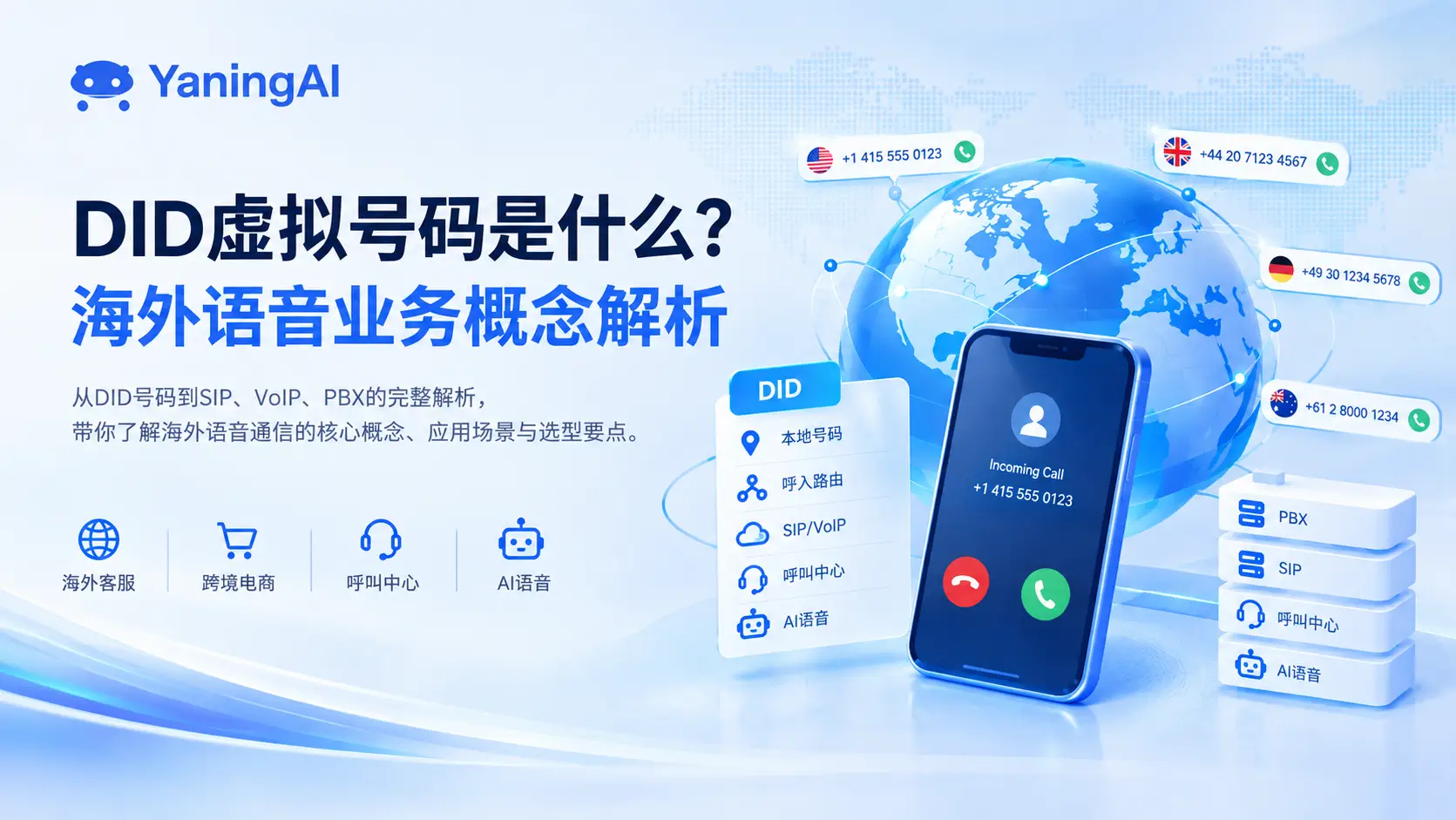
What is a DID virtual number? DID (Direct Inward Dialing) is a common enterprise number resource in overseas voice communication services. It is mainly used to receive inbound calls from the public telephone network and route them directly to SIP accounts, PBX systems, call centers, agent seats or AI voice systems.
For enterprises running overseas customer service, cross-border e-commerce, call center, SaaS or AI outbound calling businesses, DID is usually one of the foundational number resources for building an overseas voice communication system.
This article introduces the definition, working principles, application scenarios and number types of DID virtual numbers, as well as the differences between DID and SIP, VoIP, PBX and Toll-Free, helping enterprises quickly understand the core concepts of overseas voice services.
DID stands for Direct Inward Dialing and is commonly referred to as a DID number, DID virtual number or overseas virtual number.
From a communication service perspective, DID is essentially a telephone number resource that can route public network calls directly into an enterprise communication system.
Traditional enterprise telephony usually relies on a switchboard, physical lines and manual transfer to handle incoming calls. DID, through a digital voice platform, associates telephone numbers with internal systems such as SIP accounts, extensions, PBX and call centers.
A typical DID inbound call flow is as follows:
Overseas customer
    ↓
Dials the DID number
    ↓
Local carrier network
    ↓
International voice route
    ↓
SIP / VoIP voice platform
    ↓
PBX / Call center
    ↓
Agent seat / AI voice system
Therefore, the core problem DID solves is:
Allowing overseas customers to reach a designated voice communication system through a single enterprise number.
Note that DID itself is neither a complete call center nor the SIP protocol. More precisely, it is an enterprise voice number entry point.
The working process of a DID number can be divided into four stages.
An overseas user dials the enterprise DID number from a mobile phone, landline or other telephone terminal.
For example:
+XX XXX XXX XXXXThis number serves as the telephone contact point that the enterprise provides to local customers.
After the customer dials, the call first enters the local carrier network.
Based on number resources and routing rules, the carrier forwards the call to the corresponding voice route.
After identifying the called number, the voice platform distributes the call to different business systems according to the routing policy configured by the enterprise.
For example:
DID-A → Sales department
DID-B → Customer service department
DID-C → After-sales department
DID-D → AI voice systemThe call can finally reach:
Enterprises can build multi-level call routing and agent assignment mechanisms according to business needs.
A DID is more than just a phone number. In overseas voice services, it usually serves the following functions.
After entering an overseas market, an enterprise can configure number resources for the target country or region.
When customers dial the local number, the call enters the enterprise customer service system through a cloud voice platform.
This approach is suitable for:
A single DID number can establish routing relationships with multiple business nodes.
For example:
Incoming call
   ↓
DID
   ↓
Time check
   ├── Business hours → Human agent
   ├── Off hours → IVR
   └── Special service → AI voice
Routing rules can further combine conditions such as country, region, business type and time period.
DID can work with an IVR system to help enterprises handle large volumes of repetitive calls.
For example:
Welcome to the customer service center.
For pre-sales inquiries, press 1.
For after-sales service, press 2.
For technical support, press 3.
The system automatically assigns the call to the corresponding business department based on the key pressed by the customer.
After receiving an incoming call, a DID number can further forward it to a designated SIP terminal, agent seat or other voice node.
For example:
Overseas customer
   ↓
DID number
   ↓
Cloud voice platform
   ↓
SIP
   ↓
Enterprise service agent
Therefore, even without a physical office in the target country, an enterprise can build overseas telephone access capability through a cloud communication platform.
Actual forwarding capability depends on the number, the carrier and the business rules of the target country.
This is one of the most common concept confusions in overseas voice services.
A simple way to understand them:
| Concept | Main Role |
|---|---|
| DID | Enterprise telephone number resource and inbound entry point |
| SIP | Signaling protocol used in IP voice communication |
| VoIP | Technology system that transmits voice over IP networks |
| PBX | Enterprise telephone switching and call control system |
| Call center | Application system for customer service, sales and related business |
They are not replacements for one another; they can be combined.
A typical architecture:
DID number
   ↓
SIP / VoIP
   ↓
PBX
   ↓
Call center
   ↓
Customer service / Sales / AI voice
Therefore:
DID is not SIP, and SIP is not DID.
DID mainly answers "which number should customers dial", SIP answers "how the voice communication system establishes and controls sessions", while PBX and call centers handle the actual telephone business.
"Overseas virtual number" is a broad market term, and DID is one common type of enterprise communication number resource within it.
When an enterprise sees "overseas virtual number", it needs to confirm which type of number the product actually is:
Overseas virtual number
├── DID number
├── Local fixed number
├── Mobile number
├── Toll-Free number
├── SIP number
└── Other enterprise number resources
Different number types may differ in the following capabilities:
Therefore, before purchasing overseas virtual numbers, do not look at price alone; confirm the specific communication capabilities as well.
Both DID and Toll-Free can serve as enterprise service hotlines, but they are positioned differently.
DID is usually used to provide a regular telephone entry point for an enterprise, where customers pay the corresponding call charges according to local carrier rules.
Toll-Free is usually used to let end customers call an enterprise number free of charge or at low cost according to local rules, with the related charges borne by the enterprise or settled through the corresponding pricing mechanism.
Different countries differ in Toll-Free number formats, application conditions, pricing and permitted business use.
Therefore, enterprises should choose the appropriate number type based on the specific market and business scenario.
Enterprises can use DID to build a local telephone entry point for overseas customers.
Overseas customer
   ↓
Local DID number
   ↓
Cloud communication platform
   ↓
Call center
   ↓
Agent seat
Suitable for cross-border e-commerce, internet platforms, SaaS and other enterprises that need overseas customer service.
Cross-border e-commerce platforms can use DID to build overseas service entry points for handling:
Different markets can be configured with different numbers, all managed by a unified call center.
Overseas SaaS products, apps and internet platforms can use DID as their user service hotline.
After a call comes in, it can be combined with a CRM system to identify customer information and query historical orders, tickets and service records.
DID
 ↓
Caller number identification
 ↓
CRM
 ↓
Historical data
 ↓
Agent seat
This connects telephone communication with the enterprise customer management system.
DID is an important number resource when an enterprise builds an overseas call center.
A call center can be configured with multiple DIDs, setting different call entry points for different businesses:
Sales DID
Customer service DID
After-sales DID
Complaint DID
Regional DID
These are then uniformly connected to PBX, ACD, IVR and CRM systems.
With the development of AI voice technology, DID can also serve as the public network telephone entry point for AI voice systems.
A typical architecture:
DID
 ↓
Voice platform
 ↓
ASR speech recognition
 ↓
AI dialogue engine
 ↓
TTS speech synthesis
 ↓
Customer
In scenarios such as standardized inquiries, service notifications and customer follow-ups, DID can be combined with AI voice technology to form automated telephone services.
However, one distinction must be made:
DID is a number resource, while an AI voice system is a business application; they are not the same product.
For enterprises, choosing a DID number should never be about "price" alone.
First confirm whether number resources that meet business needs exist in the target market.
Number types, regional attributes and application conditions may differ across countries.
Confirm whether it is a:
The number type directly affects how it can be used.
Enterprises need to confirm whether the number supports:
Inbound calls
SIP access
Call forwarding
IVR
Concurrency
Recording
Call queue
Specific capabilities may differ across providers, countries and routes.
If the enterprise also has overseas outbound calling needs, it must confirm whether the number can be used for the corresponding caller ID display scenarios, as well as local restrictions on services such as CLI and Caller ID.
Owning a DID number does not mean it can be used without restriction for all outbound calling business.
Overseas voice services also require attention to:
For call center and AI voice businesses, route stability often directly affects the actual call experience.
Overseas DID numbers usually involve local telecom regulation and number management requirements.
Depending on the country and number type, this may involve:
Before going live, enterprises should confirm the specific requirements based on the target country, number type and actual business.
DID is well suited for enterprises that need to build overseas telephone communication capability, including:
Provide a local telephone entry point for overseas customers.
Handle telephone inquiries about orders, logistics and after-sales.
Build an overseas user service system.
Configure enterprise numbers for different departments, businesses and regions.
Provide telephone access for AI customer service, AI follow-up and similar business.
Build a unified overseas cloud voice communication architecture by country and region.
To understand DID, start with these three concepts:
DID is a number resource.
It mainly provides the external telephone entry point for an enterprise.
SIP/VoIP is communication technology.
It is mainly responsible for establishing, controlling and transmitting IP voice sessions.
PBX, call centers and AI voice systems are business applications.
They are mainly responsible for handling actual customer telephone business.
Therefore, a complete overseas cloud voice system can generally be understood as:
Number resources + Voice routes + SIP/VoIP + Call control + Business systems
Although DID is only one layer, it is an important foundation for enterprises to build localized overseas voice touchpoints.
A DID virtual number is an enterprise telephone resource that routes incoming calls from overseas customers directly to SIP accounts, PBX systems, call centers, agent seats or AI voice systems.
Yes. One of the core uses of DID is to carry public network incoming calls and route them to enterprise communication systems through a voice platform. Actual inbound capability depends on the specific country, number type and carrier route.
Some DID numbers and routes can support outbound calling, but whether it is supported and the specific usage rules depend on the number type, country, carrier and route configuration. Enterprises should not assume that all DIDs have the same outbound capability.
DID mainly describes the telephone number resource and inbound entry point, while SIP is the signaling protocol used for IP voice communication. A DID number can be connected to an enterprise telephone system through a SIP/VoIP platform.
Yes. DID can serve as the public network number entry point of a call center, with call distribution and agent answering completed through SIP, PBX, IVR, ACD and other systems.
DID can serve as the number resource for AI voice business, but AI outbound calling also requires voice routes, call control, ASR, TTS and an AI dialogue system.
Requirements differ by country and number type. Some markets may require enterprise documents, address proof, identity information or other KYC materials. Actual requirements should be confirmed for the target market.
Not exactly. DID mainly serves as a number resource within an enterprise communication system and can be combined with SIP, PBX, call centers and other systems. It is not equivalent to an ordinary mobile SIM card.
Building an overseas customer service, call center, AI outbound calling or global telephone communication system?
From number resources to SIP voice routes, and then to call centers and AI voice systems, everything needs to be matched according to the target country, business scenario and communication architecture.
YaningAI provides enterprise-grade cloud communication capabilities, supporting overseas voice, international SMS, email and other communication services, helping enterprises build communication touchpoints for global customers.
Tell us your:
Target country / Business scenario / Inbound or outbound needs / Concurrency / System integration method
Get the corresponding number and voice communication solution.
Consult Now → Get an Overseas Voice Solution