 By Samuyl Joshi
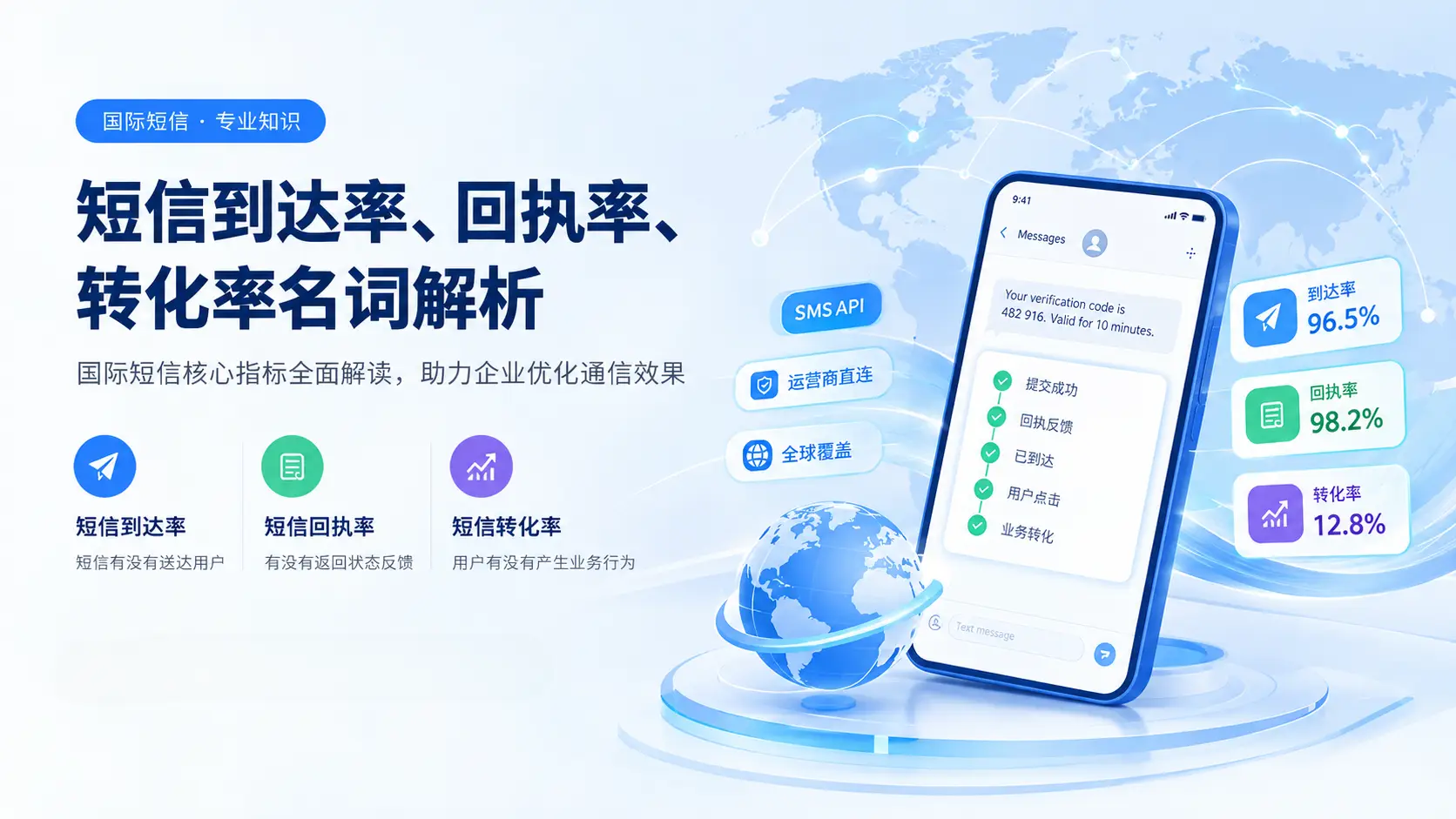
In international SMS business, enterprises often encounter metrics such as SMS delivery rate, SMS DLR rate, and SMS conversion rate.
These concepts look similar but actually correspond to different stages of the SMS sending chain:
Delivery rate focuses on whether SMS is successfully delivered to users.
DLR rate focuses on whether clear status feedback is obtained after SMS is sent.
Conversion rate focuses on whether users complete business actions such as registration, verification, click, and purchase after receiving SMS.
For enterprises choosing international SMS service providers, SMS API interfaces, and SMS routes, accurately understanding these metrics helps evaluate SMS route quality and final business results.
SMS Delivery Rate typically refers to the proportion of SMS that actually completes terminal delivery out of the valid sent SMS quantity.
Common calculation formula:
SMS Delivery Rate = Actually Delivered SMS Quantity ÷ Valid Sent SMS Quantity × 100%
For example, if an enterprise sends 100,000 international SMS to overseas users, and 96,500 are confirmed to reach user terminals, then the SMS delivery rate is:
96,500 ÷ 100,000 × 100% = 96.5%
From a business perspective, SMS delivery rate mainly reflects the delivery capability of the SMS communication chain.
After an enterprise submits a message via SMS API, the SMS typically passes through a cloud communication platform, SMS route, and local carrier network before reaching the user phone.
It can be simply understood as:
Enterprise System → SMS API → Cloud Communication Platform → SMS Route → Local Carrier → User Number → Mobile TerminalAny link in this chain may affect the final SMS delivery rate if it encounters issues.
SMS delivery rate is not solely determined by the SMS platform; it is influenced by multiple factors including numbers, routing, carriers, content, and market rules.
International SMS involves number formats from different countries and regions.
If the target number has format errors, suspended service, deregistered, or is an invalid number, terminal delivery cannot be completed even if the enterprise has successfully submitted the SMS.
Therefore, in international SMS business, number format validation and number validity management are very important.
SMS route quality is one of the important factors affecting SMS delivery rate.
Different SMS service providers use different carrier resources, routing methods, and downstream links.
For enterprise-grade international SMS business, the following need to be focused on:
Carrier direct connect capability, routing stability, route resource coverage, failover, and line quality.
Especially in markets such as Southeast Asia, Europe, the Middle East, and Latin America, carrier environments and communication rules differ significantly, requiring country-specific routing management.
International SMS is not a globally unified communication service.
Different countries and regions may have different requirements for:
and other aspects.
If SMS content, sending subject, or sending method does not meet local carrier and regulatory requirements, SMS interception, delay, or sending failure may occur.
SMS content itself may also affect delivery effectiveness.
For marketing SMS in particular, a large amount of duplicate content, abnormal links, sensitive keywords, or obvious batch sending characteristics may increase the risk of being filtered.
Therefore, international SMS cannot be simply understood as "send interface connected means normal sending".
When enterprises conduct large-scale SMS sending, they also need to focus on:
Sending speed, concurrency, peak traffic, queue scheduling, and carrier-side rate limiting.
For example, if a business suddenly generates a large number of verification code requests, the SMS platform may experience sending delays or even request failures if it lacks reasonable traffic scheduling capability.
After SMS is sent, enterprises usually need to know the current status of the SMS.
For example:
Submitted successfully, sent successfully, delivered, sending failed, invalid number, carrier rejected, timeout, etc.
These status information returned by the SMS platform, carrier, or downstream communication link are typically called:
SMS DLR, status DLR, SMS status report, DLR (Delivery Report).
Among them, DLR is a very important mechanism in the international SMS system.
Through status DLR, enterprises can further understand the processing result of SMS in the communication chain.
SMS DLR rate is typically used to measure the proportion of valid status feedback obtained after SMS is sent.
Common formula:
SMS DLR Rate = SMS Quantity with Valid Status DLR ÷ Submitted SMS Quantity × 100%
For example:
If an enterprise sends 100,000 international SMS, of which 98,000 receive clear status feedback, then:
DLR Rate = 98,000 ÷ 100,000 × 100% = 98%
Special attention needed:
A high SMS DLR rate does not equal a high SMS delivery rate.
This is a concept that is easily confused when enterprises actually use international SMS services.
You can quickly understand through the table below:
| Metric | Main Problem Solved | Focus |
|---|---|---|
| SMS DLR Rate | Whether sending status is returned | Whether status feedback is complete |
| SMS Delivery Rate | Whether SMS completes delivery | User terminal delivery |
| SMS Conversion Rate | Whether users produce business behavior | Final business result |
For example, a cross-border e-commerce enterprise sends 10,000 international SMS:
Then:
SMS DLR Rate = 98%
SMS Delivery Rate = 95%
Business Conversion Rate = 10% (when calculated based on 10,000 valid reached)
The specific conversion rate statistics caliber needs to be determined according to the enterprise business definition.
SMS Conversion Rate mainly measures the proportion of users who produce actual business behavior after SMS reaches them.
Unlike delivery rate, conversion rate is not a pure communication metric, but a business operations metric.
For example:
Verification Code Scenario: Verification Code Conversion Rate = Completed Verification Users ÷ SMS Reached Users × 100%
Registration Scenario: Registration Conversion Rate = Completed Registration Users ÷ SMS Reached Users × 100%
E-commerce Scenario: Purchase Conversion Rate = Completed Purchase Users ÷ SMS Reached Users × 100%
Therefore, there is no fixed calculation formula for SMS conversion rate that applies to all enterprises.
The key is for the enterprise to first clarify:
What behavior counts as conversion?
This is a relatively common problem in international SMS marketing.
For example:
A cross-border e-commerce enterprise sends 100,000 international marketing SMS.
SMS delivery rate reaches 96%.
But ultimately only 5,000 people click the link, and 800 complete purchase.
This shows that the communication chain itself is only part of the entire business chain.
Enterprises need to continue analyzing user behavior.
Whether the sending targets are real target users will directly affect SMS marketing effectiveness.
A large number of low-activity users, non-target users, or long-term silent users may not produce clicks and purchases even if SMS reaches them normally.
Whether users are willing to continue operating after receiving SMS is closely related to the content itself.
For example:
Whether the brand is clear, whether the benefit point is clear, whether the offer is real, whether the action guide is obvious, whether the link is trustworthy.
These factors all affect subsequent user behavior.
The SMS sending time for different business scenarios is not the same.
Verification codes focus on real-time;
Logistics notifications focus on timeliness;
Marketing SMS needs to be arranged based on user active time and marketing campaign cycles.
SMS itself is only the entry point for users to access business pages.
If there are issues such as:
Slow page Loading, Poor Mobile Adaptation, Redirect Failure, Complex Payment Flow, SMS Offer Inconsistent with Landing Page Information
and other problems, the final conversion rate may be relatively low even if the SMS delivery rate is high.
For enterprises, it is not recommended to look at only one number.
A more reasonable approach is to establish a complete SMS data chain:
Sent Volume
↓
Submit Success Rate
↓
DLR Rate
↓
Delivery Rate
↓
Click Rate
↓
Registration/Verification Rate
↓
Purchase Conversion Rate
↓
Final Business Revenue
This analysis method helps enterprises locate whether the problem occurs in:
the communication chain or the user behavior chain.
Different business scenarios have different focus points.
Core focus:
SMS delivery rate, sending speed, DLR status, verification code validity period.
For example, overseas App registration, login, payment verification and other businesses have high requirements for SMS timeliness.
Core focus:
SMS delivery rate, stability, timeliness, and status traceability.
Suitable for logistics notifications, order notifications, account notifications and other businesses.
In addition to delivery rate, also need to focus on:
Click rate, conversion rate, opt-out rate, user complaints, and cost per conversion.
Because the final evaluation standard for marketing SMS is not just "how many were sent" but how many effective business results it can bring.
Simply comparing "SMS price" or "advertised delivery rate" is not enough to judge the actual capability of an international SMS service provider.
For enterprise-grade business, it is recommended to evaluate from the following dimensions:
Whether it covers target countries and regions, and whether key markets have stable carrier resources.
Whether it has stable international SMS lines and reasonable intelligent routing strategies.
Whether it can provide clear, accurate, and traceable SMS status DLR.
Whether it supports standardized SMS API interface and can quickly integrate with existing enterprise business systems.
Whether it can view:
Sent Volume, Success Volume, Failure Volume, DLR Status, Delivery Status, Country-Dimension Data, etc.
Whether it can provide Sender ID, template, content, and sending rule support for different countries.
When enterprises conduct overseas business, SMS not only serves the verification code sending function but also gradually becomes an important communication channel for registration, login, notification, order, and marketing reach.
YaningAI focuses on enterprise-grade international communication services, providing international SMS communication capabilities for overseas enterprises, and supports integration with business systems via API, SMPP, and other methods.
Enterprises can build based on actual business needs:
Registration Verification Code → Login Verification → Order Notification → User Reactivation → Marketing Reach
and other SMS application scenarios.
Through stable SMS routes, status DLR, and data statistics capabilities, enterprises can more clearly understand the entire process of SMS from sending to delivery.
If an enterprise is looking for international SMS API, SMS routes, or global SMS services, it can conduct targeted evaluation based on business coverage countries, sending scenarios, daily SMS volume, and system integration methods.
Consult International SMS Service → Get Route Solution → API Test Integration → Official Launch
SMS delivery rate, SMS DLR rate, and SMS conversion rate are core metrics at three different levels.
SMS DLR rate mainly solves:
"Is status feedback obtained after sending?"
SMS delivery rate mainly solves:
"Is SMS terminal delivery actually completed?"
SMS conversion rate mainly solves:
"Do users complete business actions after receiving SMS?"
For international SMS business, truly complete data analysis should start from:
Send → DLR → Delivery → Click → Conversion
layer by layer.
Only by combining SMS route quality with user business data can enterprises determine whether international SMS services truly meet business needs, and further optimize sending strategies, communication costs, and final conversion effectiveness.
SMS delivery rate, DLR rate, and conversion rate reflect performance across three stages: communication delivery, status feedback, and business conversion.
If your enterprise is conducting overseas business, needs stable international SMS routes, or is evaluating the delivery rate, DLR capability, and API stability of your current SMS service provider, you can test and evaluate based on actual business scenarios.
Global SMS Routes | Status DLR Tracking | Quick API Integration | Multi-Scenario Communication Support
Applicable to:
Submit your target countries/regions, SMS type, and estimated sending volume to get a targeted international SMS route solution.
Not just comparing SMS prices — focus on route quality, status DLR, delivery performance, and actual business needs.