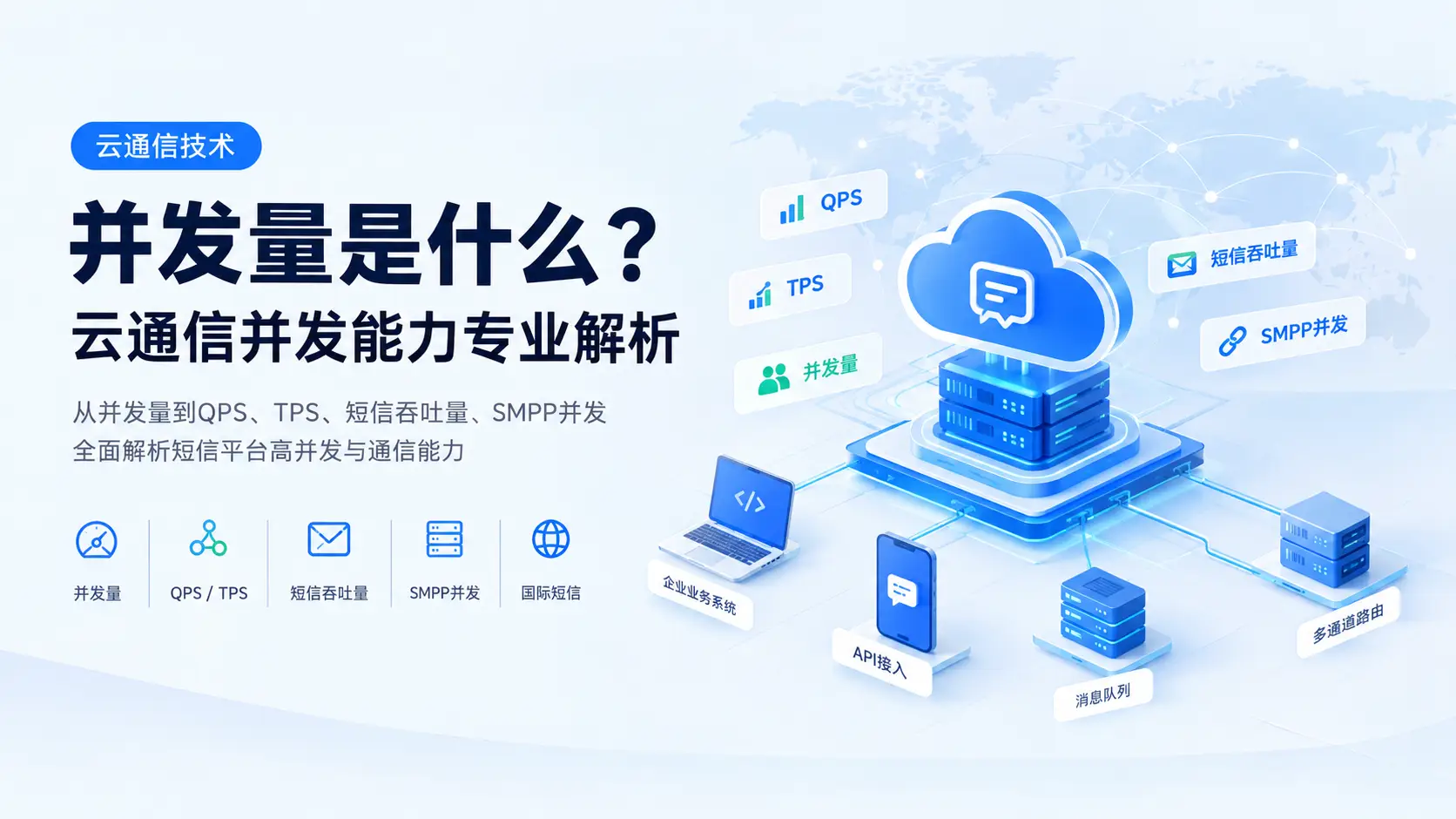
What Is Concurrency? A Professional Analysis of Cloud Communication Concurrency | High Concurrency and Throughput of SMS Platforms
I. What Is Concurrency?
Concurrency is a key metric that measures how many requests, tasks, or connections a system can handle simultaneously at a given moment.
Simply put:
Concurrency describes "how many can be handled at the same time", not "how many can be handled per second".
In the cloud communication field, concurrency typically appears in scenarios such as SMS API, international SMS, OTP verification codes, bulk SMS, SMPP persistent connections, and message queues.
For example, when an enterprise system sends a large number of requests to an SMS platform within a short time, it puts pressure on the API access layer, message processing system, routing system, and SMS channels.
Therefore, when evaluating the concurrency capability of a cloud communication platform, you should not focus only on a single "maximum concurrency" figure, but analyze the entire communication link.
II. Why Does Cloud Communication Concurrency Capability Matter?
With the development of cross-border ecommerce, fintech, gaming going global, online education, and overseas social businesses, enterprises demand higher real-time performance and stability for international communications.
Especially for services such as OTP verification codes, login verification, and order notifications, traffic often shows obvious burst characteristics.
For example, after a marketing campaign starts:
Normal requests
   ↓
100 req/s
   ↓
Campaign starts
   ↓
2000 req/s
   ↓
5000 req/s peak
If the SMS platform cannot handle the sudden increase in requests, the following may occur:
- API request timeouts
- SMS submission failures
- Message queue backlog
- Sending delays
- Channel congestion
- DLR receipt delays
Therefore, cloud communication concurrency capability directly affects communication stability during traffic peaks.
III. SMS Concurrency Is Not SMS Sending Speed
This is a common misconception when enterprises choose international SMS platforms.
For example, a platform may claim:
"Supports 100,000 concurrent sessions."
This parameter alone does not directly indicate how many SMS can be sent per second.
Because the complete SMS business link is usually:
Enterprise Business System
      ↓
   HTTP API
      ↓
API Gateway / Authentication
      ↓
Message Queue
      ↓
Routing Strategy
      ↓
SMS Channel
      ↓
Carrier Network
      ↓
User Terminal
      ↓
   DLR Receipt
Suppose the API layer can handle 10,000 concurrent requests, but the downstream SMS channel can actually process only 500 messages per second; then the final SMS sending speed will still be limited by the channel processing capacity of about 500 messages per second.
Therefore:
High concurrency capability solves traffic access and system processing problems; real SMS sending capacity is still affected by message queues, routing systems, and downstream channel capacity.
IV. Difference Between Concurrency, QPS, TPS, and CPS?
In cloud communication technology procurement, you often see parameters such as concurrency, QPS, TPS, and CPS at the same time.
Although these metrics are all related to system performance, their meanings are different.
1. Concurrency
Concurrency mainly represents:
The number of requests, connections, or tasks being processed at the same time.
For example:
Requests processed simultaneously: 1000
It means the system needs to handle 1,000 concurrent requests at a certain moment.
2. QPS
QPS (Queries Per Second) usually represents:
The number of requests processed per second.
For example:
QPS = 1000
It usually means the system can process about 1,000 requests per second on average.
In SMS API scenarios, QPS is more suitable for measuring the request processing capability of the API access layer.
3. TPS
TPS (Transactions Per Second) usually represents:
The number of transactions completed per second.
In cloud communication systems, the specific statistical definition of TPS may vary by platform.
Some systems treat API calls as transactions, while others count by business message processing.
Therefore, when comparing TPS across SMS platforms, enterprises need to confirm:
What exactly this TPS measures.
4. CPS
CPS (Calls Per Second) is typically used in voice communication, representing:
The number of calls per second.
Therefore, in international SMS business, the more common metrics are:
Concurrency, QPS, TPS, and SMS throughput.
While in voice communication, call centers, and VoIP scenarios, CPS is more important.
V. What to Look for in Cloud Communication Platform Concurrency?
For enterprises, what really matters is not an isolated "high concurrency" number, but multiple performance metrics.
1. API Concurrency Capability
The SMS API is the first layer for enterprises to access a cloud communication platform.
Key points to focus on:
- Maximum concurrent API requests
- QPS
- API response time
- Peak response time
- HTTP connection count
- Rate limiting mechanism
- Authentication processing capability
If the API access layer cannot receive requests quickly, the SMS system behind it will hardly be effective even with abundant channel resources.
2. SMS Throughput
SMS throughput usually represents:
The number of SMS the system can process per unit of time.
For example:
500 msgs/sec
1000 msgs/sec
5000 msgs/sec
This metric is closer to what enterprises really care about: "SMS sending capacity".
Especially for marketing, notification, and bulk SMS scenarios, sustained throughput is very important.
3. Message Queue Capability
Mature cloud communication architectures usually use message queues for peak shaving and asynchronous processing.
Typical architecture:
API
 ↓
Message Queue
 ↓
Routing System
 ↓
SMS Channel
When an enterprise suddenly generates a large number of SMS requests, the system can first write tasks into the queue, and the backend consumes them continuously according to actual channel capacity.
This reduces the impact of burst traffic on core systems.
Metrics to focus on include:
- Queue write speed
- Consumption speed
- Queue length
- Message backlog
- Consumption latency
- Exception message handling capability
VI. Why Does International SMS Test Concurrency More?
Compared with single-country SMS business, an international SMS platform needs to handle more complex communication resources and routing relationships.
For example, different countries may have different:
- Carriers
- Sender ID rules
- Template requirements
- Compliance requirements
- Channel resources
- Number formats
- Routing strategies
- Network quality
After an international SMS enters the platform, it usually goes through:
Number Parsing
   ↓
Country/Region Identification
   ↓
Carrier Identification
   ↓
Route Matching
   ↓
Channel Selection
   ↓
SMS Sending
   ↓
DLR Receipt
When large volumes of SMS from different countries enter the system simultaneously, the platform not only needs to handle high-concurrency API requests, but also must complete message scheduling and routing decisions in real time.
Therefore, the concurrency capability of an international SMS platform is actually a comprehensive reflection of multiple system capabilities.
VII. What Are the Concurrency Requirements of OTP Verification Codes?
OTP verification codes are a typical burst-type communication service.
For example, when users intensively perform:
Registration
↓
Login
↓
Password change
↓
Payment verification
A large number of verification code requests may be generated within seconds.
Such scenarios especially focus on:
Instant concurrency + API response speed + message processing speed + SMS submission latency.
Verification code business must not only ensure "messages can be sent", but also minimize the time of the entire link:
User operation
 ↓
API request
 ↓
SMS submission
 ↓
Carrier processing
 ↓
Code received on phone
from end to end.
Therefore, for OTP business, simply comparing "maximum connections" is not very meaningful; what matters more is end-to-end processing capability under real traffic peaks.
VIII. Marketing SMS Focus More on Sustained Throughput
Marketing SMS usually have bulk sending characteristics.
For example, an enterprise needs to send marketing SMS to 1 million users.
Assume the sustained throughput of the system is:
500 msgs/sec
Theoretical calculation:
1,000,000 ÷ 500
= 2,000 seconds
About 33 minutes.
If the sustained throughput increases to:
2000 msgs/sec
The theoretical processing time is significantly shortened.
Therefore, large-scale SMS business needs to focus on:
Sustained throughput, not just instant concurrency.
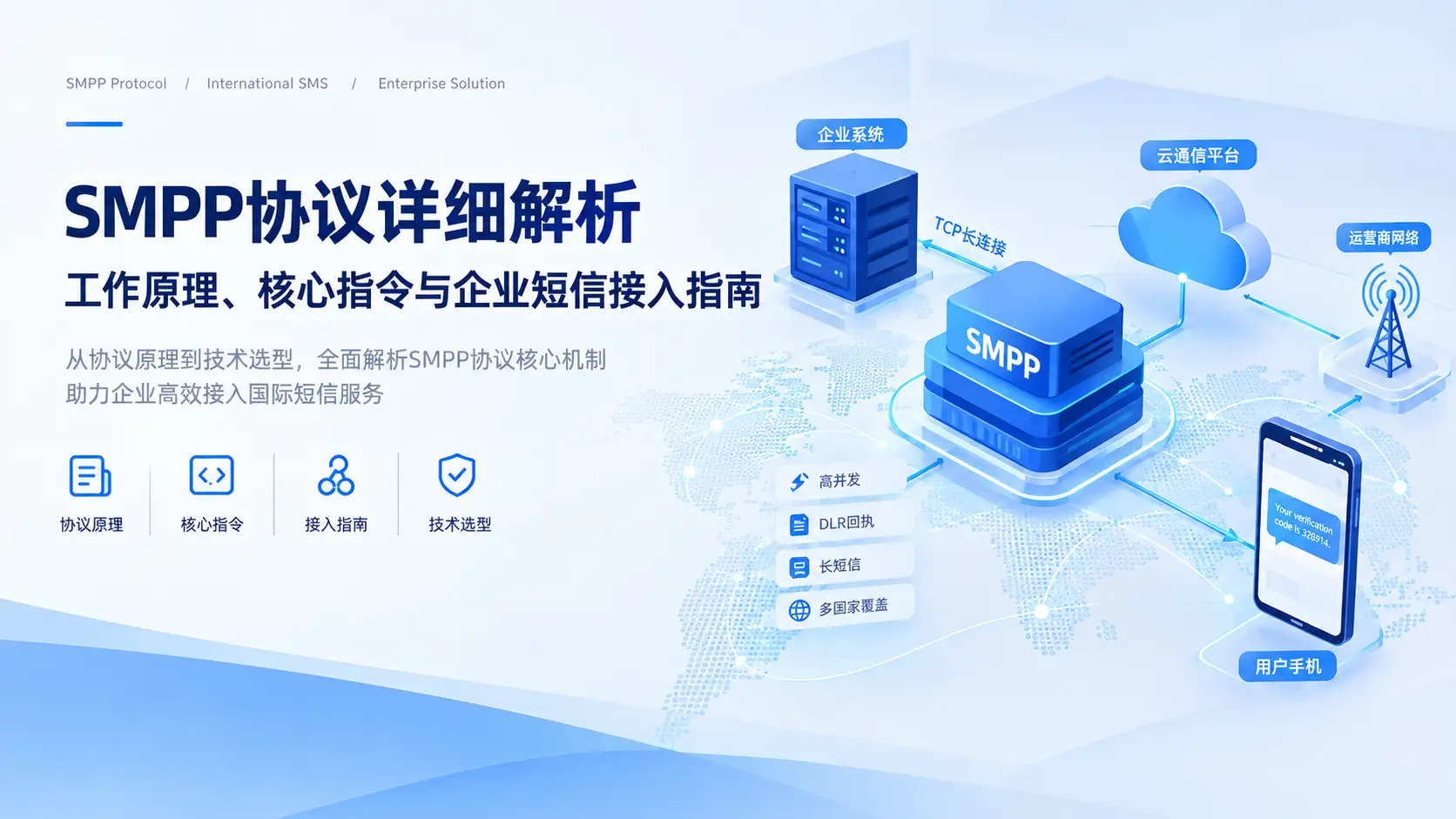
IX. What Does SMPP Concurrent Connection Count Mean?
In enterprise-grade SMS systems, SMPP is a common SMS communication protocol.
Unlike ordinary HTTP APIs, SMPP usually uses persistent connections.
For example:
Enterprise SMS System
      ↓
SMPP Persistent Connection
      ↓
Cloud Communication Platform
      ↓
SMS Center / Carrier
Therefore, in SMPP scenarios, besides message throughput, you also need to focus on:
- TCP connection count
- SMPP connection stability
- bind status
- submit_sm processing capability
- window size
- sequence number
- DLR processing capability
- Reconnection mechanism
Therefore:
A high SMPP connection count does not necessarily mean high SMS TPS.
Connection capability and message processing capability should be measured separately.
X. What Technical Architecture Do High-Concurrency Platforms Use?
To support large-scale international SMS business, multiple infrastructure components usually need to work together.
API Gateway
Responsible for traffic access, authentication, rate limiting, and request control.
Redis
Can be applied to: high-speed caching, rate limiting, state management, distributed locks, queues, and other scenarios.
Message Queue
Used for: peak shaving, asynchronous processing, and task decoupling.
Routing Engine
Routes messages based on country, region, carrier, channel status, and strategies.
Multi-Channel Resource Pool
Reduces dependence on a single path through multiple suppliers and channel resources.
SMPP Connection Pool
Maintains enterprise-grade SMS persistent connections, improving communication efficiency and connection management.
Monitoring and Alerting System
Continuously monitors:
QPS
TPS
Concurrent connections
CPU
Memory
Redis
MQ
Queue backlog
SMS throughput
Failure rate
DLR latency
Channel status
API response time
Only when these systems work together can a true high-concurrency cloud communication architecture be formed.
XI. How to Test the Real Concurrency of an SMS Platform?
When procuring international SMS services, enterprises can verify actual platform capability through stress testing or trial runs.
Test 1: Sustained Stress Test
For example:
1000 req/s
for 10 minutes
Observe whether the system shows:
- Continuously rising CPU
- Queue backlog
- Increased API latency
- Decreased SMS processing speed
Test 2: Instant Peak Test
Simulate:
100 req/s
      ↓
5000 req/s
Observe whether the platform can quickly absorb burst traffic.
Test 3: Long-Term High Load
For example:
5000 req/s
for 30 minutes
This type of test more easily reveals sustained bottlenecks in databases, Redis, message queues, and channel capacity.
Test 4: Channel Failure Test
For example:
Channel A
 ↓
Exception occurs
 ↓
Routing system
 ↓
Channel B
Focus on observing whether the platform can perform failure isolation, intelligent switching, and traffic scheduling.
For international SMS business, this capability is often more meaningful than a simple peak concurrency figure.
XII. How Should Enterprises Evaluate Platform Concurrency?
When choosing an international SMS platform, enterprises can focus on the following questions.
What exactly does the concurrency metric mean?
Does "100,000 concurrency" mean:
API concurrency, TCP connections, message concurrency, or system task count?
The statistical definition must be clarified.
What are the peak and sustained capabilities?
For example:
Peak: 5000 TPS
Sustained: 1000 TPS
versus:
Sustained: 5000 TPS
are completely different performance levels.
What is the downstream SMS channel capacity?
High concurrency at the API layer does not mean the downstream channels have the same high throughput.
The final SMS sending speed is still affected by the entire link.
Is a message queue supported?
For scenarios like promotions and concentrated verification code requests, message queues help the system absorb burst traffic.
Are multi-channel and intelligent routing supported?
For international SMS, multi-channel resources and routing scheduling directly affect system stability in complex communication environments.
Can complete receipts be viewed?
It is recommended to track:
API request
 ↓
Submission success
 ↓
Channel sending
 ↓
Carrier processing
 ↓
DLR receipt
 ↓
Final status
Only with a complete data tracking link can enterprises identify exactly where a problem occurred.
XIII. Choosing an International SMS Platform: Do Not Look Only at Concurrency
For a cloud communication platform, concurrency is just one of the performance metrics.
What really determines the enterprise communication experience is the comprehensive processing capability of the entire system:
API access capability + concurrency processing + message throughput + queue capability + intelligent routing + channel capacity + DLR receipts + failover + monitoring capability.
Therefore, when procuring international SMS services, enterprises should not only compare:
"Whose concurrency number is bigger?"
But should focus more on:
Whether the platform can stably receive requests, quickly complete message scheduling, and continuously deliver SMS under real business peaks.
For cross-border ecommerce, fintech, gaming going global, online education, and overseas social businesses, this is the real value of cloud communication concurrency capability.
FAQ
Concurrency refers to the number of requests, connections, or tasks a system processes at the same time. It differs from metrics such as QPS and TPS, and cannot directly represent SMS sending volume per second.
2. Is higher SMS platform concurrency always better?
Concurrency is only one dimension of platform performance. Actual SMS sending capability also depends on API performance, message queues, routing systems, and downstream channel capacity.
3. What is the difference between QPS and TPS?
QPS usually describes the number of requests processed per second, while TPS describes the number of transactions processed per second. Since statistical definitions vary across systems, enterprises should confirm metric definitions during procurement.
4. How much concurrency does an international SMS platform need?
There is no unified concurrency standard for all enterprises. OTP, notification, and marketing SMS have different traffic models; capacity should be determined based on peak request volume, sending scale, target countries, and latency requirements.
5. Is SMPP concurrent connection count the same as SMS TPS?
No. SMPP concurrent connection count mainly describes the number of persistent connections, while SMS TPS describes message processing capability per unit of time. They are different performance metrics.
6. How to test SMS API concurrency capability?
You can test through sustained stress, instant peaks, long-term high load, and channel failure scenarios, while observing API response time, message backlog, SMS throughput, and DLR latency.
Enterprise International Communication Solution
When business grows from a single SMS interface to multi-country, multi-service, multi-channel communication at scale, relying on basic API access alone is no longer enough to handle complex business traffic.
Enterprises usually need a complete communication link covering:
API Access -> Message Queue -> Intelligent Routing -> International SMS Channel -> DLR Receipt -> Data Monitoring
YaningAI focuses on enterprise international communication scenarios, providing cloud communication capabilities such as international SMS for global businesses, supporting HTTP API, SMPP, and other integration methods to help enterprises quickly integrate SMS capabilities into their own systems.
Applicable Scenarios
- Cross-border Ecommerce
- OTP Verification
- Order Notifications
- Fintech
- Gaming Going Global
- Online Education
- Overseas Social
- Cross-border Logistics
Need to evaluate international SMS concurrency capability?
We can provide a targeted assessment of SMS API concurrency, throughput, and channel capacity based on your daily sending volume, peak TPS, target countries/regions, and business type.
Explore International SMS Services ->