What Are Channel Code, MO, and MT? Concept Distinctions and International SMS Technical Analysis
In cloud communication services such as international SMS, verification code SMS, and notification SMS, channel code, mobile originated (MO), and mobile terminated (MT) are fundamental concepts that enterprise technical teams, procurement personnel, and developers encounter frequently.
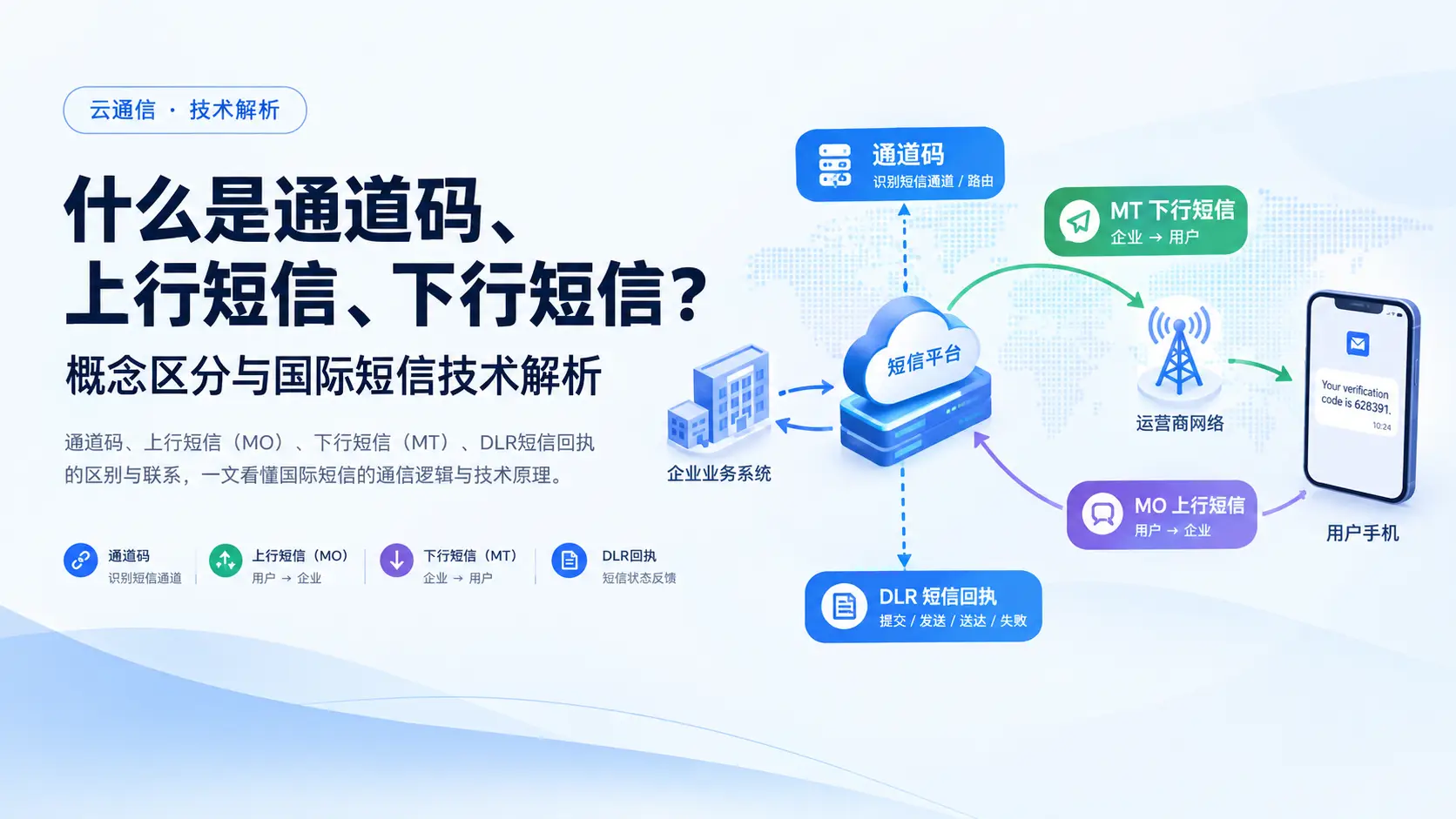
Among them, channel codes are mainly used to identify SMS channels or routes; MT represents enterprises sending SMS to users; MO represents users sending SMS to enterprises.
Although all three belong to the SMS communication system, they operate at different layers.
For enterprises integrating international SMS APIs, SMPP, and SMS platforms, correctly understanding these concepts helps with SMS interface development, channel selection, routing strategy design, and SMS status monitoring.
This article will systematically explain channel codes, MO, MT, and DLR from three dimensions: communication direction, technical architecture, and real business scenarios.
I. What Is a Channel Code?
What is a channel code?
A channel code (Channel Code) is typically an identifier used by an SMS platform to recognize a specific SMS channel, route, supplier resource, or routing configuration.
In international SMS services, a country or region may correspond to multiple SMS channels. Different channels may differ in carrier resources, coverage, pricing, latency, stability, and compliance requirements.
Therefore, SMS platforms usually assign independent channel identifiers to different routes.
A channel code is the identifier an SMS platform uses to recognize which channel an SMS should travel through.
For example, an international SMS platform may have the following internal configuration:
| Country/Region |
Channel Name |
Channel Code |
Business Type |
| Singapore |
Singapore Direct |
SG01 |
OTP |
| Thailand |
Thailand Direct |
TH02 |
OTP/Notification |
| Indonesia |
Indonesia Route |
ID03 |
Notification |
| Europe |
Europe Route |
EU01 |
OTP/Notification |
Here, SG01, TH02, ID03 and similar values serve as internal channel codes for the platform.
Note that different cloud communication platforms may not use the same naming for channel codes. They may also use:
- Channel ID
- Channel
- Route ID
- Supplier ID
- Route Code
and other field names.
Therefore, during SMS API integration, refer to the API documentation and backend definitions provided by the specific platform.
II. What Is the Role of a Channel Code?
Channel codes mainly serve the SMS platform in route management, smart routing, supplier management, and data statistics.
1. Distinguishing Different SMS Channels
International SMS covers multiple countries and regions, and different countries may correspond to different carriers and SMS routes.
For example, an enterprise sends a verification code SMS:
Your verification code is 628391.
Target number:
+66 8XXXXXXXX
After identifying the target country, the platform can select the corresponding Thailand SMS channel based on preset routing rules.
The complete process can be understood as:
Enterprise business system
      ↓
SMS API
      ↓
Number country identification
      ↓
Smart routing
      ↓
Match channel code
      ↓
SMS channel
      ↓
Carrier network
      ↓
User mobile phone
Therefore, channel codes are essentially identifiers within the SMS routing system.
2. Supporting Smart SMS Routing
Mature international SMS platforms typically do not rely on a single route; instead, they dynamically select channels based on different business conditions.
For example:
Target country
    ↓
Carrier
    ↓
Business type
    ↓
Number range
    ↓
Channel quality
    ↓
Cost
    ↓
Select optimal route
For verification codes, notifications, and similar services, platforms also need to consider:
- SMS delivery rate
- Average latency
- Failure rate
- DLR status
- Carrier restrictions
- Channel stability
Finally, an appropriate SMS channel is selected.
Route quantity does not equal route quality; the core is routing capability and actual delivery performance.
3. Used for SMS Channel Quality Analysis
Platforms can compile SMS sending statistics based on different channel codes.
For example:
Channel: TH02

Submitted: 1,000,000
Submission successful: 998,200
Final delivery: 985,600
Failed: 14,400
Average latency: 2.5 seconds
With this data, platforms can continuously identify high-quality routes, abnormal routes, and routes with higher latency.
This is also one of the metrics enterprises should focus on when selecting an international SMS service provider.
III. What Is Mobile Terminated (MT)?
Mobile Terminated (MT) refers to SMS sent from an enterprise, application system, or SMS platform to a user mobile phone.
That is:
Enterprise → User
This is currently the most common communication direction in enterprise SMS business.
For example:
YaningAI

Your verification code is 628391.
The code is valid for 5 minutes.
After generating a verification code, the enterprise system submits it to the SMS platform via an SMS API or SMPP interface, and the platform sends it through the SMS channel and carrier network to the user mobile phone.
This is a typical Mobile Terminated (MT) SMS.
IV. What Are the Application Scenarios of MT?
1. OTP Verification Code SMS
Verification codes are one of the most common application scenarios for international SMS.
For example:
Your verification code is 819236.
Commonly used for:
- Registration verification
- Login verification
- Password recovery
- Secondary identity verification
- Payment verification
- Risk control verification
Verification code services typically have high requirements for SMS delivery speed, delivery rate, and stability.
2. Transaction and Notification SMS
Enterprises can send business status updates to users via MT SMS.
For example:
Your order #A10293 has been shipped.
Common in:
- Cross-border e-commerce
- Cross-border logistics
- SaaS
- Fintech
- Platform-based internet products
3. Marketing SMS
For example:
20% OFF this weekend. Shop now.
Marketing SMS is mainly used for:
- Campaign promotion
- User reactivation
- Promotion notification
- Product recommendation
- Marketing outreach
Compared with OTP and notification SMS, marketing SMS usually requires more attention to the target countrys user authorization, content regulations, Sender ID, opt-out mechanisms, and local regulatory requirements.
V. What Is Mobile Originated (MO)?
Corresponding to MT SMS is:
Mobile Originated (MO)
MO refers to:
User → Enterprise
That is, SMS is initiated by the user mobile phone and sent to the enterprise or SMS platform.
For example, the enterprise sends:
Reply YES to confirm your subscription.
The user replies:
YES
This SMS sent back from the user to the enterprise system is a typical MO (Mobile Originated) SMS.
VI. What Is the Role of MO?
1. User Replies
This is the most typical application scenario for MO.
Enterprises can ask users to reply with specific content:
YES
NO
STOP
START
After receiving user replies, the SMS platform forwards the messages to the enterprise business system via API callbacks, SMPP, and similar methods.
2. SMS Commands
Some services can complete simple business commands via SMS.
For example:
BALANCE
Query account status.
Or:
STOP
Execute opt-out.
This approach does not require users to open an App or log in to a webpage, suitable for some simple interactive business scenarios.
3. User Interaction
When enterprises need to form two-way SMS communication with users, they must consider:
MT (downlink) + MO (uplink)
That is:
Enterprise
 ↓ MT
User
 ↓ MO
Enterprise
This constitutes complete two-way SMS communication capability.
VII. What Is the Difference Between MO and MT?
The core difference between the two is just one:
Look at who is sending the SMS to whom.
| Dimension |
MT (Mobile Terminated) |
MO (Mobile Originated) |
| English Name |
Mobile Terminated |
Mobile Originated |
| Communication Direction |
Enterprise → User |
User → Enterprise |
| Main Initiator |
Enterprise System |
User Mobile Phone |
| Common Business |
OTP, Notification, Marketing |
Reply, Opt-out, Command |
| Main Technical Focus |
Routing, Latency, Delivery Rate |
Receiving, Callback, Business Processing |
A simple way to remember:
MT = Sent by the enterprise.
MO = Sent back by the user.
VIII. What Is the Relationship Between Channel Code, MT, and MO?
This is one of the most easily confused questions during SMS technical integration.
In fact, these three concepts do not belong to the same dimension.
MT / MO solves the "direction problem"
MT:
Enterprise → User

MO:
User → Enterprise
Channel code solves the "route problem"
Enterprise
 ↓
SMS platform
 ↓
Channel code
 ↓
Specific SMS route
 ↓
Carrier
 ↓
User
Therefore:
MT and MO describe the SMS communication direction; channel codes describe the SMS channel or routing identifier.
For example:
Target country: Thailand
Business type: OTP
SMS direction: MT
Channel code: TH02
Here:
- MT: indicates this is a downlink SMS;
- TH02: indicates the SMS channel used by the platform;
- OTP: indicates the business type;
- Thailand: indicates the target country.
They are not the same concept.
IX. Is a DLR Receipt an MO SMS?
No.
DLR (Delivery Receipt) typically refers to an SMS status receipt, used to feed back SMS submission, sending, or final delivery status.
For example, an enterprise sends:
Your verification code is 123456.
The SMS platform first returns:
SUBMITTED
Then the carrier may return:
DELIVERED
Or:
FAILED
These status messages are part of the SMS receipt.
Therefore, it is necessary to distinguish:
MT
Enterprise → User
MO
User → Enterprise
DLR
SMS network/platform → Enterprise system
MO is SMS actively sent by users; DLR is SMS status returned by the system. The two are completely different.
X. What Is the Complete International SMS Communication Chain?
Taking an international verification code SMS as an example, a complete MT SMS may go through the following process:
User requests verification code
      ↓
Enterprise business system
      ↓
Call SMS API
      ↓
SMS platform
      ↓
Number country/carrier identification
      ↓
Smart routing
      ↓
Match SMS channel
      ↓
Carrier network
      ↓
User mobile phone
      ↓
DLR status receipt
      ↓
Enterprise system
If the user replies, another chain is formed:
User mobile phone
    ↓
Carrier network
    ↓
SMS platform
    ↓
MO (uplink) SMS
    ↓
Enterprise business system
From this, we can see:
Channel codes, MT, MO, and DLR are located at different stages of the SMS communication system.
XI. What Parameters Should Enterprises Focus on When Integrating an SMS API?
During international SMS API integration, enterprises typically encounter:
Mobile number
SMS content
Sender ID
Template
Channel / Route
Callback URL
Message ID
DLR
However, API parameter design varies across platforms.
For example, an enterprise request:
{
  "mobile": "668xxxxxxxx",
  "content": "Your verification code is 628391"
}
The platform can automatically determine based on the target number:
Country → Carrier → Business type → Routing → Channel
Enterprises do not need to specify a specific underlying channel.
This model reduces the dependence of the enterprise business system on specific supplier routes.
For large enterprises, they may also use:
and other methods for deeper SMS integration.
XII. What Should Enterprises Focus on When Selecting an International SMS Platform?
After understanding channel codes, MO, and MT, when selecting an SMS service provider, enterprises should not look only at SMS unit price.
Factors that truly affect SMS business outcomes also include:
1. SMS Channel Quality
Focus on:
- Carrier coverage
- Route stability
- Final delivery rate
- Average latency
- Failure rate
2. Routing Capability
Excellent international SMS platforms usually need to have:
Smart routing, route switching, anomaly monitoring, supplier management
and other capabilities.
Rather than simply providing a single fixed route.
3. DLR Receipt Capability
Enterprises need to clearly distinguish:
Submitted
Sent
Delivered
Failed
Unknown
Only then can they accurately analyze the actual effectiveness of verification codes, notification SMS, and other services.
4. MO Uplink Capability
For scenarios requiring two-way SMS communication, confirm whether the platform supports:
MO, short codes, long codes, or two-way SMS capability
The specific support method needs to be confirmed based on country and carrier conditions.
5. API / SMPP Integration Capability
Different enterprises have different system architectures.
Development teams can choose based on business scale, real-time requirements, and system architecture:
and other integration methods.
6. International SMS Compliance Capability
When conducting international SMS business, attention is also needed to local:
- Sender ID requirements
- Content regulations
- Template registration
- User authorization
- Marketing SMS rules
- Opt-out requirements
Compliance capability is also an important part of international SMS services.
XIII. Channel Code, MO, MT, DLR — Remember All at Once
The diagram below helps you quickly understand:
                Enterprise business system
                     │
                     │
              MT (downlink) SMS
                     ↓
                SMS platform
                     │
                Channel code / Route
                     ↓
                Carrier network
                     ↓
                  User mobile phone
                     │
                     │
              MO (uplink) SMS
                     ↓
                SMS platform
                     ↓
                Enterprise business system


DLR:
SMS platform / Carrier
        ↓
    Enterprise business system
        ↓
Return SMS status
The memorization method is very simple:
Channel code = which route to take
MT = enterprise sends to user
MO = user sends to enterprise
XIV. Summary
In cloud communication and international SMS business, channel codes, MO, and MT solve problems at different layers.
Channel codes are used to identify and manage SMS channels, and are important identifiers within the SMS routing system.
MT (Mobile Terminated) represents enterprises sending SMS to users, commonly seen in verification codes, order notifications, system notifications, and marketing outreach.
MO (Mobile Originated) represents users sending SMS to enterprises, commonly used for user replies, opt-outs, SMS commands, and two-way interaction.
And DLR receipts are used to feed back SMS processing and delivery status, and do not belong to MO.
For enterprises, a truly complete international SMS capability is not just about providing an SMS API; it requires:
SMS channels + Smart routing + MT downlink + MO uplink + DLR receipts + API/SMPP + Compliance management
and other links to form a complete communication capability.
For enterprises building overseas business, verification code systems, cross-border e-commerce platforms, fintech products, social applications, and SaaS products, understanding these concepts helps technical teams perform SMS API integration more accurately, and helps procurement teams evaluate international SMS service providers more comprehensively.
Learn More About International SMS Services
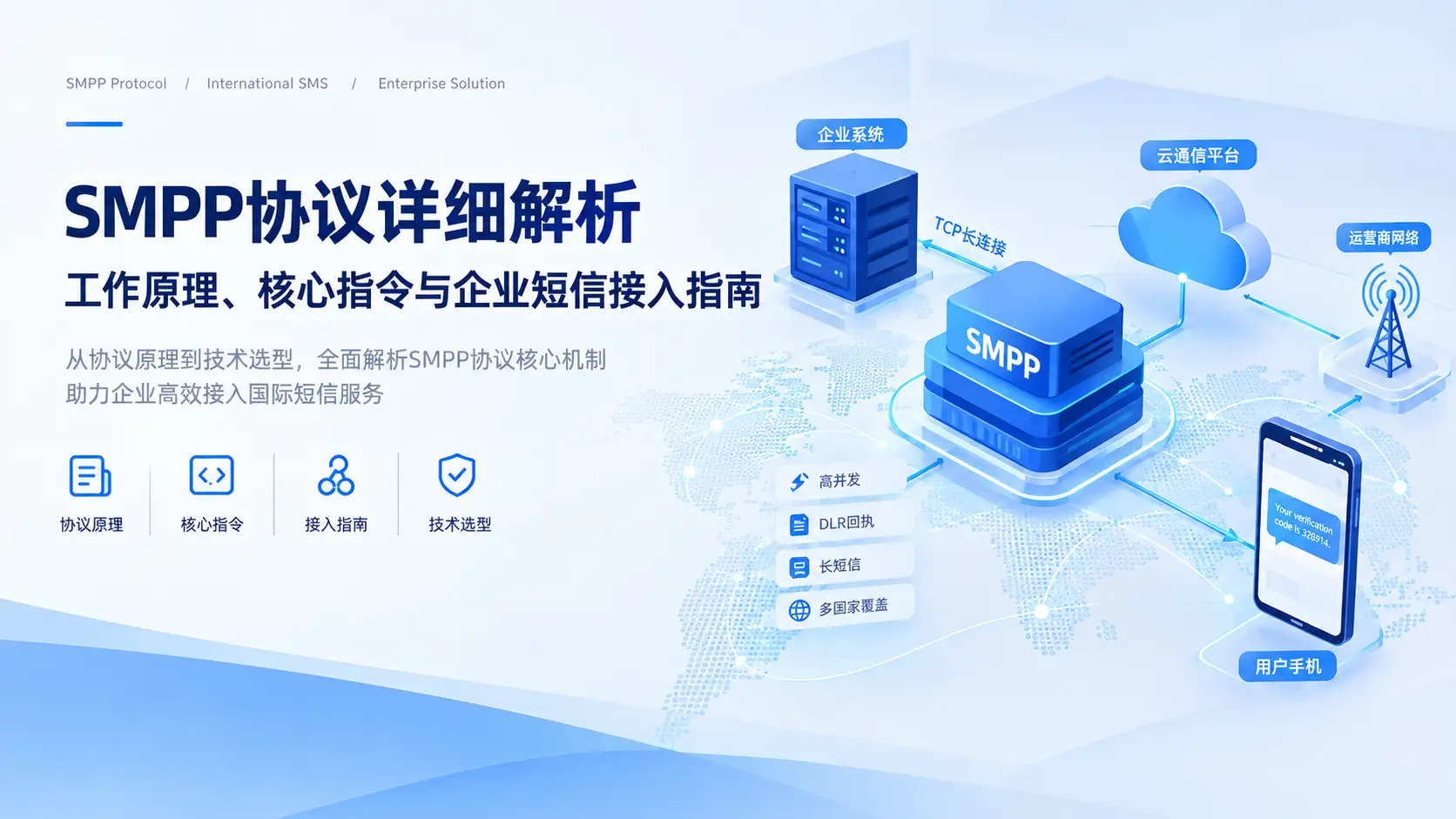
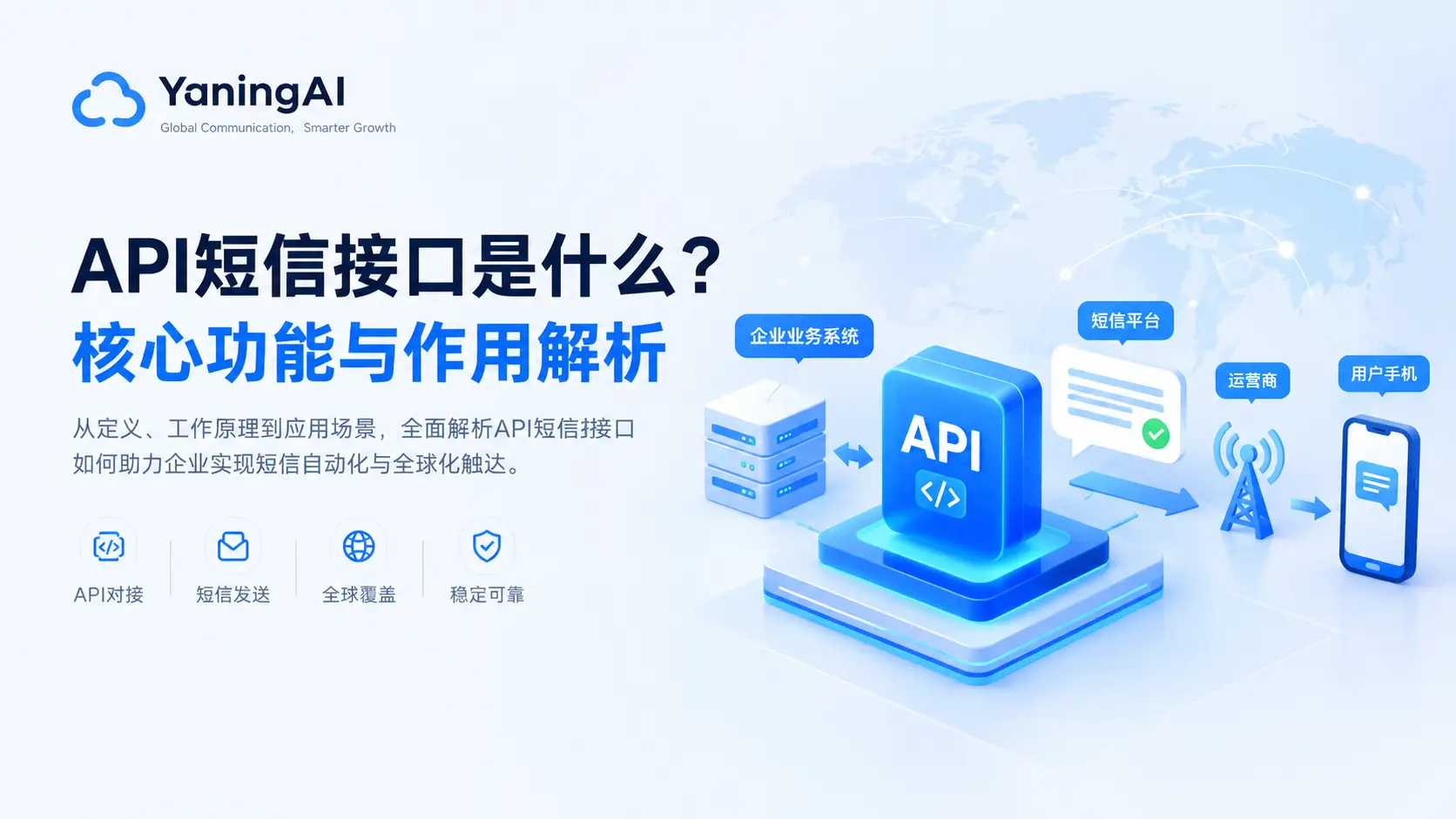
YaningAI provides enterprise-facing international SMS communication capabilities, supporting integration via HTTP API, SMPP and other methods, applicable to verification codes, notifications, business messages, and other overseas communication scenarios.
Enterprises can choose the appropriate SMS integration method based on target country, business type, and communication needs, and manage the entire sending chain through SMS channels, smart routing, and status receipts.
From API integration, to SMS channels, to final delivery, making enterprise overseas communication more stable, transparent, and efficient.