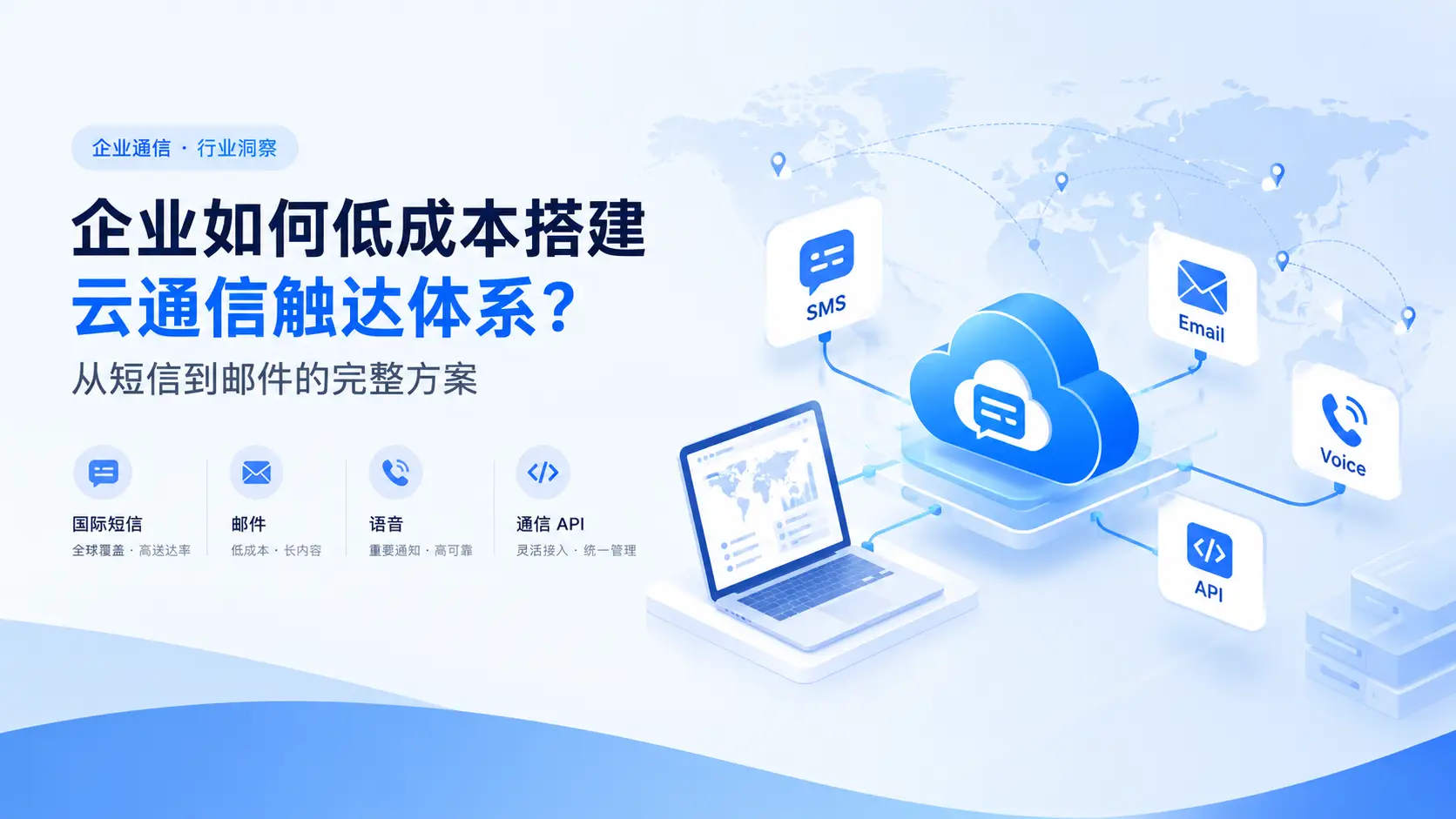
How Enterprises Can Build a Low-Cost Cloud Communication System: From SMS to Email
Cloud communication has become a vital part of digital infrastructure for global enterprises.
From verification codes at registration, to payment and logistics notifications, to marketing re-engagement and customer service, enterprises communicate with users daily via SMS, email, voice, and other channels.
As business expands across more countries and regions, enterprises face a practical challenge:
More communication channels, more complex suppliers, yet communication costs are increasingly hard to control.
Especially for cross-border e-commerce, SaaS, fintech, gaming, and social platforms, balancing international SMS delivery rates, communication stability, and compliance while controlling costs has become a critical topic.
So, how can enterprises build a reliable cloud communication outreach system at low cost?
The answer is not simply finding the cheapest SMS supplier, but optimizing holistically across communication architecture, channel selection, intelligent routing, supplier management, and data analytics.
I. What Is an Enterprise Cloud Communication Outreach System?
An enterprise cloud communication outreach system can be understood as:
Integrating SMS, email, voice, and other communication capabilities into enterprise business systems through a cloud communication platform and communication APIs, enabling unified message sending, routing, monitoring, and management.
In the traditional model, enterprises may need to separately integrate with SMS suppliers, email service providers, and voice service providers.
Ultimately forming:
业务系统
 ├── 短信供应商 A
 ├── 短信供应商 B
 ├── 邮件供应商
 └── 语音供应商
As business scales, this approach easily leads to non-unified APIs, scattered data, and complex supplier management.
Through a cloud communication platform + unified communication API, underlying communication capabilities can be centralized:
                 企业业务系统
                      │
                统一通信 API
                      │
                 通信中台
                      │
          ┌───────────┼───────────┐
          ↓           ↓           ↓
        SMS         Email       Voice
          │           │           │
       运营商       邮件网络      语音网络
          │
       用户终端
The enterprise business system does not need to directly understand complex carrier networks; it only needs to call the unified API.
II. Why Do Enterprises Need to Build a Cloud Communication System?
In the early stages, enterprises may only need to call one SMS API to solve the problem.
But as business enters the scaling phase, communication systems gradually expose several issues.
1. Growing Number of Communication Suppliers
Different countries may require different communication routes.
An enterprise may simultaneously use:
- International SMS suppliers
- Local SMS suppliers
- Email service providers
- Voice service providers
- WhatsApp and other instant messaging channels
If each supplier is developed independently, technical maintenance costs will keep rising.
2. Quality Variance in International SMS
Sending the same international SMS can produce completely different results across countries, carriers, and routes.
Influencing factors include:
- Carrier networks
- Sender ID
- Channel type
- Message content
- National regulatory policies
- Carrier interception strategies
- Communication peak periods
- Route quality
Therefore, when selecting international SMS services, enterprises should not look at pricing alone.
3. Communication Costs Grow Rapidly with Business Volume
If an enterprise sends hundreds of thousands or even millions of messages per day, even a fraction of a cent difference per message can accumulate into a significant cost gap.
Therefore, enterprises need to shift from:
to:
III. Core Principles for Low-Cost Enterprise Communication Architecture
A truly low-cost enterprise communication architecture can be summarized in five keywords:
📌 Unified API, Reasonable Channels, Intelligent Routing, Data-Driven, Elastic Scaling
1. Unified Communication API
Enterprises should avoid binding their business systems directly to a single communication supplier.
For example:
Wrong approach:
订单系统 → 供应商 A API
用户系统 → 供应商 B API
营销系统 → 供应商 C API
Recommended:
订单系统 ─┐
用户系统 ─┼→ 企业通信 API → 云通信平台
营销系统 ─┘
The biggest advantage of this approach is decoupling.
When switching communication suppliers later, there is no need to modify all business systems.
IV. How to Combine SMS, Email, and Voice?
Low cost does not mean using the same communication channel for all messages.
Different messages should be matched with different outreach methods.
| User Scenario |
Recommended Channel |
Reason |
| Registration verification |
International SMS |
High immediacy |
| Login verification |
International SMS |
Wide coverage |
| Payment verification |
SMS / Voice |
High reliability required |
| Order notification |
SMS / Email |
Balance of timeliness and content volume |
| Logistics notification |
SMS / Email |
Suitable for event notifications |
| Marketing campaign |
Email |
Lower per-message cost |
| User re-engagement |
Email / Instant messaging |
Suitable for long-term operations |
| Urgent notification |
SMS / Voice |
Reach priority |
The core principle is simple:
💡 High-value, time-sensitive messages should use high-reach channels; low-urgency, long-content messages should use low-cost channels.
V. International SMS Is a Key Component of Enterprise Cloud Communication
For global enterprises, international SMS is typically one of the most fundamental communication capabilities.
Especially in the following scenarios:
- User registration
- Login verification
- OTP verification codes
- Payment verification
- Risk control alerts
- Order notifications
- Logistics notifications
- User re-engagement
When selecting an international SMS platform, enterprises should focus on the following metrics:
① Country and Region Coverage
Whether it covers the enterprise's key markets.
For example:
- Southeast Asia
- Europe
- North America
- Middle East
- Latin America
- Africa
② Actual Delivery Rate
Do not rely solely on theoretical metrics promoted by suppliers.
More importantly, check:
📊 Country + Carrier + Message Type
real data at this granularity.
③ Message Latency
For OTP, login verification, and similar scenarios, latency directly affects user experience.
If a verification code arrives minutes later, the user may abandon the registration process entirely.
④ Sender ID Support
Some countries and regions require Sender ID registration, review, or specific formats.
Enterprises need to confirm in advance whether the service provider can offer relevant support.
⑤ Delivery Report
A mature SMS API should not only return "submitted successfully" but also provide subsequent message status.
API Request
    ↓
Submitted
    ↓
Sent
    ↓
Delivered
If delivery fails, it should further return:
Failed
 ↓
Error Code
 ↓
Failure Reason
Only with a complete receipt system can enterprises truly analyze SMS quality.
VI. Reducing International SMS Costs Through Intelligent Routing
When enterprise SMS volume reaches a certain scale, intelligent routing becomes an important means of reducing communication costs.
A basic intelligent routing system can select communication routes based on the following factors:
- Country
- Carrier
- Message type
- Channel price
- Historical delivery rate
- Average latency
- Failure rate
- Real-time channel status
For example:
用户号码
   ↓
识别国家
   ↓
识别运营商
   ↓
读取线路质量
   ↓
匹配最佳通道
   ↓
发送短信
   ↓
获取 Delivery Report
   ↓
异常?
 ┌─┴─┐
否   是
↓     ↓
结束  切换备用路由
The value of this mechanism is not simply "finding the lowest price."
Rather:
⚖️ Finding the optimal balance among price, stability, and delivery rate.
VII. How Message Queues Help Enterprises Reduce Costs
Communication systems are typical high-concurrency scenarios.
If the business system directly calls the SMS API synchronously:
用户下单
 ↓
订单系统
 ↓
调用短信 API
 ↓
等待结果
 ↓
返回订单结果
When sending volume suddenly increases, the communication interface may in turn affect the business system.
A more reasonable approach is to introduce a message queue:
业务系统
   ↓
Message Queue
   ↓
通信任务
   ↓
短信 API
   ↓
运营商
   ↓
Delivery Report
This enables:
- Asynchronous sending
- Traffic peak shaving
- Failure retry
- Task isolation
- Improved system stability
For high-concurrency businesses, this is also a key step for enterprise communication systems to evolve from "functional" to "stable."
VIII. 1 Primary Supplier + 1–2 Backup Suppliers
Is having more suppliers always better?
The answer is usually no.
Maintaining a large number of communication suppliers simultaneously may lead to:
- Different API standards
- Different data structures
- Different receipt formats
- Different billing systems
- Complex technical integration
- Increased O&M costs
For most enterprises, the recommended approach is:
✅ 1 primary communication platform + 1–2 backup resources.
Managed through a unified communication API wrapper.
The primary supplier handles daily traffic, while backup suppliers are used for:
- Failover
- Specific country supplementation
- Specific carrier optimization
- Peak-period expansion
This avoids single-supplier risk while keeping system complexity manageable.
IX. Managing Communication Costs with Data, Not Feelings
When an enterprise sends hundreds of thousands or more messages per day, manual judgment of which route is better or which supplier is cheaper is unrealistic.
Establishing a communication data analytics system is recommended.
At minimum, record:
- Message ID
- Country
- Carrier
- Sender ID
- Channel
- Send time
- Delivery time
- Delivery Status
- Error Code
- Retry count
- Per-message cost
Then analyze from three dimensions:
Performance
国家 → 通道 → 平均延迟
Ultimately forming a communication route scoring system.
This enables enterprises to continuously eliminate low-quality routes and optimize cost-effective ones.
X. How to Build Enterprise Cloud Communication Architecture in Phases
Enterprises do not need to build a complex communication middle platform on day one.
It can evolve gradually according to business scale.
Phase 1: Rapid API Integration
Suitable for enterprises just starting overseas business.
Build:
- SMS API
- Email API
- Message templates
- Webhook
- Sending logs
Goal: Quickly establish communication capabilities.
Phase 2: Communication Platformization
As business volume grows, add:
- Message queues
- Intelligent routing
- Failure retry
- Multi-supplier support
- Data analytics
- Monitoring and alerting
Goal: Improve stability and manageability.
Phase 3: Communication Middle Platform
When the enterprise reaches scale, further build:
- Multi-active architecture
- Communication resource pool
- Country-level routing
- Carrier-level routing
- SLA monitoring
- Cost analysis
- Automatic failover
- Unified communication data platform
Goal: Make communication capabilities true enterprise infrastructure.
XI. How to Calculate True Communication Costs
It is recommended not to simply use:
for the calculation.
A more reasonable metric is:
有效触达成本
=
通信总成本 ÷ 实际成功触达数量
For example:
One route charges 0.05 yuan per SMS, so 1 million messages cost 50,000 yuan.
If 900,000 users are actually reached:
50000 ÷ 900000
≈ 0.0556 元/次有效触达
Another route may charge 0.052 yuan but only reach 800,000:
52000 ÷ 800000
= 0.065 元/次有效触达
On the surface, the second route is only slightly more expensive, but its effective reach cost is much higher.
Therefore:
💡 Enterprise communication procurement should shift from "lowest unit price" to "lowest effective reach cost."
XII. Compliance Is an Essential Part of Cloud Communication
Low cost cannot be built on non-compliant sending.
Especially for international SMS, different countries and regions may have different requirements for:
- Sender ID
- SMS content
- User consent
- Marketing messages
- Opt-out mechanisms
- Data privacy
- Template review
with different requirements.
Therefore, when selecting a cloud communication platform, enterprises should not only ask:
❓ "How much per message?"
but also ask:
✅ "How is communication compliance handled for target countries?"
A mature enterprise communication system needs to consider:
🔒 Route quality + System stability + Data security + Communication compliance + Cost control.
XIII. What to Look for When Choosing a Cloud Communication Platform
If an enterprise is preparing to procure cloud communication services, it can evaluate from the following dimensions.
| Evaluation Dimension |
Key Question |
| Coverage |
Does it cover target markets? |
| International SMS |
Does it have stable international routes? |
| API |
Does it provide standard APIs? |
| Delivery rate |
Can it provide real data? |
| Latency |
Is it stable for OTP scenarios? |
| Receipts |
Does it support Delivery Reports? |
| Routing |
Does it support intelligent routing? |
| Disaster recovery |
Are backup routes available? |
| Compliance |
Does it support target market requirements? |
| Data |
Does it provide complete data analytics? |
| Pricing |
Does it support volume-based pricing? |
| Technical support |
Can it handle route issues promptly? |
Do not compare quotes alone.
What should really be compared is:
📊 Communication capabilities + Stability + Technical capability + Service capability + Total cost.
XIV. Final Architecture for a Low-Cost Cloud Communication System
Overall, a cloud communication architecture suitable for global enterprises can be designed as:
                    企业业务系统
                         │
              ┌──────────┴──────────┐
              │                     │
           用户触达               业务事件
              │                     │
              └──────────┬──────────┘
                         ↓
                    通信 API
                         ↓
                    消息队列
                         ↓
                    通信中台
                         ↓
                   智能路由引擎
              ┌──────────┼──────────┐
              ↓          ↓          ↓
             SMS       Email      Voice
              ↓          ↓          ↓
          运营商网络   邮件网络    语音网络
              ↓
             用户
              ↓
        Delivery Report
              ↓
          数据分析平台
              ↓
       成本 / 质量 / 延迟分析
The core of this architecture is not pursuing technical complexity, but enabling the enterprise to achieve:
🎯 Business-communication decoupling, unified channel management, flexible route switching, and centralized data analytics.
XV. Summary: The Essence of Low Cost Is Sustainable Communication Capability
For enterprises, building a low-cost cloud communication outreach system is not simply finding the cheapest supplier.
The truly effective approach is to build a communication architecture that evolves sustainably with business scale:
1. Unified Communication API
2. SMS + Email + Voice Multi-Channel
5. Multi-Supplier and Backup Routes
6. Communication Data Analytics
7. Continuous Cost Optimization
For global enterprises, the communication system ultimately connects the complete user lifecycle:
Registration → Verification → Order → Payment → Logistics → After-sales → Marketing → Re-engagement.
Therefore, what enterprises truly need is not the "cheapest SMS," but a:
💡 Cloud communication system that achieves stable, compliant, trackable, and scalable user outreach at a reasonable cost.
If enterprises incorporate communication APIs, international SMS, email, intelligent routing, and data analytics into a unified architecture from the start, they can quickly scale on the existing system regardless of which country they enter or how many business scenarios they add, without repeatedly rebuilding communication infrastructure.
Building an Overseas Communication System?
If your business involves international SMS, SMS APIs, email APIs, voice communication, or multi-channel user outreach, you can design a solution based on actual business volume, target countries, communication scenarios, and existing technical architecture.
⚠️ Before procuring communication services, enterprises are advised to conduct target country route testing and communication cost assessment.
Get Enterprise Communication Solutions
Supported capabilities:
- 👉 International SMS API
- 👉 Global SMS channels
- 👉 OTP verification codes
- 👉 Email API
- 👉 Voice API
- 👉 Intelligent routing
- 👉 Communication data analytics
- 👉 Enterprise overseas communication solutions
Choose appropriate communication channels and routes based on actual business scenarios, rather than simply pursuing the lowest price.
Contact us