Omnichannel Communication Strategy for Overseas Enterprises: SMS + Voice + Email + Social Media | YaningAI
I. Why Do Overseas Enterprises Need Omnichannel Communication?
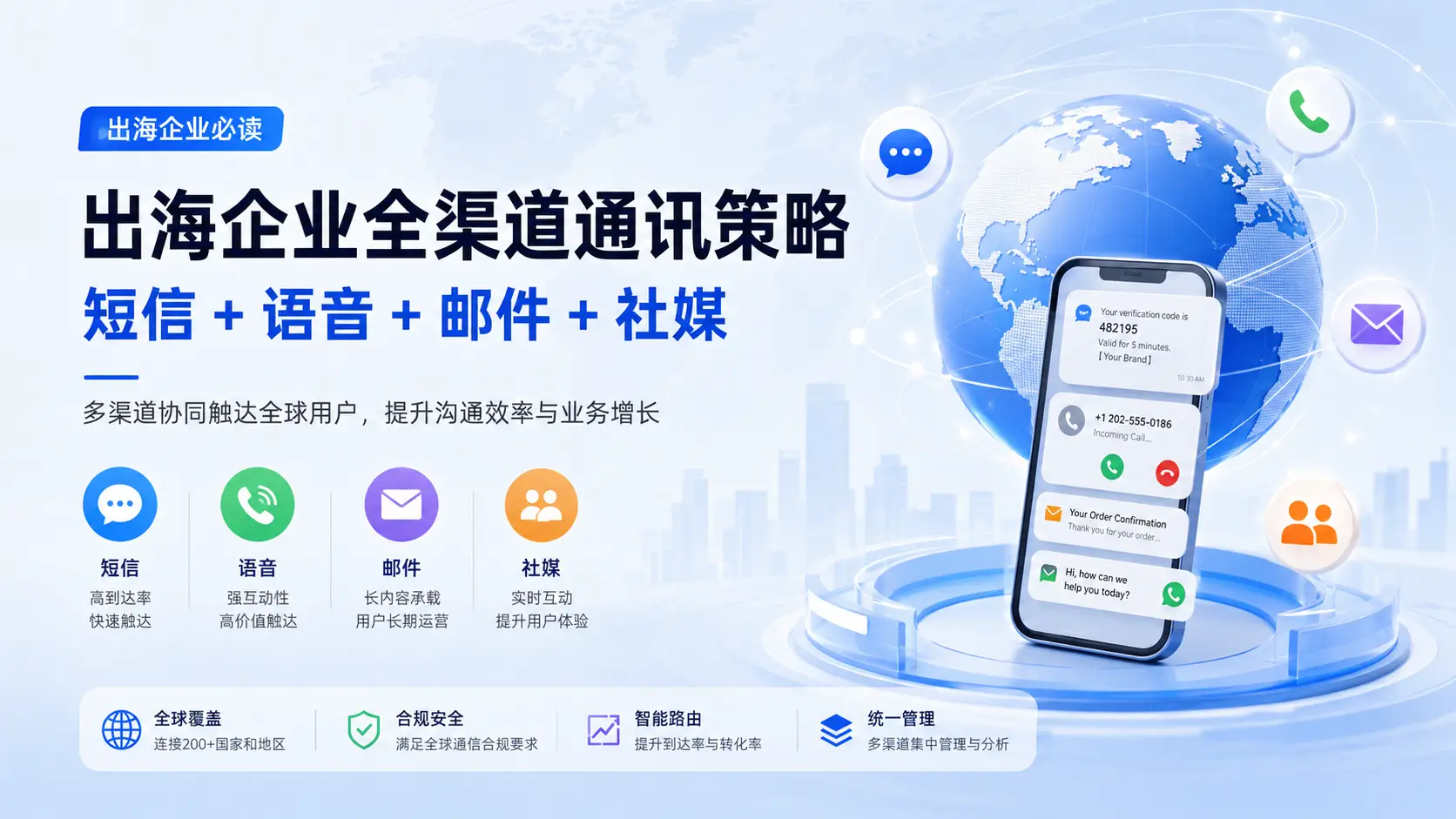
After entering overseas markets, enterprises find users distributed across different countries and regions, with distinct differences in communication habits, carrier rules, and social platform usage patterns.
A single communication channel can hardly cover the complete user lifecycle.
For example:
- International SMS: Suitable for verification codes, order notifications, payment reminders, and other time-sensitive scenarios
- Voice Communication: Suitable for voice verification codes, important notifications, and high-value customer reach
- Email: Suitable for product notifications, marketing content, and long-term user operations
- Social Media Messaging: Suitable for customer inquiries, after-sales service, and real-time interaction
💡 Therefore, what overseas enterprises need to build is not a simple "multi-channel sending system," but an omnichannel communication system that can automatically select channels based on user, country, business scenario, and message status.
II. The Core of Omnichannel Communication: Different Channels for Different Tasks
1. International SMS: Solving Time-Sensitive Communication Needs
International SMS remains an important foundational capability in the communication system of overseas enterprises.
Common applications include:
- Registration verification codes
- Login verification
- OTP identity verification
- Payment notifications
- Order notifications
- Logistics reminders
- Risk control alerts
- Password reset
- Account change notifications
Choosing an international SMS platform should not be based solely on unit price.
Enterprises should pay more attention to:
📌 Delivery rate, average latency, channel stability, carrier coverage, Sender ID, content compliance, and failure retry capability.
Especially in different markets such as Europe, America, Southeast Asia, and the Middle East, regulatory requirements for SMS content, Sender ID, and A2P SMS are not exactly the same.
💡 Therefore, a stable international SMS channel is an important foundation for overseas enterprises to build global communication capabilities.
2. Voice Communication: Covering Scenarios SMS Cannot Solve
SMS is suitable for asynchronous notifications, but for some important business operations, enterprises need stronger reach capabilities.
For example:
- Voice verification codes
- Financial risk control notifications
- High-value order confirmation
- Customer return visits
- Delivery exception contact
- Sales follow-up
- Customer service outbound calls
Enterprises can establish:
🔄 SMS reach → User no response → Voice call → Human customer service
Such a communication flow.
💡 Compared to repeatedly sending SMS, using communication orchestration to make voice a backup or escalation channel can further improve the reach efficiency of critical messages.
3. Email: Handling Long-Term User Operations
Email is more suitable for scenarios with larger information volumes and is an important channel for overseas enterprises to conduct user lifecycle operations.
Common applications include:
- Registration welcome emails
- Product usage guides
- Bills and invoices
- Order details
- Marketing campaigns
- Newsletter
- Product updates
- User reactivation
SMS solves "timely delivery," while email solves "long-term communication."
The two are not alternatives but should be coordinated through a unified enterprise communication platform.
For example:
User Registration
→ SMS sends verification code → Email sends welcome email
User Places Order
→ SMS sends order reminder → Email sends complete order information
User Long-term Inactive
→ Email reactivation → Social media for secondary reach
III. Social Media Communication: From Message Delivery to User Interaction
With the development of overseas social platforms and instant messaging tools, enterprise communication is shifting from one-way message delivery to two-way interaction.
Social channels like WhatsApp and Messenger can be used for:
- Pre-sales consultation
- Online customer service
- Order tracking
- After-sales service
- User reactivation
- Event marketing
- Customer relationship maintenance
Compared with traditional SMS, the biggest feature of social media channels is stronger interactivity.
After receiving a message, users can directly reply, inquire, or enter subsequent service processes.
💡 For cross-border e-commerce, SaaS, online education, and fintech overseas enterprises, this communication method can further shorten the path from "receiving information" to "taking action" for users.
IV. How Should an Omnichannel Communication Platform Be Designed?
When building overseas communication systems, many enterprises tend to create:
⚠️ One system for SMS + one system for email + one system for voice + one system for social media
This architecture may seem to enable quick launch in the short term, but it creates significant problems long-term:
- Scattered API interfaces
- Inability to unify user data
- Inability to uniformly manage message status
- Difficulty maintaining communication strategies
- Complex troubleshooting
- Difficulty aggregating operational data
💡 A more reasonable approach is to establish a unified enterprise communication platform (CPaaS).
The basic architecture can be designed as:
Business System
↓
Unified Communication API
↓
Communication Scheduling & Smart Routing
↓
SMS / Voice / Email / Social Media
↓
Carriers / Email Networks / Social Platforms
↓
User
The platform layer uniformly implements:
- API management
- Message queue
- Smart routing
- Template management
- Send scheduling
- Failure retry
- Delivery Report
- User tags
- Data statistics
- Risk control management
- Compliance management
💡 This way, the business system does not need to separately connect with multiple communication vendors.
V. Smart Routing Is Key to Omnichannel Communication
Omnichannel does not mean sending every message simultaneously.
A truly mature communication platform needs to perform smart routing based on real-time data.
For example:
User Registration
Prefer SMS for OTP delivery
↓ Not delivered within specified time
↓ Automatically switch to backup SMS channel
↓ Still unsuccessful
↓ Trigger voice verification based on business rules
User Completes Order
SMS sends order reminder
↓ Email sends detailed order information
↓ User actively replies via social media
↓ Enters customer service process
💡 The value of the communication platform is to consolidate these business rules into configurable communication orchestration capabilities.
VI. Developing Communication Strategies by User Lifecycle
Overseas enterprises should not plan their communication systems only by "channel" but should design them according to the user lifecycle.
| User Stage |
Recommended Channels |
Main Scenarios |
| Acquisition |
Email / Social Media |
Marketing reach |
| Registration |
SMS / Email |
Verification & welcome |
| Activation |
Email / Social Media |
Product education |
| Transaction |
SMS / Email |
Order & payment |
| Risk Control |
SMS / Voice |
Risk alerts |
| After-sales |
Social Media / Voice |
Customer service |
| Repurchase |
SMS / Email / Social Media |
Marketing reach |
| Reactivation |
Email / SMS / Social Media |
User activation |
💡 This approach allows enterprises to upgrade from "sending messages" to full-lifecycle user communication management.
VII. How Should Overseas Enterprises Choose a Cloud Communication Platform?
When selecting an international cloud communication service provider, it is recommended to focus on evaluating the following dimensions.
(1) Global Coverage
Whether it covers the enterprise's key target markets and has stable local carrier resources.
(2) International SMS Delivery Capability
Focus on real delivery rate, latency, and failure rate in production environments, rather than simply comparing test SMS prices.
(3) Multi-Channel Capability
Whether it supports SMS, Voice, Email, and mainstream social communication channels, and whether they can be managed through a unified API.
(4) Smart Routing Capability
Whether it can dynamically route based on country, carrier, business type, and real-time delivery status.
(5) API & Technical Capability
Whether it provides standard REST API, Webhook, SDK, and other development capabilities, and whether it is easy to integrate with existing business systems.
(6) Compliance Capability
Whether it can assist enterprises with Sender ID, templates, A2P SMS, and communication regulatory requirements across different countries and regions.
(7) Data & Monitoring Capability
Whether it can view send volume, delivery rate, failure reasons, latency, and communication performance across different countries in real time.
VIII. YaningAI: Providing Omnichannel Communication Capabilities for Overseas Enterprises
For enterprises needing to cover multiple overseas markets simultaneously, rather than building multiple communication systems separately, it is better to centrally manage through a unified cloud communication platform.
YaningAI provides international SMS, email, voice, and other communication capabilities around the communication needs of overseas enterprises, helping enterprises access global communication resources through a unified interface.
From verification codes and order notifications to marketing reach and customer service, enterprises can combine different communication channels based on business scenarios and manage communication, monitor data, and optimize strategies through a unified platform.
For cross-border e-commerce, SaaS, fintech, online education, gaming, logistics, and other overseas enterprises, the ultimate goal of omnichannel communication is not to increase message volume, but to:
📌 YaningAI
💡 Deliver the right information, at the right time, through the right channel, to the right user.
IX. Build Your Global Communication System Now
If your enterprise is expanding into overseas markets, or is facing:
- Unstable international SMS delivery rate
- Unable to receive overseas verification codes
- Difficulty managing multiple communication vendors
- Fragmented SMS/email/voice systems
- Complex communication compliance across different countries
and other issues, you can re-plan from three dimensions: communication architecture, channel quality, and business scenarios.
YaningAI helps overseas enterprises uniformly access international SMS, email, voice, and other communication capabilities, reducing the complexity of building and operating global communication systems.
- 👉 Consult Global Communication Solutions Now
- 👉 Get International SMS/Email/Voice Integration Plans
- 👉 Contact Technical Team for API Integration
Contact us