GDPR/TCPA SMS Compliance Guide 2026: Must-Read for Overseas Enterprises (With Compliance Checklist)
I. SMS Compliance in 2026: A Life-or-Death Issue Overseas Enterprises Cannot Avoid
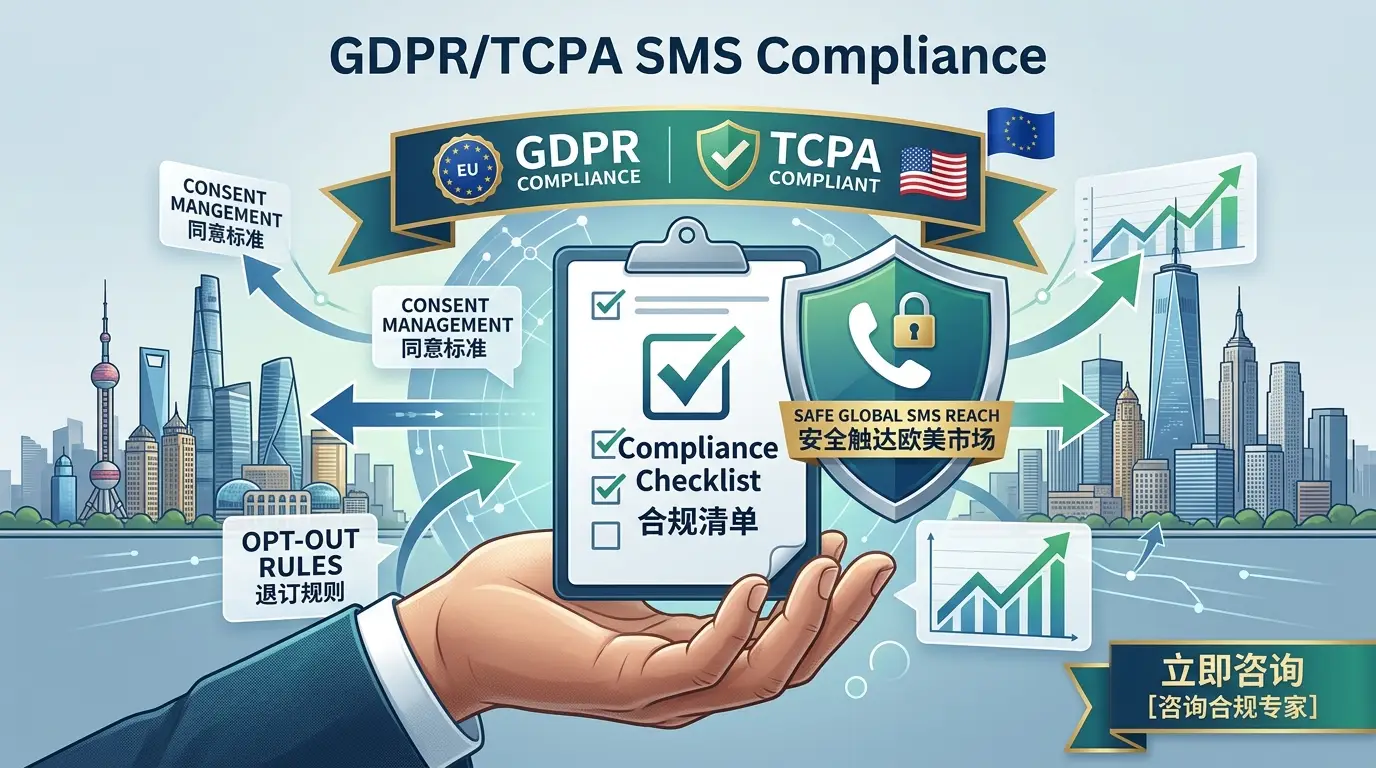
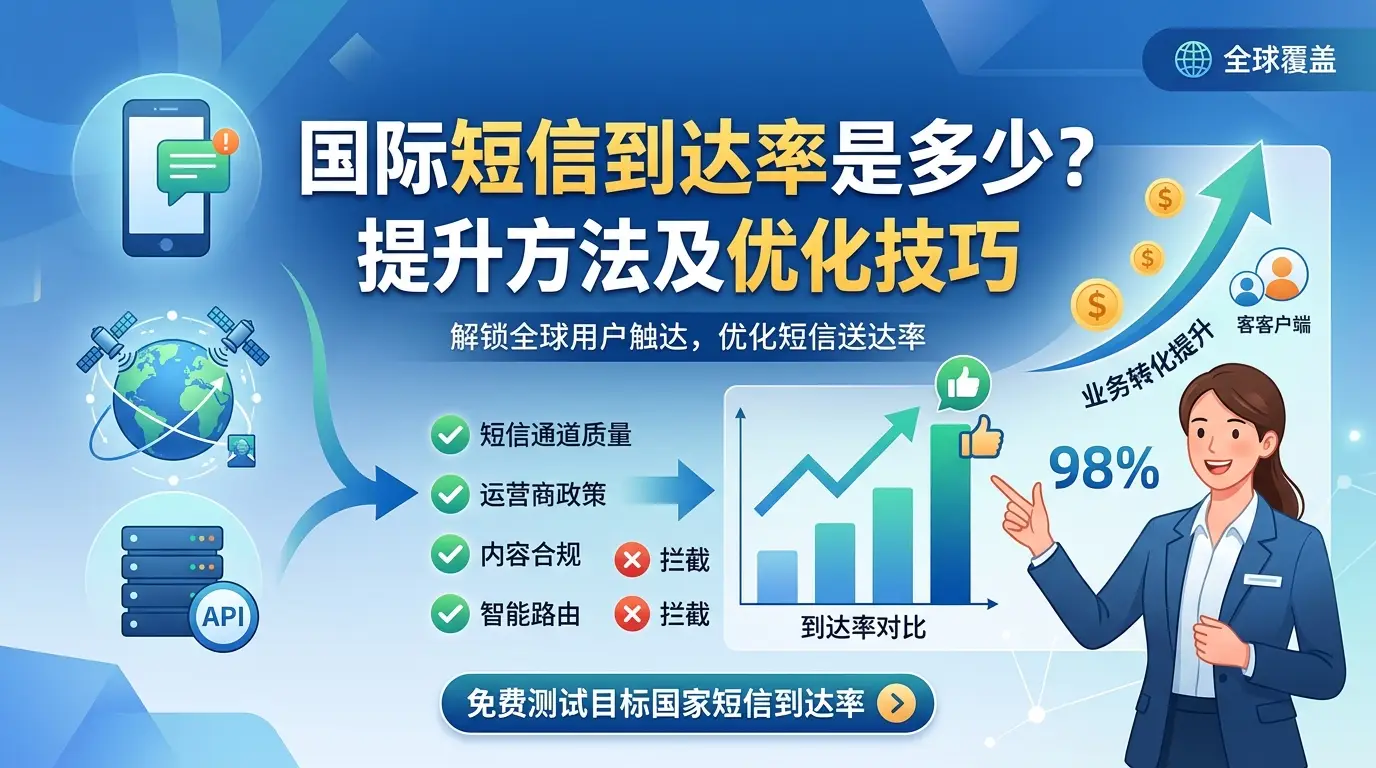
With an open rate of nearly 98%, SMS marketing remains one of the most efficient channels for overseas enterprises to reach global users. But high efficiency comes with high risk—SMS marketing targeting European and American markets is simultaneously governed by two regulatory frameworks: GDPR (EU General Data Protection Regulation) and TCPA (U.S. Telephone Consumer Protection Act).
In 2026, the cross-border SMS market continues to expand, but regulation is also upgrading across the board. U.S. TCPA violations carry fines of $500 to $1,500 per message, with no cap on class-action damages; EU GDPR violations can be fined up to €20 million or 4% of global annual revenue. A single violation can severely damage an overseas enterprise.
This is not a question of "whether to comply," but "how long you can survive without compliance."
This article will systematically outline the core requirements of GDPR and TCPA for SMS marketing, helping overseas enterprises build an actionable compliance framework.
II. GDPR: The "Explicit Consent" Threshold for the EU Market
GDPR applies to all enterprises that process personal data of EU residents, regardless of whether the enterprise itself is located within the EU. SMS marketing involves the processing of personal data such as phone numbers, so it must meet GDPR compliance requirements.
1. Consent Standard: Free, Specific, Informed, and Unambiguous
GDPR Article 7 requires that processing personal data for marketing must be based on the user's explicit consent. In the SMS context, this means:
- No pre-ticked boxes: Authorization must not be obtained through pre-ticked checkboxes, default consent, or hidden clauses. Users must actively tick an unchecked checkbox to express consent.
- Item-by-item authorization: SMS consent cannot be bundled with email marketing or terms of service. If collecting consent for both SMS and email marketing simultaneously, separate fields should be used so users can subscribe to one rather than all.
- No bundling: Consent must not be a condition for obtaining goods or services.
- Clear disclosure: When collecting consent, you must clearly state how user information will be used, what types of messages will be sent, the frequency, and how to unsubscribe.
💡 Countries such as Germany, Austria, and Switzerland consider Double Opt-in a best practice, meaning users must confirm a second time via email or SMS link after their initial submission.
2. Record Keeping: Consent Is Evidence, Not a Status
GDPR requires enterprises to maintain complete consent records, including: when, where, and how (through which form, popup, or channel) the user consented, and the specific content of the consent.
⚠️ A common misconception in practice is treating consent simply as a "subscription status" field that only records "yes/no," lacking audit information such as timestamps, source channels, and displayed copy. This data structure cannot prove compliance under GDPR.
3. Opt-out and Sending Time
- Opt-out convenience: Unsubscribing must be as easy as subscribing. SMS should support keywords like STOP, and opt-out requests must take effect immediately.
- Sending hours: Limited to daytime only; marketing SMS must not be sent during quiet hours.
- Sender identification: Each message must clearly indicate the brand or organization name.
4. Real Penalty Cases
GDPR penalty enforcement is not just on paper.
⚖️ France CNIL × SOLOCAL MARKETING SERVICES
Fined €900,000 for conducting commercial promotions without user consent.
⚖️ Italy Garante × Verisure Italia
Fined €400,000 for sending promotional SMS to former customers.
III. TCPA: The "Prior Written Consent" Requirement for the U.S. Market
TCPA is a U.S. federal law enforced by the FCC (Federal Communications Commission), which sets extremely strict rules for marketing SMS.
1. Consent Standard: Prior Express Written Consent
Under TCPA, enterprises must obtain prior express written consent from recipients before sending marketing SMS. This means:
- A clear written consent agreement is required—electronic signatures are equally valid—explicitly authorizing the enterprise to send marketing messages to a specific number.
- Consent must be voluntary and cannot be a condition for purchasing goods or services.
- Consent must be disclosed clearly and conspicuously.
🔔 2026 Important Update: The originally scheduled "One-to-One Consent Rule" has been vacated by the U.S. Eleventh Circuit Court of Appeals. Enterprises can still operate under the previous standard—collecting consent for multiple sellers through a single interaction—but the core requirement of prior express written consent has never changed.
2. New Opt-out Rules (Effective April 2025)
In April 2025, the FCC implemented new opt-out revocation rules, raising the bar for SMS marketing:
- No designated unique opt-out method: Enterprises can no longer require "STOP" as the only valid opt-out. Consumers can express opt-out intent through any reasonable means, and enterprises must respect it.
- Keyword list: Replying with "stop," "quit," "end," "revoke," "opt out," "cancel," "unsubscribe," and other standard replies are all considered valid opt-outs.
- Reasonableness standard: For non-standard opt-out requests, reasonableness is judged based on the "overall circumstances." In case of disputes, the sender may bear the burden of proof.
- Confirmation message limit: After receiving an opt-out, a one-time confirmation or clarification message may be sent, but it must be within 5 minutes and must not contain any marketing or promotional content.
3. Sending Hours and Rules
TCPA prohibits sending marketing SMS before 8:00 AM and after 9:00 PM in the recipient's local time. Additionally, at the carrier level, CTIA guidelines apply, including sender registration (such as mandatory A2P 10DLC registration), content standards, and mandatory STOP handling—non-compliance may result in traffic being filtered or blocked.
4. Real Penalty Cases
TCPA's penalty mechanism is extremely severe, and the private right of action makes class-action lawsuits very common:
⚖️ DSW
Settled a class-action lawsuit for $4.42 million for sending marketing SMS to users who had opted out.
⚖️ Albertson's
Settled for nearly $6 million after continuing to send SMS after users sent STOP requests.
⚖️ Kaiser Permanente
Agreed to pay $10.5 million to settle a TCPA SMS class-action lawsuit.
IV. Core Differences Between GDPR and TCPA
The following compares the core SMS marketing requirements of GDPR and TCPA across 7 dimensions:
| Dimension |
GDPR (EU) |
TCPA (U.S.) |
| Consent Standard |
Explicit consent; must actively tick an unchecked checkbox |
Prior express written consent |
| Pre-ticked Checkbox |
Strictly prohibited |
Not allowed (consent must be actively given) |
| Consent Bundling |
Prohibited from bundling with email/terms of service; item-by-item authorization required |
Requires separate, clear consent; cannot be a condition of purchase |
| Sending Hours |
Daytime only; avoid quiet hours |
8:00 AM to 9:00 PM (recipient's local time) |
| Opt-out Mechanism |
Must be as easy as subscribing |
From April 2025, must accept opt-out via "any reasonable means" |
| Maximum Fine |
€20 million or 4% of global annual revenue |
$1,500 per violating message, no cap |
| Enforcement |
Regulatory authority enforcement |
Regulatory enforcement + private lawsuits (class actions common) |
📌 Core Difference
GDPR focuses on the legality and transparency of data processing, requiring enterprises to prove "why they can process this number"; TCPA focuses on the communication itself without consent, requiring enterprises to prove "the user explicitly agreed to receive this message."
V. Practical Compliance Checklist for Overseas Enterprises
Based on the above regulatory requirements, overseas enterprises building an SMS marketing system should implement the following checklist item by item:
✅ Consent Collection Layer
- ☐ Use unchecked checkboxes; users must actively tick them
- ☐ Use independent consent fields for each marketing channel (SMS, email)
- ☐ Clearly disclose on the consent collection interface: sending frequency, message types, opt-out methods, privacy policy link
- ☐ Explicitly state that consent is not a prerequisite for purchasing goods or services
✅ Data Recording Layer
- ☐ Save for each consent record: timestamp, source (specific form/page), IP address, full displayed consent copy
- ☐ Treat consent as an independent data entity, not a simple user attribute field
- ☐ Ensure consent records are searchable, auditable, and support traceability years later
✅ Sending Control Layer
- ☐ Control sending windows by recipient's local time (8:00-21:00)
- ☐ Use different consent standards and sending strategies for marketing SMS vs. transactional SMS (order confirmations, shipping notifications, etc.)
- ☐ Build a globally unified opt-out blacklist to ensure opt-out requests take effect immediately
✅ Opt-out Processing Layer
- ☐ Support standard keywords like STOP, HELP and local language variants
- ☐ Respond to opt-out requests in any form (replying with any keyword, email, phone, etc.)
- ☐ Opt-out confirmation messages must not contain any marketing content
✅ Compliance Audit Layer
- ☐ Conduct at least one GDPR compliance audit annually, focusing on the completeness of consent records
- ☐ Regularly review TCPA compliance status and monitor FCC rule updates
- ☐ Require third-party data providers to supply complete original consent records
VI. Why Choose a Professional Cloud Communication Provider?
SMS compliance is not a one-time configuration but a system engineering effort requiring sustained investment. A professional cloud communication provider can offer critical support to overseas enterprises in the following areas:
- Compliance infrastructure: Built-in consent management (Opt-in/Opt-out) systems, blacklist synchronization, sending hour controls, and other compliance modules
- Multi-country regulation adaptation: Covers GDPR, TCPA, CASL (Canada), PECR (UK), and other multinational regulatory requirements
- 10DLC registration support: Assists with mandatory U.S. A2P 10DLC registration to ensure SMS delivery
- Continuous compliance updates: Tracks the latest rule changes from FCC, CNIL, and other regulatory bodies
- Audit evidence retention: Automatically records consent sources, timestamps, IP, and other complete audit information
📊 In 2026, only 42% of providers in the cross-border SMS market meet the standards for delivery rate and compliance. Choosing an internationally certified cloud communication provider is the first step for overseas enterprises to reduce compliance risk.
Conclusion
The essence of SMS marketing compliance is not "can we send it now," but "can we still produce evidence when sued three years later." Although GDPR and TCPA differ in regulatory details, their underlying logic is the same: consent must be genuine, traceable, and provable.
If an overseas enterprise cannot answer "when the user consented, how they consented, and what copy they saw at the time," then this system does not have the capability to survive in the European and American markets.
Act now. Don't wait until the day you receive a summons.
Consult Now
Want to learn more about SMS compliance solutions? Contact our compliance experts for a customized compliance assessment report.
Contact us