What Is the International SMS Delivery Rate? Factors, Methods, and Optimization Tips
What Is International SMS Delivery Rate? Why Should Enterprises Care?
As enterprises globalize, international SMS has become an important way to reach overseas users, widely used in:
SMS verification codes (OTP)
User registration verification
Login security alerts
Payment notifications
Order and logistics notifications
Marketing campaigns
For overseas enterprises, international SMS delivery rate directly affects user registration rates, payment success rates, and business conversion efficiency.
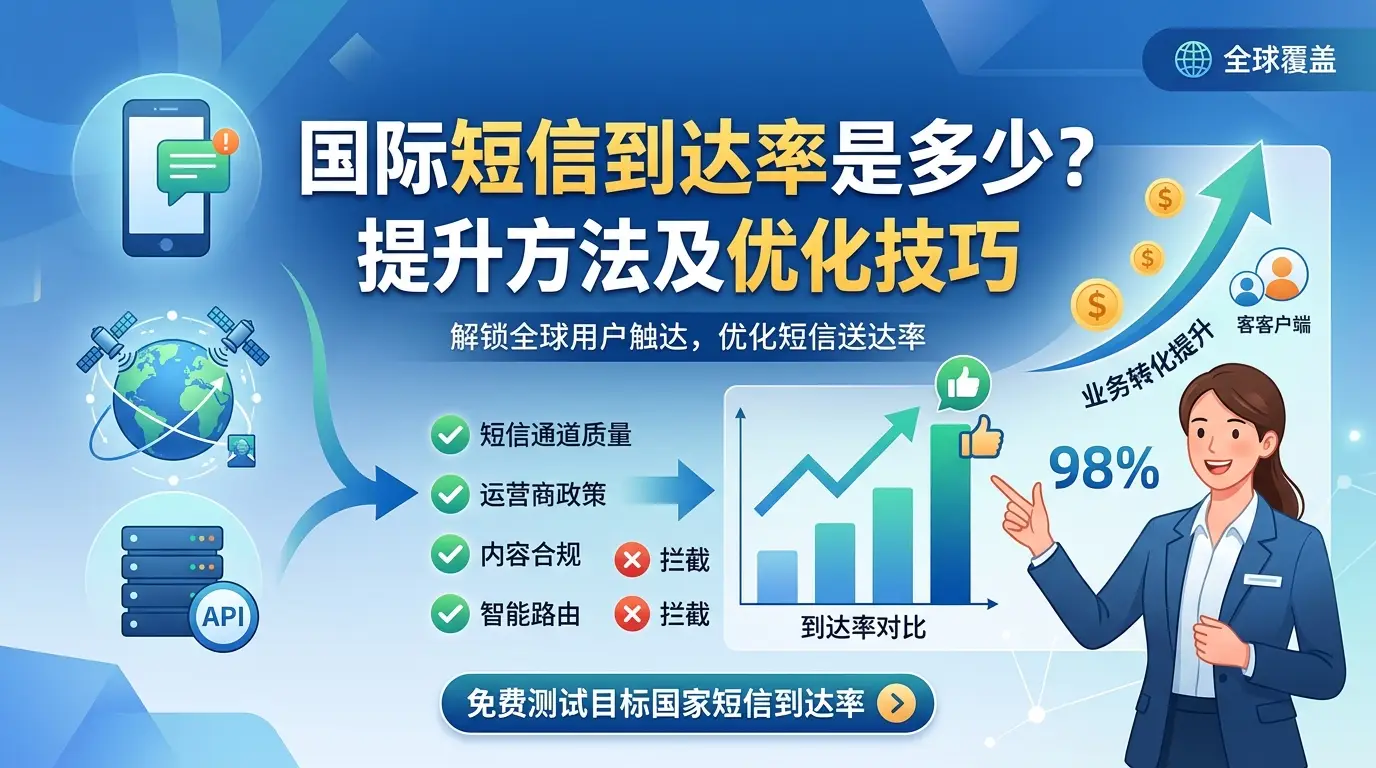
International SMS delivery rate refers to the proportion of SMS messages that successfully reach users' mobile phones after the enterprise submits the request.
For example:If an enterprise sends 1 million international SMS messages and 980,000 are successfully delivered, the delivery rate is 98%.
But note:A successful SMS API response does not necessarily mean the user received the SMS.
International SMS passes through multiple stages:
Enterprise System → SMS Platform → International SMS Channel → Target Carrier → User Phone
Any issue in any stage can cause SMS delays or failures.
I. 5 Key Factors Affecting International SMS Delivery Rate
1. International SMS Channel Quality
The SMS channel is the core factor affecting delivery rate. The market mainly includes:
- Carrier direct connection channels
- International SMS aggregated channels
- Multi-level transit channels
Carrier direct connection channels typically offer:
- Shorter transmission links
- More stable network quality
- More accurate status receipts
- Lower blocking probability
Some enterprises choose low-price SMS channels, but may encounter:
- Mass SMS failures
- Long delivery times
- Carrier blocking
- Users not receiving verification codes
Therefore, choosing a stable international SMS platform is the first step to improving delivery rate.
2. National Carrier Policy Impact
Different countries have different SMS management rules. For example:
- US implements A2P 10DLC registration management;
- India requires Sender ID and SMS template registration;
- Some European countries strengthen marketing SMS regulation.
If enterprises do not comply with local SMS rules, the following may occur:
- SMS filtered
- Sending delays
- Delivery rate decrease
Excellent international SMS providers need global carrier resources and compliance capabilities.
3. Sender ID Affects SMS Credibility
Sender ID is the sender name users see when receiving SMS. For example:
Normal:
BrandName: Your verification code is 123456
Abnormal:
INFO-83921: Verification code 123456
If Sender ID is not registered, it may trigger carrier risk control.
When sending international SMS, enterprises need to focus on:
✓ Sender ID registration
✓ Brand certification
✓ Country rule matching
To improve SMS credibility and delivery capability.
4. SMS Content Affects Carrier Filtering
Carriers typically use SMS firewalls to identify risky content. The following factors may lower international SMS delivery rate:
- Mass duplicate content
- High-risk marketing keywords
- Suspicious links
- Frequent sending
- Templates not matching business scenarios
For example:
Verification code SMS:
[Brand] Your verification code is 123456, valid for 5 minutes.
Compared to:
Get free prizes, click the link.
Is more likely to pass review. Enterprises should optimize SMS templates according to different country rules.
5. Phone Number Quality
Some SMS failures are not channel issues but number anomalies. Common causes:
- Phone number does not exist
- Country code error
- User account suspended
- Virtual numbers cannot receive SMS
Enterprises can use:
✓ HLR number lookup
✓ User number verification
✓ Blacklist filtering
To reduce invalid sends and improve SMS resource utilization.
II. How to Improve International SMS Delivery Rate?
Method 1: Choose a Quality International SMS Provider
When choosing an international SMS platform, focus on:
① Global Carrier Coverage
Whether it covers target markets:
🌍 Southeast Asia
🌍 Europe
🌍 North America
🌍 Middle East
🌍 Latin America
② Intelligent Routing Capability
Excellent platforms can route based on:
- Country
- Carrier
- Historical success rate
- Network quality
Automatically selecting the best SMS route.
③ Real-time Status Monitoring
Supports:
- Sending status query
- Delivery Report (DLR)
- Failure reason analysis
Helping enterprises quickly identify issues.
Method 2: Build an Intelligent SMS Routing System
International SMS sending is not a simple fixed route but requires dynamic scheduling. Intelligent routing systems can:
- Automatically identify country carriers
- Assign the best channel
- Automatically switch to backup routes on failure
For example:
If route A success rate drops in a country, the system automatically switches to route B, reducing SMS failures.
Method 3: Optimize SMS Templates
Enterprises should:
- Keep content concise
- Use clear brand names
- Avoid sensitive keywords
- Reduce URL usage
- Control sending frequency
To improve carrier approval rates.
III. SMS Delivery Rate Improvement: What Should Enterprises Focus On?
Many enterprises focus only on price when choosing an international SMS provider.
But what actually affects business results is:
Price × Delivery Rate × Stability
Low-price SMS routes with mass failures lead to:
❌ User churn
❌ Registration decline
❌ Increased customer service costs
❌ Brand experience degradation
Professional international SMS platforms typically feature:
- ✔ Global carrier direct connection resources
- ✔ Intelligent SMS routing
- ✔ Multi-channel automatic switching
- ✔ Global SMS compliance capabilities
- ✔ Fast API integration capability
- ✔ Real-time sending data analytics
Helping enterprises build a stable global user reach system.
IV. International SMS Delivery Rate FAQ
Q1: Why does international SMS show as sent but users don't receive it?
Main reasons include: channel quality issues, carrier blocking, phone number anomalies, SMS content violations, and national policy restrictions. Analysis using SMS status codes and carrier receipts is needed.
Q2: What delivery rate is considered stable?
It varies by country. Verification code SMS typically focuses on: success rate, delivery speed, and stability. Enterprises should evaluate based on target market carrier performance, not just global averages.
Q3: How to choose an international SMS platform?
Key criteria: whether it has quality international SMS channels; whether it supports API/SMPP interfaces; whether it provides intelligent routing; whether it has local compliance experience; whether it supports real-time data monitoring.
V. Conclusion: Stable International SMS Capability Is Enterprise Overseas Infrastructure
International SMS delivery rate is not just a technical metric but the result of communication resources, carrier relationships, platform capabilities, and compliance systems. For overseas enterprises:
- Verification codes need fast delivery;
- Transaction notifications need stable reliability;
- Marketing SMS needs scale reach.
Choosing a professional international SMS provider and building stable, efficient, and compliant global SMS communication capabilities can truly support long-term overseas growth.
Get global international SMS channel test credits and improve overseas SMS delivery rate
You can also:
- → Test target country SMS delivery rate for free
- → Get international SMS API integration plan
- → View global SMS coverage capabilities
Contact Now → Get International SMS Delivery Rate Test Plan