What Is an API SMS Interface? Core Features, Working Principles and Use Cases | YaningAI
In scenarios such as user registration, login verification, order notifications, logistics alerts, identity authentication and overseas business outreach, enterprises often need to send real-time messages to users via SMS.
Relying on staff to manually log in to an SMS platform and send messages is not only inefficient, but also unable to meet the automation, real-time and large-scale delivery requirements of internet businesses.
This is the main reason why enterprises use an API SMS interface.
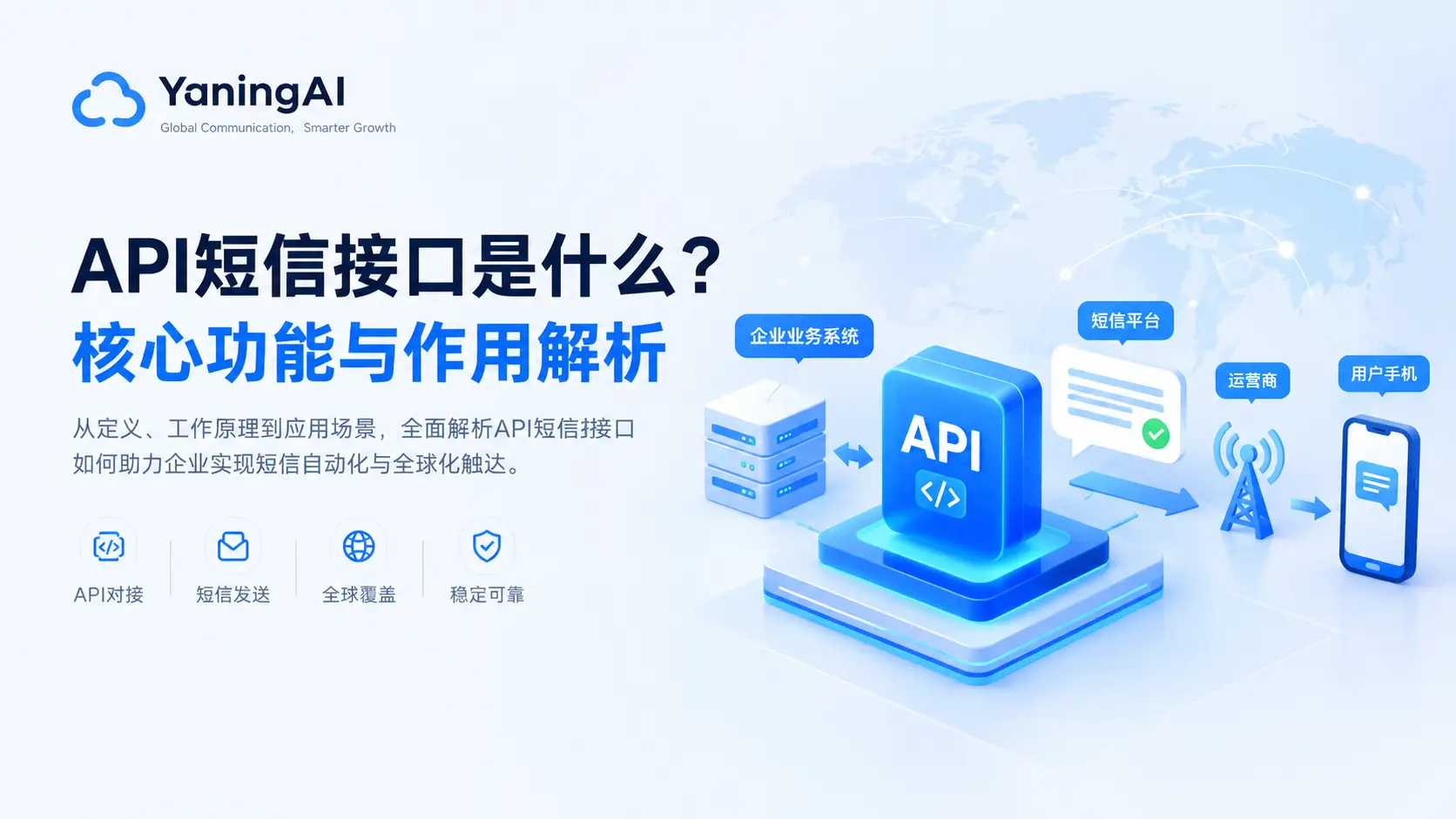
An API SMS interface is a standardized technical interface through which enterprise business systems invoke SMS communication capabilities. After developers complete the integration, the business system can submit sending requests to the SMS platform via HTTP/HTTPS, and the platform takes care of number validation, template processing, channel routing, message delivery and status receipts.
Put simply:
The API SMS interface connects enterprise business systems with the SMS platform, turning SMS sending from manual operation into automatic system invocation.
I. What Is an API SMS Interface?
API stands for Application Programming Interface.
In the SMS industry, the SMS API interface is usually provided by cloud communication service providers. Once developers complete integration according to the API documentation, they can invoke the SMS service directly from their own business systems.
For example, when a user clicks "Get Verification Code" on a website or app, the backend system can automatically generate a code and call the SMS API:
User enters mobile number
       ↓
Business system generates code
       ↓
Call API SMS interface
       ↓
SMS platform processes request
       ↓
Number/template/content validation
       ↓
SMS routing
       ↓
Carrier network
       ↓
User mobile phone
       ↓
SMS status receipt returned
No manual login or backend operation is required throughout the process.
Therefore, from a technical architecture perspective, the API SMS interface is essentially the connection layer between enterprise software systems and SMS communication capabilities.
II. SMS API vs. Manual SMS Sending: What Is the Difference?
Manual SMS sending usually requires a person to log in to the SMS backend, enter phone numbers and message content, and then execute the send.
This approach suits small-volume, temporary messaging tasks.
The SMS API, on the other hand, integrates communication capabilities directly into the enterprise own business systems.
For example:
- Automatically send a welcome SMS after user registration;
- Automatically send an OTP code at login;
- Automatically send a transaction notice after payment;
- Automatically push logistics alerts when delivery status changes;
- Reach target users in bulk according to campaign rules when marketing starts.
The core differences between the two approaches can be summarized as follows:
| Comparison |
Manual SMS Sending |
API SMS Interface |
| Sending method |
Manual operation |
Automatic system calls |
| Automation |
Low |
High |
| Real-time performance |
Low |
High |
| Bulk processing |
Limited |
Systematic processing supported |
| System integration |
Weak |
Strong |
| Suitable scenarios |
Ad-hoc sending |
Enterprise production systems |
Therefore, for registration, verification codes, orders, logistics and marketing, the SMS API interface is generally more suitable for long-term use.
III. What Are the Core Features of an API SMS Interface?
When choosing an SMS API service, enterprises should not only look at whether it can send messages, but also at the complete communication capabilities behind the interface.
1. SMS Sending
SMS sending is the most basic function of the API.
After the enterprise submits the phone number, SMS template and variable parameters to the API, the platform completes the delivery.
Common SMS types include:
- Verification code SMS
- Notification SMS
- Identity verification SMS
- Order SMS
- Logistics SMS
- Marketing SMS
- International SMS
For overseas business, number formats, Sender ID, SMS templates and content rules must also be handled according to the carrier rules of different countries and regions.
2. SMS Template Management
Enterprises usually do not rewrite the full message in every API request; instead they use a template plus parameters.
For example:
Your code is {code}. It expires in 5 minutes. Do not share it.
The enterprise system only needs to pass:
code = 583921
And the final message is:
Your code is 583921. It expires in 5 minutes. Do not share it.
This reduces development complexity and makes it easier for enterprises to manage message content consistently.
For international SMS, template management also involves content compliance and the communication rules of different countries, making it a key foundational capability of an SMS platform.
3. SMS Status Receipts
A successful API call does not mean the SMS has already reached the user phone.
This is an easily overlooked issue when enterprises integrate an SMS API.
SMS delivery usually goes through the following stages:
API submission successful
      ↓
Platform processing
      ↓
Carrier accepted
      ↓
Carrier delivery
      ↓
Final delivery
Therefore, enterprises need to obtain the final message status through a DLR, or Delivery Report.
Common statuses include:
Sent successfully, processing, delivered, failed.
With status receipts, enterprises can analyze delivery performance and handle failed messages accordingly.
4. Bulk SMS Sending
For marketing campaigns, member notifications and large-scale user outreach, enterprises often need to process a huge number of SMS requests at once.
An enterprise-grade SMS interface needs strong concurrency handling, combined with message queues, task scheduling and traffic control to complete bulk sending.
Support for bulk sending does not mean unlimited concurrency.
Actual sending capacity is still affected by the platform architecture, channel capacity, carrier policies and the rules of destination countries and regions.
5. Intelligent Routing
For domestic SMS, route differences are relatively limited; but for an international SMS API, routing capability becomes significantly more important.
Different countries and regions may have different carriers, communication resources and SMS policies, so the platform must match routes based on destination country, carrier and business type.
API request
   ↓
Identify number country
   ↓
Determine carrier
   ↓
Match communication channel
   ↓
Select route
   ↓
Submit to carrier
A sound routing strategy helps improve sending stability and reduces the business impact of abnormal routes.
6. Failure Retry
Network exceptions, channel congestion and temporary carrier failures may occur during SMS sending.
Therefore, enterprise-grade SMS platforms usually design retry mechanisms based on error types. For example:
Primary channel send
    ↓
Temporary failure
    ↓
Determine failure cause
    ↓
Retry conditions met
    ↓
Switch to backup channel
    ↓
Send again
However, retry does not mean resending indefinitely after every failure.
Retry rules for verification codes, notifications and marketing SMS are usually different and must be configured per business scenario, otherwise duplicate messages and extra costs may result.
IV. What Are the Use Cases of an API SMS Interface?
In actual enterprise usage, the API SMS interface has become a foundational communication capability in many digital businesses.
1. Verification Code SMS
Verification codes are the most typical use case for an SMS API.
Including:
Registration codes, login codes, password recovery, phone number binding, payment verification and identity authentication.
For example:
User clicks get code
        ↓
Business system generates OTP
        ↓
Call SMS API
        ↓
SMS platform sends
        ↓
User receives code
Verification code SMS usually demands high response speed, stability and delivery capability.
2. Order and Transaction Notifications
E-commerce, payment, SaaS and fintech companies can bind SMS to business events through the API.
For example:
Order created, payment succeeded, refund completed, order cancelled, and so on.
This way SMS sending requires no manual operation; the system triggers it automatically according to business status.
3. Logistics Notifications
Cross-border e-commerce and international logistics platforms can integrate the SMS API with order, warehousing and logistics systems.
For example:
Order shipped
   ↓
Logistics status updated
   ↓
Trigger API
   ↓
SMS platform sends
   ↓
User receives delivery alert
For cross-border business, this automated notification approach improves user outreach efficiency.
4. International SMS
For enterprises with overseas users, the international SMS API is an important communication capability for reaching mobile users worldwide.
Common scenarios include:
Overseas user registration, OTP authentication, payment reminders, order notifications, logistics alerts and marketing outreach.
International SMS is more complex than domestic SMS because enterprises must pay attention to all of the following:
- Countries and regions
- Carrier resources
- Sender ID
- SMS templates
- Content compliance
- Channel routing
- Status receipts
- Local communication policies
Therefore, when choosing an international SMS provider, enterprises should not compare only the price per message.
V. Why Do Enterprises Need an SMS API?
For enterprises, the value of an SMS API is not merely "sending messages automatically".
More importantly, it makes SMS capability a direct part of the business system.
Automation
The system automatically triggers SMS when business events occur.
Real-time Performance
Verification codes and transaction notices can be sent quickly after the business event.
System Integration
The SMS service can be integrated with CRM, ERP, SaaS, e-commerce, payment and logistics systems.
Bulk Processing
Supports large-scale user outreach.
Data Loop
Sending records and status receipts enable delivery performance statistics.
Therefore, from an enterprise architecture perspective, the SMS API is in fact a foundational communication capability.
VI. How Does an API SMS Interface Work?
A complete API SMS delivery chain usually consists of several core stages:
Enterprise business system
       ↓
API Gateway
       ↓
SMS service
       ↓
Parameter validation
       ↓
Number validation
       ↓
Template/content processing
       ↓
Risk control and compliance checks
       ↓
Intelligent routing
       ↓
SMS channel
       ↓
Carrier
       ↓
End user
       ↓
DLR status receipt
       ↓
Enterprise business system
In high-concurrency scenarios, SMS platforms usually also rely on:
Redis, message queues, databases, logging systems, monitoring systems and traffic control.
These infrastructure components together ensure processing efficiency and system stability for SMS requests.
VII. What Matters When Choosing an SMS API?
This is the key transition from "understanding SMS APIs" to "choosing an SMS service provider".
1. API Stability
Pay attention to:
- API response time
- Concurrency handling capacity
- Timeout mechanisms
- Service availability
- Exception handling capability
2. Actual SMS Delivery Performance
Do not only look at the API submission success rate.
What really matters is:
Whether messages can reliably reach end users.
For international SMS in particular, there can be significant differences between countries and carriers.
3. DLR Status Receipts
A mature SMS platform should provide relatively complete status receipts so enterprises know the final processing result of each message.
4. International SMS Channels
If the enterprise needs to send overseas SMS, it should focus on communication resource coverage and route quality in the target countries and regions.
5. Intelligent Routing
A strong SMS platform does not use exactly the same route for every country and carrier; it routes dynamically according to actual conditions.
6. Compliance Capability
International SMS involves the communication policies of different countries and regions.
Enterprises should focus on Sender ID, SMS templates, marketing SMS, opt-out mechanisms and content review.
7. Technical Support
After the API goes live, what enterprises worry about most is usually not "how to integrate", but:
Whether problems can be located quickly when sending exceptions occur.
Therefore, technical support, logging capability, status receipts and troubleshooting ability are equally important.
VIII. What Is the Difference Between HTTP API and SMPP?
When connecting to an SMS platform, enterprises often encounter two methods: HTTP API and SMPP.
HTTP API
An HTTP API completes SMS submission through HTTP/HTTPS requests.
Its advantages are:
Low development threshold, fast integration and suitability for internet businesses.
Typical applications include:
E-commerce platforms, SaaS platforms, apps, websites and internal enterprise business systems.
SMPP
SMPP is a professional SMS communication protocol mainly used for data exchange between SMS centers and communication platforms.
SMPP typically uses persistent TCP connections and is more suitable for high-throughput, continuous communication scenarios.
Therefore:
| Comparison |
HTTP API |
SMPP |
| Integration difficulty |
Lower |
Higher |
| Development cost |
Lower |
Higher |
| Communication method |
HTTP/HTTPS |
Persistent TCP connection |
| Suitable scenarios |
Enterprise systems, internet apps |
Large-scale SMS business |
| Technical requirements |
Lower |
Higher |
| Flexibility |
High |
High |
| Throughput |
Depends on platform |
Stronger |
For most ordinary enterprises, an HTTP API is usually sufficient; communication platforms and large-scale SMS businesses may consider SMPP based on their system architecture.
IX. What Is the Difference Between an API SMS Interface and an SMS Channel?
This is a very important concept when choosing an SMS service provider.
The API SMS interface solves "how to submit the SMS request".
While:
The SMS channel solves "how the SMS finally reaches the user phone".
The two are not the same thing.
The complete chain can be understood as:
Enterprise business system
      ↓
API SMS interface
      ↓
SMS platform
      ↓
Intelligent routing
      ↓
SMS channel
      ↓
Carrier
      ↓
User mobile phone
So no matter how complete a provider API is, if the underlying communication channels are unstable, the end-user SMS experience may still suffer.
For international SMS in particular, enterprises should evaluate comprehensively across API stability + channel quality + routing capability + DLR receipts + compliance capability.
X. How Does an API SMS Interface Help Enterprises Automate Business?
After combining the SMS API with business systems, enterprises can build event-driven communication mechanisms.
For example:
User registration
   ↓
Generate code
   ↓
Call SMS API
   ↓
Send OTP
Or:
Order payment succeeds
      ↓
Business system generates event
      ↓
Call SMS API
      ↓
Send order notification
And for example:
Logistics status changes
      ↓
System identifies target user
      ↓
Call international SMS API
      ↓
Send logistics alert
This shows that SMS is no longer an independent "sending tool", but a foundational communication module within business processes.
XI. Future Trends of API SMS Interfaces
As enterprises digitize and globalize, the SMS API is evolving from a simple message-sending interface into more complete cloud communication infrastructure.
Future enterprise SMS platforms will need to provide not only:
But also increasingly complete:
Intelligent routing, real-time monitoring, risk control, compliance, data analytics and multi-channel communication capabilities.
For companies going global, SMS will no longer be limited to verification codes; it will further cover identity authentication, order notifications, logistics alerts and customer outreach.
Throughout this evolution, the API SMS interface remains an important entry point connecting enterprise business systems with cloud communication platforms.
XII. What Should Enterprises Focus on When Choosing an API SMS Service?
It can be summarized in one sentence:
Do not just look at "whether the API can send"; look at "whether the entire communication chain is stable".
Enterprises are advised to focus on:
2. Actual SMS delivery performance
4. International SMS channel coverage
5. Intelligent routing capability
6. Sender ID and content compliance
7. Technical support and troubleshooting capability
If the enterprise mainly targets overseas markets, it should conduct real tests by target country and region, rather than judging only from the unified parameters provided by the service provider.
XIII. Conclusion
The API SMS interface is an important technical entry point connecting enterprise business systems with SMS communication capabilities.
Through the SMS API interface, enterprises can integrate verification codes, identity authentication, order notifications, logistics alerts and marketing outreach directly into their business systems, achieving automated SMS sending, streamlined processes and traceable data.
For international business, the API is only one part of the entire communication chain.
What enterprises really need to pay attention to runs from:
API interface → SMS platform → Intelligent routing → SMS channel → Carrier → User
the stability and manageability of this complete chain.
Therefore, when choosing an international SMS API, besides development convenience, enterprises should comprehensively assess channel quality, routing capability, status receipts, compliance capability and technical support.
Only when API access capability and underlying communication resources form a complete loop can SMS truly become a stable and reliable business communication infrastructure for enterprises.
Need to integrate SMS capability into your business system?
YaningAI provides enterprise-grade international SMS communication capabilities, supporting API integration into existing enterprise business systems. It can be applied to scenarios such as verification codes, identity authentication, order notifications, logistics alerts, and overseas user outreach.
Enterprises can choose the appropriate SMS service and integration method based on business scale, target countries, and actual communication needs, and quickly complete system integration through the API.
International SMS API
Providing stable SMS communication capabilities for enterprises going global.
API Integration Documentation
View API parameters, request methods, and development integration instructions.
Contact Technical Advisor
Get targeted integration recommendations based on target countries, business scenarios, and sending volume.
Contact us