 By Samuyl Joshi
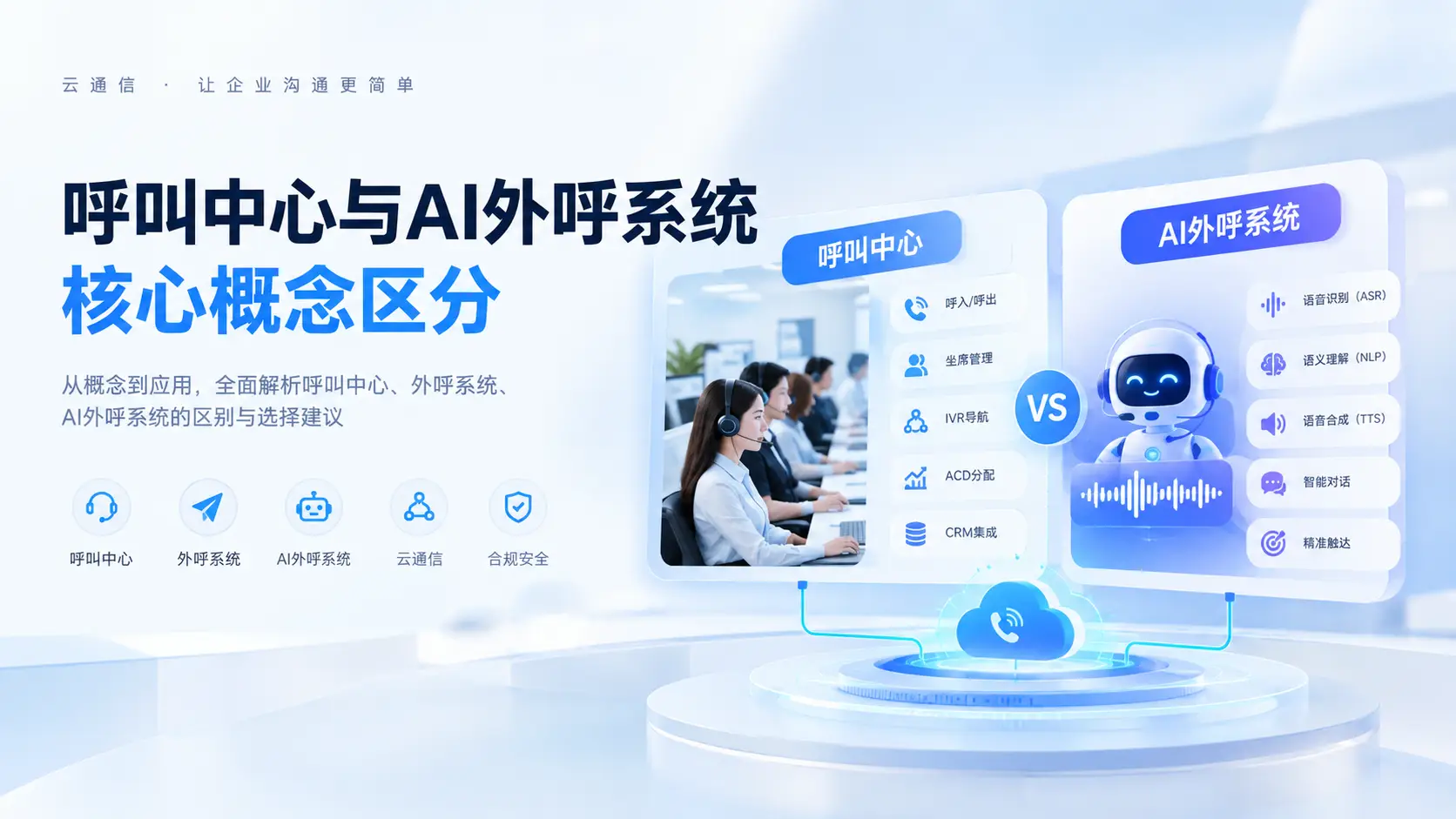
In enterprise sales, customer service, user operations, and overseas business expansion, concepts such as call center, outbound calling system, AI outbound calling system, intelligent outbound system, and predictive dialing are often used interchangeably.
However, from the perspective of technical architecture and business functionality, they do not represent the same type of product.
In simple terms:
Call center addresses overall enterprise telephone communication and agent operations;
Outbound calling system mainly addresses the issue of enterprises proactively making phone calls;
AI outbound calling system adds speech recognition, semantic understanding, speech synthesis, and intelligent dialogue capabilities on top of automatic outbound calling.
Therefore, before choosing between a call center system or an AI outbound calling system, enterprises must first clarify exactly what problem they need to solve.
This article will systematically analyze call centers and AI outbound calling systems from the perspectives of concepts, functions, technical architecture, and application scenarios.
Call Center is a comprehensive business operations system built by enterprises around telephone communication.
Traditional call centers mainly rely on human agents to handle customer inquiries, sales, after-sales service, callbacks, and complaints. With the development of cloud communication and software technology, modern call center systems have gradually shifted from traditional hardware devices to cloud-based, software-based, and intelligent solutions.
A complete call center typically includes the following capabilities:
Handles inbound and outbound enterprise calls, including SIP, voice lines, number resources, soft phones, and other basic communication capabilities.
IVR (Interactive Voice Response) uses voice menus and keypad operations to guide customers into different service flows.
For example:
Press 1 for product inquiry, press 2 for after-sales service, press 0 for manual service.
ACD (Automatic Call Distribution) assigns incoming customer calls to appropriate agents based on agent status, skill groups, priority, and other rules.
Includes agent login, calling, transfer, hold, monitoring, recording, status management, and other features.
Associates call records with customer data, orders, work orders, sales leads, and other business data.
Therefore, a call center is not just a phone dialing software, but a comprehensive platform jointly composed of communication, agents, business systems, and operations management.
Outbound Calling System mainly addresses the issue of enterprises proactively initiating telephone contact with customers.
Compared with call centers that focus on incoming customer calls, outbound calling systems place greater emphasis on "proactive reach".
Common application scenarios include:
A typical business workflow can be understood as:
Customer list
   ↓
Outbound task
   ↓
Automatic dialing
   ↓
Customer answers
   ↓
Agent communication
   ↓
Record call result
   ↓
CRM write-back
The focus of traditional automatic outbound systems is to help enterprises improve phone dialing efficiency.
Therefore, the core difference between it and an AI outbound calling system is not "whether it can dial automatically", but who handles the communication after the call is connected.
AI Outbound Calling System is a category of intelligent communication system that adds artificial intelligence capabilities on top of traditional outbound calling systems.
Its core technologies typically include:
ASR speech recognition + NLP semantic understanding + TTS speech synthesis + dialogue management + business rules
Some systems also integrate large language models to enable more flexible natural language interaction.
Traditional automatic outbound calling solves:
How to quickly make phone calls go out?
AI outbound calling further solves:
After the call is connected, how can the system automatically complete the communication?
For example:
After the customer connects and says:
I do not have a purchase need at this time.
The AI outbound calling system can capture the customer voice through speech recognition, then determine customer intent through semantic analysis, and decide the next action based on the preset business flow.
It may enter:
Customer answers
   ↓
Identity confirmation
   ↓
Need identification
   ↓
Customer has interest?
 ┌───┴────┐
Yes       No
↓         ↓
Transfer   End/Record
   to agent
Therefore, the core value of an AI outbound calling system is not simply "automatically making phone calls", but enabling the machine to have a certain degree of automatic voice interaction capability.
This is the most common question that arises during enterprise selection.
The three can be understood in terms of business scope:
| System | Core Function | Primary Usage |
|---|---|---|
| Call center | Unified management of telephone business and agents | Inbound + Outbound |
| Outbound calling system | Improves proactive dialing efficiency | Outbound-focused |
| AI outbound calling system | Automatic dialing + intelligent voice interaction | AI automatic outbound |
| Predictive dialing | Improves agent dialing efficiency | Automatic scheduling + agents |
| Intelligent customer service | Automatically handles customer inquiries | Customer-initiated inquiry-focused |
From a system relationship perspective, it can be simply understood as:
              Call Center System
                    │
        ┌───────────┴───────────┐
        │                       │
   Inbound Business          Outbound Business
        │                       │
  IVR / ACD / Agents      Outbound System
                                │
                    ┌───────────┴───────────┐
                    │                       │
              Manual Outbound           AI Outbound
                                            │
                                 ASR / TTS / NLP
                                            │
                                      AI Dialogue
The AI outbound calling system is not a replacement for the call center; the two can also together form an enterprise intelligent calling system.
Traditional outbound system:
Automatic system dialing + human takeover
AI outbound:
Automatic system dialing + AI completes dialogue
Therefore, traditional outbound mainly addresses agent dialing efficiency, while AI outbound further reduces repetitive human communication.
Traditional outbound is usually based on standard scripts, with human agents continuing the conversation based on customer feedback.
AI outbound uses technologies such as ASR and NLP to recognize and analyze customer natural language.
Therefore:
Traditional outbound emphasizes "calling efficiency";
AI outbound emphasizes "automated interaction".
Traditional outbound relies more on agents manually filling in customer results.
AI outbound calling systems can automatically generate structured data such as customer tags, intent levels, and call outcomes based on dialogue results, then sync to the CRM system.
For example:
Customer call
   ↓
Speech recognition
   ↓
Intent analysis
   ↓
Customer tag
   ↓
CRM
   ↓
Sales follow-up
This is also an important application direction for AI outbound in large-scale customer operations scenarios.
When learning about AI outbound calling systems, many enterprises also encounter "Predictive Dialer".
Predictive dialing is not the same as AI outbound.
It mainly uses algorithmic analysis of:
Then it dials the next round of phone calls in advance, thereby reducing agent waiting time.
Its core goal is:
Improve the effective working time of human agents.
The core goal of AI outbound is:
Enable the system to have a certain degree of automatic communication capability.
So:
Predictive dialing focuses on "agent efficiency"; AI outbound focuses on "machine interaction".
The two can also be used in combination.
These three concepts are also very easily confused in enterprise communication projects.
Voice and keypad interaction based on fixed menus.
For example:
Press 1 for Chinese service, press 2 for English service.
The core is:
Fixed flow + keypad operation.
Can understand customer natural language and provide corresponding services based on customer intent.
The core is:
Understanding customer expression.
Initiated proactively by the enterprise and uses AI to complete automatic voice interaction.
The core is:
Proactive reach + intelligent communication.
Therefore it can be summarized as:
IVR
Fixed voice menu
       ↓
Intelligent customer service
Understanding customer expression
       ↓
AI outbound
Proactively initiating calls + intelligent interactionFrom a technical perspective, an AI outbound calling system typically consists of a communication layer, an AI capability layer, and a business system layer.
A typical architecture is as follows:
CRM / Business System
       ↓
Outbound Task Center
       ↓
Call Scheduling System
       ↓
SIP / VoIP Communication Network
       ↓
Customer Phone
       ↓
ASR Speech Recognition
       ↓
NLP / AI Model
       ↓
Intent Recognition / Dialogue Management
       ↓
TTS Speech Synthesis
       ↓
Customer
The three layers each bear different responsibilities.
Handles telephone connections, including:
SIP, VoIP, lines, numbers, call control, concurrency management, etc.
Handles:
Speech recognition, semantic understanding, intent recognition, speech synthesis, dialogue control, etc.
Handles:
Customer data, task management, CRM, tags, work orders, and data analysis, etc.
Therefore, a production-ready AI outbound calling system cannot be completed simply by connecting a large language model.
AI outbound is more suitable for businesses with high standardization, strong repeatability, and a need for large-scale phone reach.
Automatically conduct satisfaction surveys and service callbacks for customers who have completed purchases or services.
Use AI to complete the first round of customer reach, then hand over customers with clear needs to human sales for follow-up.
Proactively reach out to long-inactive users via phone.
Used for information confirmation in scenarios such as meetings, events, and service appointments.
For phone notification tasks with fixed processes and clear content, automation can reduce repetitive manual operations.
For complex sales, high-value customer communication, and complaint handling scenarios, human agents are still typically required.
Therefore, the more common pattern in actual enterprise deployment is:
AI handles standardized tasks; humans handle complex tasks.
When purchasing an AI outbound calling system, enterprises should not focus only on the AI model itself.
What truly affects production environment performance is the synergy of the entire communication system and business system.
When a large number of tasks execute simultaneously, whether the system can stably handle multiple phone lines.
Includes call clarity, latency, packet loss, echo, etc.
Factors such as spoken expression, industry terminology, and environmental noise need to be considered.
Focus on voice naturalness, speech rate, pauses, and response speed.
AI outbound is a real-time voice interaction scenario; slow system response directly affects the call experience.
Whether AI call results can be synced to the customer system to form a complete business loop.
Security management of numbers, call records, recordings, customer information, and other data.
For business involving marketing calls, user authorization, privacy protection, and recording management, it needs to meet relevant laws and regulations and carrier requirements according to the target market and specific business scenarios.
The two are not a simple either-or choice.
If the main needs are:
Human customer service, after-sales inquiry, customer service, inbound call handling
then the focus is typically on building
Call center system.
If the main needs are:
Bulk customer dialing, sales callbacks, user reach
then the focus can be on
Outbound calling system.
If the enterprise needs:
Large-scale proactive reach + automatic voice interaction + AI customer screening
then it can further build
AI outbound calling system.
For enterprises with larger business scale, they can also combine:
Call center + outbound system + AI outbound + CRM
AI outbound does not exist in isolation.
In actual enterprise projects, AI outbound calling systems typically need to rely on underlying cloud communication infrastructure to implement phone connections, line management, number management, and call scheduling.
It can be understood as:
AI Application Layer
↓
AI Outbound / Intelligent Customer Service / Intelligent Agent
↓
Business System Layer
CRM / Work Orders / User Platform
↓
Cloud Communication Platform
Voice / SIP / API / Call Scheduling
↓
Carriers and Communication Networks
↓
End Users
Therefore, AI capability determines the "intelligence level" of the system, while cloud communication capability determines whether the system can stably complete phone connections and business carrying.
For enterprises that need to conduct international voice communication, overseas customer reach, and cross-regional telephone business, in addition to AI capabilities, they also need to focus on lines, numbers, communication quality, and local compliance requirements of the target country or region.
From the perspective of enterprise communication systems:
Call center is a complete telephone business operations platform.
Outbound calling system mainly handles enterprises proactively making phone calls.
Automatic outbound system emphasizes bulk dialing and task execution.
Predictive dialing emphasizes agent efficiency and call scheduling.
AI outbound calling system further adds speech recognition, semantic understanding, and intelligent dialogue capabilities.
Therefore, the simplest way to understand these concepts is:
Call centers solve "how enterprises manage telephone business";
Outbound calling systems solve "how enterprises make phone calls efficiently";
AI outbound calling systems solve "after the call is connected, how the system automatically completes part of the communication".
For enterprises, what really matters is not the product name, but whether communication, AI, business systems, and data management can form a complete closed loop.
When enterprises need to build call centers, outbound systems, or AI voice outbound capabilities, the underlying communication architecture is an important foundation for the stable operation of the entire system.
YaningAI focuses on enterprise international communication scenarios, providing corresponding communication access and technical integration capabilities around enterprise business needs, helping enterprises connect business systems, communication capabilities, and customer reach scenarios.
Contact YaningAI to further evaluate communication access solutions based on your business scenarios, target markets, and technical architecture.