 By Samuyl Joshi
What is an AI smart outbound call system? How does it work? What is the difference from a traditional call center? Is it suitable for enterprises?
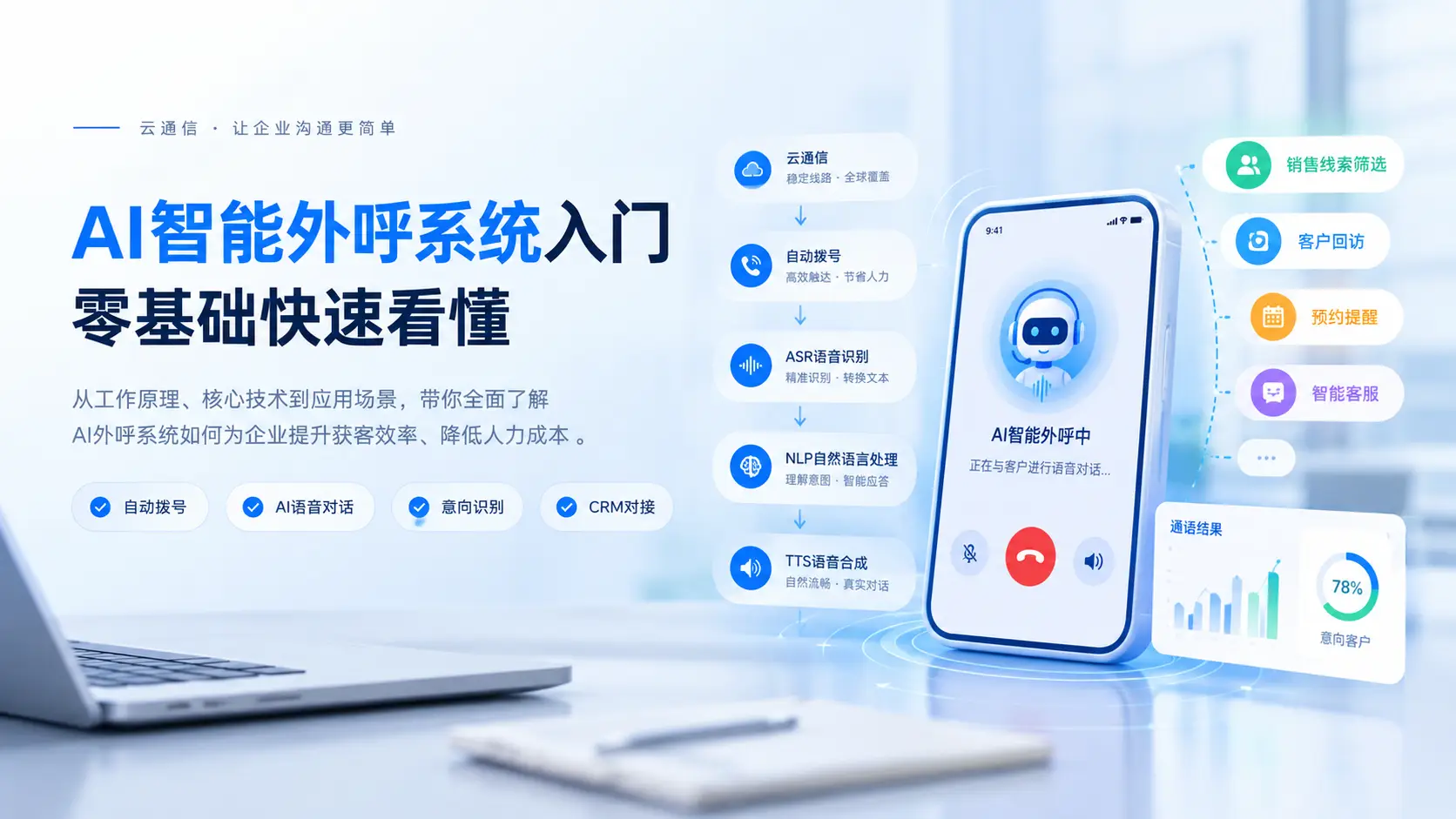
As enterprise customer acquisition, customer service, and sales outreach gradually digitize, traditional manual outbound calling faces increasing challenges in efficiency, labor costs, and customer management. AI smart outbound call systems combine cloud communication, auto-dialing, ASR speech recognition, NLP natural language processing, TTS speech synthesis, and business process management to achieve automatic phone dialing, intelligent dialogue, customer intent recognition, and call result recording.
For enterprises new to this field, you can start with a simple definition:
An AI smart outbound call system is an intelligent communication system that uses artificial intelligence and communication technology to achieve auto-dialing, AI voice interaction, customer intent recognition, and business result management.
AI smart outbound call systems, also known as AI outbound call systems, smart outbound call systems, or AI phone robots, are mainly used for enterprise batch phone outreach, customer screening, callbacks, notifications, appointments, and sales lead mining.
Traditional phone outbound calling usually works as:
Manual Agent → Manual Dialing → Customer Answers → Manual Communication → Manual Recording
AI smart outbound calling can achieve:
Business System → Auto-Dialing → Customer Answers → AI Voice Dialogue → Intent Recognition → Result Classification → CRM Return
For example, an enterprise needs to call back 10,000 customers.
The traditional approach requires manual one-by-one dialing and recording results after each call.
The AI smart outbound call system can automatically execute phone outreach according to preset tasks and enter different dialogue flows based on customer responses.
Therefore, AI outbound calling is not simply "robots making calls" but a complete solution combining communication infrastructure, AI voice capabilities, business processes, and data systems.
From a technical architecture perspective, a complete AI outbound call system typically includes the following core modules.
Communication lines are responsible for establishing phone connections.
Common communication technologies include:
AI models cannot directly complete phone connections on their own, so the underlying communication lines are the foundation for the normal operation of an AI outbound call system.
When choosing an AI outbound call service provider, in addition to focusing on AI voice quality, enterprises also need to pay attention to line stability, number resources, call concurrency, connection quality, and communication rules of the target market.
The auto-dialing module is responsible for creating and executing outbound call tasks.
For example, after an enterprise uploads 10,000 customer numbers, the system can automatically complete the following based on task rules:
Number Validation → Task Queuing → Concurrent Dialing → Connection Check → AI Dialogue
Compared with manual one-by-one dialing, auto-dialing can reduce repetitive operations and improve batch customer outreach efficiency.
ASR, short for Automatic Speech Recognition, is automatic speech recognition.
Its role is to convert customer speech into text.
For example:
"I recently have overseas SMS needs, how do you charge?"
The system first recognizes customer speech through ASR, then passes the recognition result to AI for semantic analysis.
ASR recognition quality is affected by factors such as environmental noise, network quality, accent, and speaking speed.
Therefore, the speech recognition capability of an AI outbound call system is one of the important factors affecting actual dialogue results.
NLP, or Natural Language Processing, is responsible for understanding the content and intent expressed by customers.
For example:
"How much does this service cost?"
The system may recognize it as:
Price Inquiry
While:
"We are about to launch, can you arrange a sales contact?"
May be recognized as:
High-Intent Customer
This means the AI outbound call system does not merely recognize keywords but also needs to make judgments based on context, dialogue content, and business rules.
TTS, or Text To Speech, is used to convert AI-generated text into speech.
For example, AI generates:
"Sure, I will record this for you and arrange a staff member to contact you later."
TTS synthesizes this text into speech and plays it to the customer through the phone line.
Therefore, a complete AI phone interaction is actually:
Customer Voice → ASR → AI Understanding → Generate Reply → TTS → Voice Playback
AI smart outbound call systems and traditional call centers are not completely mutually exclusive alternatives.
The traditional model mainly relies on:
Manual Agents + Communication Lines + Call Center System + CRM
Customer communication and business processing are completed manually.
AI outbound calling further adds on top of traditional communication capabilities:
ASR + NLP + TTS + AI Dialogue Engine + Automatic Task Management
Therefore, it can automatically complete a portion of standardized phone communication.
Simply put:
Traditional call centers focus on "how people can make calls efficiently," while AI outbound calling further solves "which calls can be automatically completed by the system."
In actual enterprise applications, the more common approach is:
AI handles batch outreach, screening, and basic communication; humans handle complex problem solving, sales consultation, and final conversion.
A complete AI outbound call flow can typically be broken down into the following steps:
Enterprise Business System
      ↓
Create Outbound Call Task
      ↓
Customer Numbers Enter Task Queue
      ↓
Auto-Dialing
      ↓
Customer Answers
      ↓
AI Plays Opening Script
      ↓
Customer Gives Voice Reply
      ↓
ASR Speech Recognition
      ↓
AI Understands Customer Intent
      ↓
Generate Next-Round Reply
      ↓
TTS Converts to Voice
      ↓
Continue Dialogue
      ↓
Identify Final Result
      ↓
Record Call Data
      ↓
CRM / Business System
For example, an enterprise needs to screen sales leads.
AI can ask:
"Hello, would you like to know if your company currently has overseas SMS business needs?"
Customer replies:
"Yes, we mainly focus on the Southeast Asian market."
AI can continue asking:
"Which countries do you mainly cover? What is your approximate monthly SMS sending volume?"
Based on customer responses, the system can automatically classify customers into:
High Intent / General Intent / Pending Manual Follow-up / No Current Need / Rejected / Unreachable
Sales staff can then directly view the screening results and manually follow up on key customers.
AI outbound calling can batch-contact potential customers and make initial judgments on customer needs.
The basic model is:
Customer List → AI Outbound → Intent Recognition → Lead Classification → Manual Follow-up
This can reduce the time sales staff spend on invalid customers.
Suitable for:
Such business typically has relatively standardized scripts and is more suitable for automated execution.
For example:
AI can automatically initiate calls based on tasks generated by the business system.
For enterprises with a large number of potential customers, AI can complete the first round of screening.
For example:
10,000 Customers
      ↓
AI Auto Outbound
      ↓
Effective Connection
      ↓
Need Recognition
      ↓
Intent Classification
      ↓
Manual Follow-up of Key Customers
The core value of AI outbound calling is not simply increasing dialing volume but helping enterprises achieve automated customer outreach and lead screening.
For business with clear processes and high standardization of problems, AI outbound calling can also be used for some customer service and notification scenarios.
When choosing an AI smart outbound call system, it is recommended not to only look at "whether the AI voice sounds like a real person" but also pay attention to the overall system business capabilities.
Reflects the proportion of outbound numbers that successfully establish a call connection.
The connection rate is usually related to line quality, number resources, call timing, target market, and other factors.
The proportion of effective interactions formed after a customer answers the phone.
Simply connecting but immediately hanging up does not represent effective communication.
Whether the system can accurately understand customer needs is an important capability of AI outbound calling.
For example:
"Send me the materials first to have a look."
The system needs to combine context to determine whether the customer belongs to inquiry, general intent, or further follow-up stage.
When AI encounters problems beyond the business scope, it needs to promptly transfer the call to a human agent.
Different scenarios need to focus on different business metrics:
Therefore, the value of an AI outbound call system should be measured against specific business objectives, not just technical parameters.
No.
This is a common misconception when enterprises build AI outbound call systems.
A system truly usable in a production environment typically requires at least the following layers.
Responsible for:
SIP, Lines, Numbers, Calling, Concurrency, Connection Management
Responsible for:
ASR, TTS, Natural Language Understanding, AI Dialogue
Responsible for:
Customer Lists, Outbound Tasks, Scripts, Flows, Customer Tags
Responsible for:
Call Records, Recordings, Text, Customer Intent, Statistical Data
Responsible for:
Monitoring, Alerts, Exception Handling, Concurrency Control, Cost Management
Therefore, a complete AI smart outbound call platform is essentially:
Communication Infrastructure + AI Voice Capabilities + Dialogue Flow Engine + Enterprise Business System + Data Analytics Platform
For enterprises, AI outbound calling truly generates business value typically by integrating with existing systems.
Common integration methods include:
API Interface
Used for creating outbound call tasks, submitting customer lists, obtaining call results, etc.
Webhook
Used for pushing call status, customer intent, task results, and other data back to enterprise systems in real time.
CRM Integration
Associates outbound call records, customer tags, and call results with CRM customer profiles.
For example:
CRM Customer Data
      ↓
API Submit Outbound Task
      ↓
AI Outbound Platform
      ↓
Auto-Complete Phone Outreach
      ↓
Identify Customer Intent
      ↓
Webhook Push Results Back
      ↓
CRM Update Customer Status
Through this approach, AI outbound calling is no longer an independent "phone robot" but becomes an automated outreach module within the enterprise business system.
This question usually requires judgment based on the enterprise technical team, business scale, and customization needs.
Enterprises build on their own:
This approach offers a high degree of control but also requires undertaking system development, line management, operations, and stability assurance.
Enterprises directly obtain through a cloud communication platform:
Communication Lines + Call Capability + AI Voice Capability + API + Data Management
Enterprises can focus more on business processes and customer operations.
For enterprises needing to quickly validate AI outbound call business, the cloud communication model can typically reduce the construction of underlying communication infrastructure.
AI outbound calling involves phone numbers, customer information, call recordings, and marketing outreach, so enterprises need to pay attention to communication and privacy rules of the target market during actual operations.
Especially when conducting overseas business, different countries or regions may have different requirements for the following:
Therefore, before AI outbound calling officially goes live, specific compliance requirements need to be confirmed based on the target market.
The technical system is responsible for implementing communication capabilities, but enterprises still need to bear corresponding compliance responsibilities for their own business actions.
You can quickly judge from three aspects.
If the enterprise needs to manually dial a large number of structurally similar calls every day, the value of automation is usually more apparent.
Customer callbacks, appointment confirmation, demand research, basic lead screening, and other business are relatively suitable for process-oriented design.
Many enterprises do not need to achieve "full automation."
The more common model is:
AI Completes First-Round Outreach → AI Judges Customer Intent → High-Value Customers Transferred to Human → Humans Complete Complex Business
Therefore, the focus of AI outbound calling is not to completely replace humans but to free humans from repetitive work.
An AI smart outbound call system combines auto-dialing, cloud communication, and AI voice technology to achieve automatic phone communication, customer intent recognition, call recording, and business result management through ASR, NLP, and TTS.
The two are often used interchangeably in the market. AI phone robots typically emphasize AI voice interaction capabilities, while AI outbound call systems include auto-dialing, task management, communication lines, data statistics, and CRM integration in addition to AI dialogue.
Yes. Enterprises can connect customer data, outbound tasks, call status, and customer intent information with CRM systems through API, Webhook, and other methods.
Common applications include finance, internet, e-commerce, education, logistics, enterprise services, and customer service. Whether it is suitable specifically needs to be judged based on customer scale, phone outreach frequency, and business process standardization.
Yes. Overseas AI outbound calling needs to be planned based on target country communication lines, number resources, local communication rules, privacy protection, and marketing call requirements.
AI is more suitable for handling standardized, repetitive phone tasks. Scenarios involving complex consultation, business negotiation, professional services, and final closing typically still require human participation.
Whether high concurrency is supported depends on underlying communication lines, SIP architecture, call gateway, task scheduling, and system capacity. Enterprises need to assess concurrency based on actual outbound scale, not just the AI model itself.
There is no single metric applicable to all enterprises. Sales lead scenarios can focus on effective lead rate and transfer-to-human rate; callback scenarios can focus on completion rate; notification business focuses more on connection and task completion.
From actual enterprise applications, the value of AI outbound calling is mainly concentrated in three areas:
Achieve batch customer outreach through auto-dialing and task scheduling.
Hand over large volumes of standardized, repetitive phone tasks to AI.
Through AI voice interaction and intent recognition, make initial customer classifications and hand high-value customers to human teams for continued processing.
Therefore, the core of AI outbound calling is not simply "letting AI make calls" but:
Transforming phone outreach from manual operation into an orchestrable, automatable, and data-driven business process.
If an enterprise is looking for an AI smart outbound call solution, it can focus on the following capabilities:
Whether stable, whether it supports the target market, and whether it meets business scenario needs.
Whether it can support actual outbound task scale and peak-period call demand.
Focus on ASR recognition, TTS synthesis, natural language understanding, and multi-turn dialogue capability.
Whether it supports custom scripts, flow nodes, customer intent tags, and transfer-to-human rules.
Whether it can quickly integrate with CRM, ERP, marketing systems, and internal enterprise business platforms.
Whether it can view call status, task execution, customer intent, and exception data.
For overseas enterprises, also examine target country numbers, communication lines, and localization capabilities.
AI models determine "whether they can understand customers," while communication infrastructure determines "whether calls can be stably connected."
Therefore, an AI outbound call system truly oriented toward enterprise production environments needs to simultaneously have:
Stable Communication Lines + Auto-Dialing + AI Voice Interaction + High Concurrency + API Interface + CRM Integration + Data Monitoring + Compliance Mechanism.
For enterprises with overseas business, local communication environments of different countries and regions also need further consideration.
This is also what enterprises need to focus on when choosing an AI outbound call platform:
Do not just look at AI dialogue results; also look at underlying communication capabilities and the overall system feasibility.
If an enterprise is conducting sales lead screening, customer callbacks, appointment notifications, smart customer service, or overseas phone outreach, it can plan holistically from dimensions including communication lines, concurrency, AI voice, API interface, and business system integration.
The YaningAI Cloud Communication Platform can provide enterprise communication business with platform-level infrastructure including communication lines, API interfaces, and smart communication capabilities, helping enterprises connect phone outreach capabilities with their own business systems.
Start with one API integration and let AI outbound calling truly enter enterprise business processes.
Consult Now / Get AI Outbound Call Solution →