 By Samuyl Joshi
A privacy intermediary number, also called a privacy number, privacy code or virtual intermediary number, is a number protection service built on a cloud communication platform.
It mainly solves one problem:
Customers and service agents need to talk by phone, but neither side wants to reveal their real mobile number.
In traditional communication, the path is usually:
Customer A → Service agent BWhen the two sides call each other directly, the other party can easily obtain the mobile number during the call.
With a privacy intermediary number, the communication path becomes:
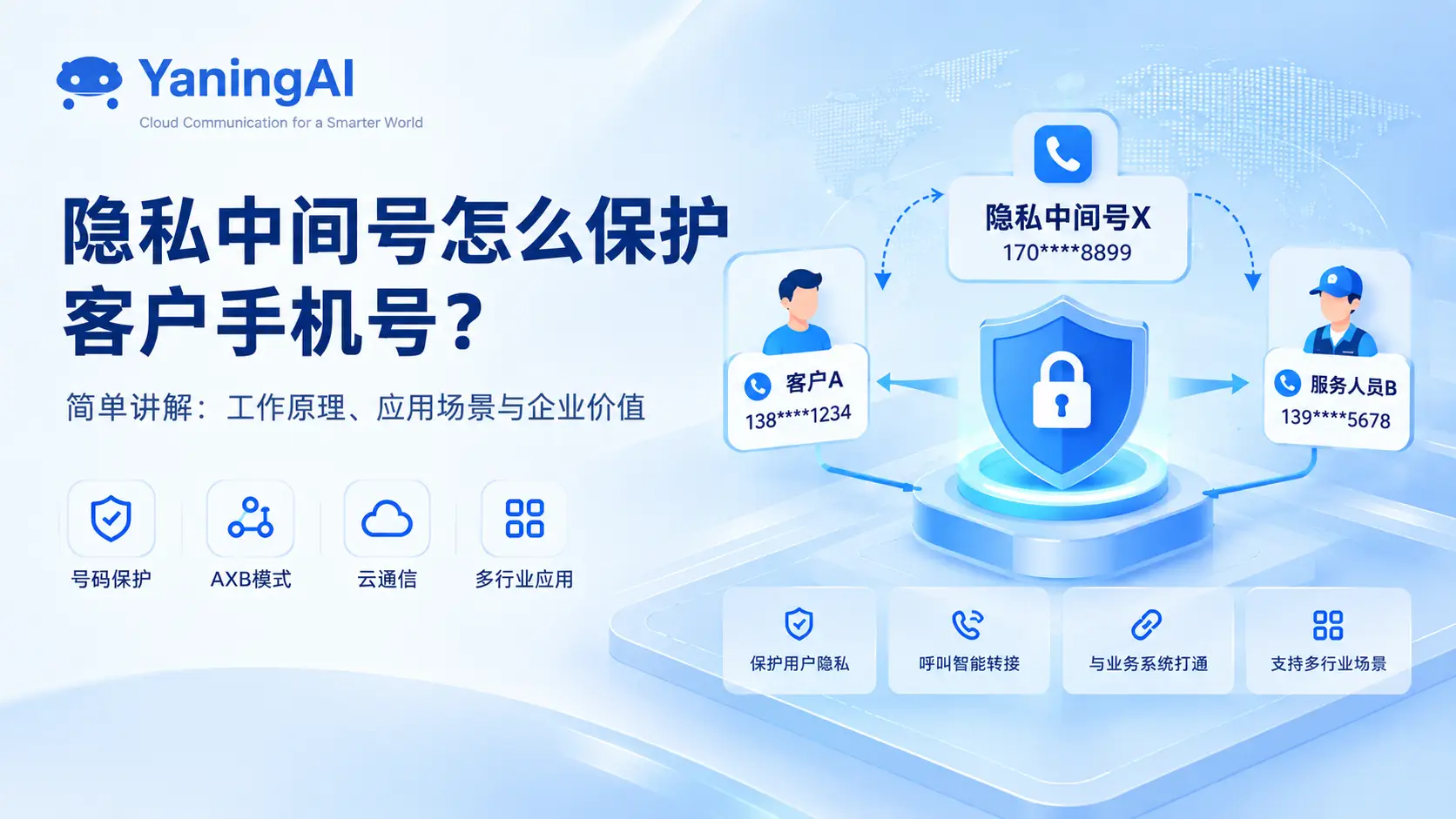
Customer A → Privacy intermediary number X → Service agent BX is the intermediary number provided by the platform.
The cloud communication platform connects A and B through number mapping and call routing, while preventing the two sides from directly exchanging real mobile numbers.
Therefore, the core of a privacy intermediary number is not simply providing a virtual number, but building a set of number isolation, call forwarding and business mapping mechanisms.
The core technologies used to protect phone numbers include:
Number pool + Number mapping + Call routing + Communication relay
For example:
Customer A: 138****1234
Service agent B: 139****5678
Privacy intermediary number X: 170****8899
The system establishes:
Number A ↔ Intermediary number X ↔ Number B
When the customer dials the X number, the cloud communication platform identifies the current number binding and forwards the call to B.
The overall communication process can be understood as:
Customer A
138****1234
      │
      │ Initiates the call
      ▼
Privacy intermediary number X
170****8899
      │
      │ Routes and forwards
      ▼
Service agent B
139****5678
A does not need to dial B directly, and B does not need to obtain the real mobile number of A.
This is the basic principle of how a privacy intermediary number achieves phone number protection.
From a technical architecture perspective, a privacy intermediary number usually involves four key steps.
After a user creates an order, delivery task or service request, the business system sends a request to the cloud communication platform.
For example:
Business ID: ORDER20261006
Number A: 138****1234
Number B: 139****5678
The platform allocates an X number from the number pool:
Number X: 170****8899And establishes:
ORDER20261006
       ↓
Privacy intermediary number X
   ↙       ↘
Number A       Number B
After that, the X number is bound to the current business relationship.
What the customer sees is not the real mobile number of service agent B, but the X number provided by the platform.
The customer dials:
170****8899
After receiving the request, the cloud communication platform looks up the current number binding and finds:
B = 139****5678
It then executes call routing.
In the underlying communication link, the platform handles signaling control and call forwarding.
For the customer, it simply looks like:
Dial → Connect → Talk → Hang up
But behind the scenes it actually goes through:
Number recognition → Mapping lookup → Route forwarding → Call setup
Therefore, a privacy intermediary number is essentially a cloud communication relay service.
For order-based business, the intermediary number usually does not need long-term binding.
For example:
Order created
   ↓
Allocate privacy number
   ↓
Service in progress
   ↓
Both sides talk normally
   ↓
Order completed
   ↓
Remove number mapping
   ↓
Intermediary number released
The released number can re-enter the number pool according to platform policy.
This mechanism reduces waste of number resources and lowers the management risk of long-term number binding.
In privacy communication, the AXB model is very common.
AXB can be simply understood as:
Communication relationship:
A → X → B
X is responsible for isolating A and B.
This model is especially suitable for:
Ride-hailing, food delivery, e-commerce, logistics, housekeeping, rental, second-hand trading and other platform-based business.
For example, on a ride-hailing platform:
Passenger A
   ↓
Privacy number X
   ↓
Driver B
The binding stays in place while the order exists and is removed after the order is completed.
Therefore, the AXB model is very suitable for temporary communication needs with a clear business lifecycle.
If a platform lets customers and service agents exchange mobile numbers directly, the two sides may keep each other contact information long after the relationship ends.
A privacy intermediary number keeps real mobile numbers isolated inside the platform communication system.
In order-based business, the platform usually only wants the two sides to stay in touch during the time the business requires.
Through an intermediary number, the number binding can be linked to the order lifecycle.
For example:
Order starts → Contact allowed
Order ends → Number unbound
This mechanism is much easier to manage than directly exchanging mobile numbers.
After using a privacy intermediary number, enterprises can further connect telephone capability with:
Order systems, customer service systems, CRM, delivery systems and ticket systems to connect them together.
For example:
Order system
   ↓
Create communication relation
   ↓
Privacy number platform
   ↓
Call forwarding
   ↓
Communication records
   ↓
Order completed
In this way, a phone call is no longer an isolated communication action, but part of the entire business process.
Passengers and drivers need to coordinate pickup location and vehicle information, but platforms usually do not want the two sides to exchange mobile numbers directly.
A privacy intermediary number can establish a temporary communication relationship for each order.
Customers need to contact riders to confirm delivery details, but do not need to know the rider real mobile number.
The platform can complete communication between the two sides through a privacy number.
When cargo owners, drivers, warehouses and delivery staff need temporary phone contact, privacy numbers can reduce the exposure of real contact information.
When buyers and sellers, or consumers and customer service, need phone contact, communication can be established through an intermediary number.
Cleaning, repair, installation and similar services usually require phone contact between customers and service agents.
The platform can isolate the real mobile numbers of both sides through a privacy number.
Buyers and sellers may need to talk by phone, but the platform can use privacy numbers to reduce direct exchange of contact information.
The two are often confused, but their purposes are not exactly the same.
A virtual number is more about "providing a virtual communication number".
A privacy intermediary number focuses more on:
How to hide real phone numbers during communication between the two sides.
It can be simply understood as:
| Comparison Item | Ordinary Virtual Number | Privacy Intermediary Number |
|---|---|---|
| Core purpose | Provide a virtual number | Isolate real numbers of both sides |
| Typical model | Single-number communication | A-X-B |
| Number mapping required | Depends on the business | Usually required |
| Linked to orders | Not necessarily | Often linked |
| Temporary communication | Average fit | Very suitable |
| Platform routing control | Depends on the solution | Core capability |
Therefore, for platform business that needs to protect customer phone numbers, simply buying one virtual number does not mean a complete privacy communication solution is in place.
When choosing a privacy number service, enterprises should not only compare unit prices; they should focus more on overall communication capability.
Virtual numbers and communication business rules may differ across countries and regions.
Enterprises need to confirm:
Whether the numbers are available, whether they match the business, whether qualification requirements exist and the local communication rules.
Privacy intermediary numbers rely on underlying communication routes and call routing.
If route quality is unstable, the following problems may occur:
Call failures, connection delay, one-way audio, abnormal hang-ups and other issues.
When platform business is large, a high volume of calls must be handled at the same time.
Therefore, focus on:
Number pool capacity, call concurrency, routing processing capability and system stability.
For internet platforms, privacy intermediary numbers usually need to integrate with existing business systems.
For example:
Business system
    ↓
API create binding
    ↓
Allocate privacy number
    ↓
Initiate call
    ↓
Get call status
    ↓
Remove binding
Therefore, API stability, interface documentation, callback mechanisms and exception handling all directly affect project delivery.
A privacy intermediary number solves the number isolation problem during communication.
Enterprises still need to do well in:
Data access control, API authentication, log management, sensitive data protection and access auditing.
Using a privacy intermediary number does not mean the enterprise has completed all of its data security work.
From an enterprise business perspective, a privacy intermediary number mainly solves three problems:
Prevent customers and service agents from directly exchanging real contact information.
Link number binding to business processes such as orders, services and tasks.
Connect telephony with business systems to enable call records, status tracking and service process management.
Therefore, a privacy intermediary number can be understood as:
Number isolation and call relay capability built on cloud communication, using the mapping between the real A/B numbers and the intermediary X number to complete communication between the two sides without directly exposing phone numbers.
In actual procurement, it is recommended to focus on the following dimensions:
First, look at number resources.
Confirm whether the target countries and regions have number resources that meet business needs.
Second, look at route quality.
Focus on connection rate, call stability, latency and exception handling capability.
Third, look at API capability.
Confirm whether standard API access, status callbacks, number binding and unbinding are supported.
Fourth, look at concurrency.
Evaluate number pool and system concurrency based on peak platform call volume.
Fifth, look at data security.
Understand how the provider manages permissions for real numbers, call records and business data.
Sixth, look at technical support.
After launch, numbers, routes, interfaces and business rules may all have exceptions, so the provider technical response capability is equally important.
Yes. Through number mapping and call relay, a privacy intermediary number lets both sides complete a call via the intermediary number, reducing direct exposure of real mobile numbers.
AXB is a common privacy number architecture where A and B represent the real numbers of the two sides and X represents the intermediary number. The exact communication method of an actual product depends on number type, platform architecture and local communication rules.
Typical scenarios include ride-hailing, food delivery, e-commerce, logistics, housekeeping, rental, second-hand trading and other business that needs temporary phone contact.
It can be configured according to business rules, but order-based business is usually better suited to dynamic binding and release along the business lifecycle, which improves number resource utilization.
The core value is number isolation. Where the platform supports it, call records, recording, status callbacks, business interfaces and other capabilities can be combined for more complete communication management.
Yes. Different countries and regions have different requirements for number resources, telephone business, data protection and communication marketing. Enterprises should complete a compliance assessment based on the business location and actual communication scenarios before launch.
For ride-hailing, e-commerce, logistics, instant delivery, housekeeping and other platform-based business, "users need to make a call but must not see the phone number directly" is a very typical communication need.
YaningAI cloud communication can provide number protection and communication capability integration around enterprise business systems, helping enterprises connect:
Business system → Privacy number → Call routing → Communication status
into a complete communication link.
Whether it is order-based temporary communication or platform-level high-concurrency call scenarios, number allocation, binding, routing and release can be designed according to the actual business.
To build a privacy intermediary number, number protection or cloud communication interface, contact YaningAI for a solution and technical integration support.
Consult Now → Get a Privacy Intermediary Number Solution