 By Samuyl Joshi
In business scenarios such as cross-border e-commerce, internet finance, and gaming overseas, verification codes, transaction notifications, order reminders, and logistics notifications usually need to be sent in batches through cloud communication platforms. When large numbers of users register, log in, or participate in promotions simultaneously, message requests may increase rapidly in a short period, bringing significant pressure to the platform access services, task scheduling, and downstream communication channels.
The core of cloud communication high-concurrency message distribution architecture is to convert massive concurrent requests into controllable and trackable message sending tasks through asynchronous task processing, message queues, distributed scheduling, channel rate limiting, and reliability control.
For international SMS platforms, high concurrency is not just about adding servers or sending threads. The platform also needs to consider operator networks in different countries and regions, supplier channel capacity, SMPP connection limits, message submission latency, and status receipt processing capabilities.
This article analyzes the technical principles of cloud communication high-concurrency message distribution from the perspectives of system architecture, message queues, channel routing, concurrency control, and reliability design.
Cloud communication high-concurrency message distribution architecture refers to a technical system that, when large numbers of message requests arrive simultaneously, distributes message tasks to communication channels with corresponding processing capabilities through layered processing, asynchronous scheduling, and distributed resource management, while continuously tracking processing status.
Taking international SMS as an example, enterprises typically submit sending tasks through HTTP API, SDK, or SMPP interfaces. After messages enter the platform, they go through parameter validation, number processing, channel matching, queue scheduling, protocol encapsulation, downstream submission, and status receipt processing.
If all operations are concentrated in a single synchronous request, the interface response time will be affected by the downstream network, supplier processing speed, and operator channel status. When the request volume continues to rise, the system may experience thread blocking, connection exhaustion, request timeouts, and task accumulation.
These designs together form the foundation of high-concurrency SMS sending systems.
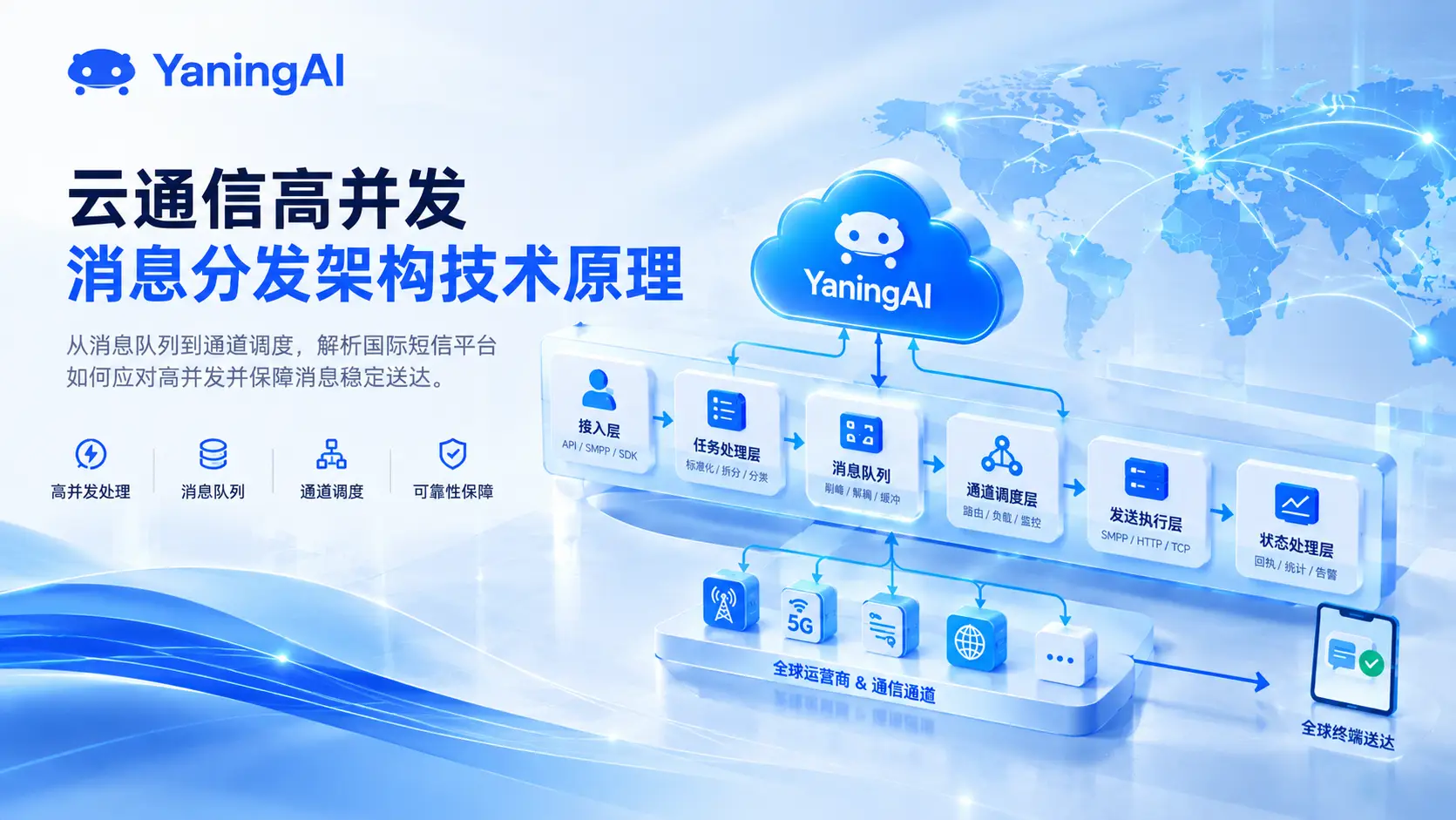
A typical cloud communication message distribution system can be divided into access layer, task processing layer, message queue layer, dispatch scheduling layer, sending execution layer, and status processing layer.
Enterprise Business System
     |
     v
HTTP API / SMPP / SDK
     |
     v
+------------------+
| Access Layer     |
| Auth, Validation |
+--------+---------+
         |
         v
+------------------+
| Task Processing  |
| Normalize, Split |
+--------+---------+
         |
         v
+------------------+
| Message Queue    |
| Buffer, Peak Cut |
+--------+---------+
         |
         v
+------------------+
| Dispatch Layer   |
| Route, Priority  |
+--------+---------+
         |
         v
+------------------+
| Sending Layer    |
| HTTP/SMPP/TCP   |
+--------+---------+
         |
         v
Operator & Downstream Network
         |
         v
Delivery Status & Receipt
         |
         v
+------------------+
| Status & Monitor |
| Receipt, Stats   |
+------------------+
This is a typical logical architecture. In actual deployment, modules can be split into multiple services based on business scale, or some functions can be deployed in the same service when the business scale is small.
The access layer is responsible for receiving message tasks submitted by enterprises and completing identity authentication, signature validation, parameter checking, number format validation, and call rate limiting.
For HTTP API, the interface design needs to clarify response semantics. For example, a successful return may only indicate that the task has been accepted by the platform, not that the SMS has been submitted to the operator.
For long-connection access methods such as SMPP, it is also necessary to maintain connection state, parse protocol messages, manage sequence numbers, and handle request-response.
The focus of the access layer is to quickly complete necessary validations and hand off tasks, rather than letting each request synchronously wait for the entire sending chain to finish.
When different customers access the platform, they may use different interface protocols and request fields. The task processing layer needs to convert these requests into a unified internal message model.
Common processing includes message ID generation, number normalization, message type identification, customer permission validation, sending priority setting, and task batch management.
A unified message model can isolate external protocols from internal scheduling logic. When the platform adds new communication suppliers or adjusts underlying protocols, it typically does not need to synchronously modify all upstream business systems.
For large-scale SMS tasks, it is also necessary to reasonably split sending batches to avoid a single oversized task occupying scheduling resources for a long time, while retaining batch IDs to support task querying, status statistics, and exception tracking.
Message queues are an important component of cloud communication high-concurrency message distribution architecture. Their main role is to decouple the message access speed from the downstream sending speed.
Assume an enterprise submits a large number of SMS messages in a short time, while the downstream channel can only receive messages at a certain rate. If the access service directly calls the downstream interface, too many concurrent requests may exhaust threads, connections, and memory resources.
After introducing a message queue, legitimate message tasks can first enter a buffer area, and then one or more consumers can retrieve and execute tasks according to actual processing capacity.
First, peak shaving and valley filling.
When the instantaneous request volume exceeds the downstream processing capacity, the message queue can temporarily store pending tasks, reducing the direct impact of burst traffic on the sending module.
Second, decoupling upstream and downstream.
The access service and sending service can be independently scaled, deployed, and recovered. When a sending channel experiences brief anomalies, the access layer does not immediately lose processing capacity along with the downstream, provided that queue capacity, persistence, and overload protection are properly designed.
Third, supporting task recovery.
With correct configuration of message persistence, consumption acknowledgment, and retry strategies, after a consumer abnormally exits, unfinished tasks can be recovered and processed.
However, message queues can only buffer traffic and cannot infinitely increase the actual sending speed.
If messages continue to enter the queue at 10,000 per second while the downstream can only process 4,000 per second, the backlog will keep growing. Therefore, the platform also needs to monitor queue depth, message wait time, production-consumption rate, and estimated clearance time, and take measures such as rate limiting, adjusting consumers, or switching available channels when necessary.
For international SMS platforms, different channels may differ in country coverage, operator support, sending rate, cost, and service quality. The dispatch scheduling layer needs to select appropriate sending paths based on message characteristics and real-time resource status.
Channel routing typically requires comprehensive analysis of the following factors.
| Scheduling Factor | Role |
|---|---|
| Target Country or Region | Match the actual coverage capability of channels |
| Target Operator | Perform finer-grained channel matching when data is available |
| Message Type | Distinguish verification codes, transaction notifications, and marketing messages |
| Channel Health Status | Avoid continuously assigning new tasks to faulty routes |
| Channel Available Rate | Control task submission volume to prevent exceeding channel quotas |
| Message Time-Sensitivity | Allocate resources reasonably for high-priority tasks |
| Quality and Cost | Optimize resource usage under business and compliance requirements |
Reasonable channel selection cannot rely solely on price or historical success rate. For example, a route with good historical performance does not mean it is currently free of congestion, nor does it mean it is suitable for all countries and message types.
Dynamic scheduling adjusts the assignment strategy for subsequent tasks based on channel operating status and sending performance.
The system can continuously collect information such as channel connection status, response time, timeout rate, submission results, queue wait time, and supplier quotas. When a route consistently shows anomalies, the scheduling module can reduce its allocation weight, pause sending new tasks to it, or activate backup routes based on preset rules.
For production environments, it is recommended to prioritize explainable and configurable scheduling strategies and retain complete routing decision records. Complex algorithms only demonstrate practical value when they have stable data sources and clear business objectives.
A multi-channel architecture can reduce the impact of single-route anomalies, but not all failures are suitable for immediate retry.
If the message has not yet been submitted downstream, the system can typically reselect a channel based on routing rules. If the request has already been sent but no response is received due to timeout, the original message may have already been received by the downstream.
In this case, directly resubmitting to a backup route may cause duplicate sending. Therefore, failover needs to be designed in conjunction with request correlation IDs, downstream status query capabilities, status receipts, and retry rules to distinguish between confirmed failures and unknown results.
In cloud communication high-concurrency architecture, message queues, consumers, and downstream communication channels need to form mutually matching processing capabilities.
Simply increasing the number of consumers does not necessarily improve final throughput. If the real bottleneck is at supplier quotas or the downstream network, more consumers will only consume queue tasks faster and increase downstream pressure.
The platform can achieve parallel processing through multiple consumers, queue partitions, or task sharding.
Different consumers handle different task sets to improve the overall efficiency of task reading, business processing, and protocol submission. However, whether linear scaling is possible also depends on whether there are shared bottlenecks in databases, message queues, connection pools, and downstream channels.
If the business requires messages from the same user or same business object to maintain order, message ordering constraints also need to be considered in the partition design.
The available throughput of a channel is not unlimited. The platform needs to set corresponding rate control mechanisms based on supplier agreements, connection configurations, and actual response performance.
Common methods include token bucket, leaky bucket, concurrency semaphore, and dynamic quota control. These mechanisms can be applied at different levels: customer, business type, destination country, sending connection, or specific channel.
For example, if a channel allows a submission rate of 200 per second, the platform needs to control the actual submission volume through rate limiting strategies and make adjustments based on supplier configuration and operating status. This number is only an example and does not represent a universal international SMS channel standard.
When downstream responses slow down or message accumulation exceeds preset thresholds, the backpressure mechanism can restrict continued task delivery to affected components.
The platform can pause some consumers, reduce task reading speed, restrict new task entry, or adjust routing based on the situation. This prevents unfinished requests from continuously accumulating and eventually exhausting thread, connection, or memory resources.
The goal of a high-concurrency system is not to unconditionally increase task entry speed, but to continuously process messages within a controllable range.
For enterprise-grade cloud communication platforms, reliability means not only that the system can operate, but also that message status is clear, exceptions can be recovered, and duplicate sending risks are controllable.
An international SMS typically goes through multiple stages: platform acceptance, task enqueueing, consumer acquisition, downstream submission, downstream response, and terminal delivery receipt.
These stages need to be recorded separately to avoid covering the entire sending chain with a simple "success" field.
Important note: Platform acceptance success does not equal submission success, and submission success does not equal terminal delivery success.
Terminal delivery status needs to be determined in conjunction with the receipt capability, receipt semantics, and timeout rules provided by the downstream channel.
In distributed systems, client duplicate submissions, consumer restarts, queue redelivery, and network timeouts can all cause the same task to be processed multiple times.
The platform can use customer request IDs, business unique keys, or message IDs to identify duplicate requests and prevent the same business request from being created as multiple tasks.
However, internal idempotency control of the platform cannot automatically guarantee end-to-end exactly-once sending on the operator side. When it is uncertain whether the downstream has received the message, status queries, receipts, and specific retry strategies are still needed.
For recoverable network anomalies, temporary service unavailability, or explicit temporary rate limiting responses, a limited number of retries can be set with backoff intervals to avoid continuously hitting an abnormal service.
For continuously failing tasks, they can be routed to a dead letter queue or exception task pool for further analysis.
For tasks with unknown results, such as those received downstream but with lost responses, a separate processing strategy should be designed. Not all timeouts should be treated as failures.
If the platform first creates a database task and then separately publishes an event to the message queue, a situation may occur where the database write succeeds but the message publishing fails.
A common approach is the transactional Outbox pattern: writing business records and pending events in the same database transaction, then having an independent task deliver events to the queue. Combined with idempotent consumption, failure retries, and status auditing, this can reduce the risk of task omission.
The specific implementation needs to be chosen based on platform scale and infrastructure, but it must be clear at which stage messages are persisted, how completion is confirmed, and how recovery occurs after failure.
When evaluating cloud communication high-concurrency capabilities, different metrics should be distinguished: interface access, queue processing, downstream submission, and terminal delivery.
| Metric | Primary Use |
|---|---|
| API Request Throughput | Measure the request processing capacity per unit time at the interface |
| Message Enqueue Rate | Measure the speed of tasks entering the message queue |
| Message Submission Throughput | Measure the speed of tasks submitted to downstream channels |
| Terminal Delivery Rate | Measure the proportion of messages confirmed delivered via valid receipts |
| Queue Backlog | Reflect the scale of pending tasks |
| Message Processing Latency | Reflect the time from acceptance to a specified processing stage |
| Timeout Rate and Error Rate | Identify abnormal components and potential capacity bottlenecks |
Assume the current queue has a backlog of 1.2 million messages, the actual processing capacity is stable at 4,000 per second, and no new messages enter during the period. The theoretical clearance time is:
1,200,000 / 4,000 = 300 seconds, about 5 minutesIf new tasks continue to enter, or the actual downstream processing capacity changes, the clearance time will change accordingly.
This is why production environments should not only monitor the total number of messages in the queue, but also evaluate in combination with new task rate, actual consumption rate, and oldest task wait time.
Bottlenecks in cloud communication platforms may appear in different components, for example:
Actual optimization should be based on load testing data and operational metrics to identify the real bottleneck before scaling or architecture adjustments.
Cloud communication high-concurrency architecture needs to be adjusted based on business characteristics, rather than using the same scheduling strategy for all messages.
Verification Codes and Identity Authentication
Focus on sending timeliness, burst request control, message validity period, and duplicate sending risk. After a verification code expires, continuing to send it may no longer have business value.
Cross-Border E-Commerce and Logistics Notifications
Focus on task backlog during promotions, batch processing efficiency, and message status tracking, while preventing large-scale marketing tasks from crowding out high-priority transaction notification processing resources.
Overseas Financial Transaction Notifications
Greater emphasis on business message correlation, exception alerting, data security, and status traceability. Related processing should also comply with applicable regulatory and information security requirements.
Gaming Overseas and User Operations
Login verification, activity reminders, and user recall may have different timeliness and priority requirements. Queue isolation or resource quota division can be made based on business rules.
The common requirement of these scenarios is to plan the architecture based on actual business peaks, channel capacity, and service quality objectives, rather than relying on a single total concurrency number to judge platform capability.
Cloud communication high-concurrency message distribution architecture is a distributed processing system composed of access services, message queues, dispatch scheduling, sending execution, and status processing.
Message queues handle traffic buffering and upstream-downstream decoupling; channel routing matches message tasks with communication resources; parallel consumers and connection management mechanisms improve processing efficiency; rate limiting and backpressure mechanisms control system load; idempotency, retries, status receipts, and monitoring systems reduce risks of task loss, duplicate processing, and failure recovery.
For international SMS platforms, high-concurrency capability cannot be simply equated with server count or API receiving speed. When selecting a provider, enterprises should focus on understanding the platform real message submission capability, channel scheduling mechanisms, congestion control strategies, exception recovery capabilities, and status receipt systems.
A mature cloud communication architecture ultimately needs to achieve: providing stable, controllable, and trackable message processing services under conditions of traffic fluctuation, route anomalies, and task accumulation.
Cloud communication high-concurrency message distribution architecture refers to a platform managing and distributing large numbers of simultaneously arriving message tasks through mechanisms such as message queues, asynchronous processing, distributed scheduling, channel rate limiting, and status tracking, enabling tasks to be executed stably according to system and downstream channel processing capacity.
Message queues can decouple enterprise request access from downstream SMS sending, temporarily storing tasks when traffic suddenly increases, and then executing them gradually by consumers according to available processing capacity. They can buffer instantaneous peaks but cannot eliminate long-term processing capacity gaps, so backlog monitoring and task entry rate control are still needed.
It typically requires combining asynchronous task processing, parallel consumers, connection reuse, dynamic channel routing, and layered rate limiting. Actual throughput is also limited by supplier quotas, SMPP connection parameters, downstream network performance, message content, and target country or operator, and cannot be determined solely by adding servers.
Not necessarily. Successful submission typically means the downstream system has accepted or confirmed processing of the message, while terminal delivery needs to be determined based on subsequent status receipts. Different channels may have different status definitions, so the platform should clearly distinguish between task acceptance, downstream submission, and terminal delivery statuses.
It should comprehensively evaluate interface throughput, message submission rate, queue backlog, end-to-end processing latency, error rate, timeout rate, channel switching capability, and failure recovery mechanisms. For international SMS business, attention should also be paid to channel coverage in different countries or regions, actual route capacity, and receipt quality, rather than just looking at a single concurrency number in marketing materials.
When verification code sending is delayed, marketing messages accumulate, or channel quality varies across countries, the problem is often not just about API calls, but may involve message scheduling, route selection, and downstream processing capacity.
YaningAI focuses on international communication services and can help evaluate international SMS access and channel selection needs based on enterprise business scenarios, target countries, sending scale, and access methods.
If your business is expanding into overseas markets, consider the following questions: