 By Samuyl Joshi
As cross-border e-commerce, fintech, SaaS and overseas gaming businesses continue to develop, the US market has become an important target market for enterprise international SMS business.
US 10DLC number registration is essentially the registration and management of enterprise identity, SMS business purpose and sending numbers through Brand Registration, Campaign Registration and number association mechanisms. After registration is completed, the SMS still needs to pass through the communication platform business validation, traffic scheduling and US carrier networks before finally reaching the user mobile phone.
When enterprises use US local numbers to send verification codes, transaction notifications, order reminders and marketing SMS, they need to focus on A2P 10DLC registration requirements. Number procurement is only one step of business access; brand registration, SMS campaign review, number association and carrier network access together form the complete US 10DLC SMS implementation process.
Starting from the technical architecture of the cloud communication platform, this article analyzes the US 10DLC number registration process, the TCR registration mechanism, Campaign review requirements and SMS route implementation principles.
10DLC stands for 10-Digit Long Code, which is the US ten-digit local long number.
A2P (Application-to-Person) refers to the communication mode in which applications send SMS messages to individual users. For example, an enterprise business system automatically triggers SMS through an API to deliver verification codes, order status and account reminders to user mobile phones.
Unlike P2P SMS between individuals, A2P SMS usually has characteristics such as automation, batch processing and business triggering.
When enterprises use US 10-digit local long numbers to send A2P SMS to US users, they need to complete A2P 10DLC registration according to the corresponding carrier registration system.
This mechanism was established mainly to let carriers identify the SMS sending entity, business purpose and sending behavior, and to reduce the impact of unauthorized commercial SMS and spam on mobile networks.
Common US A2P 10DLC SMS business includes:
Identity Verification
User login verification codes, registration verification codes and account security verification.
E-commerce Notifications
Order confirmation, logistics updates and payment status notifications.
Financial Services
Account change reminders, transaction notifications and risk alerts.
Customer Service
Ticket handling, service progress and business notifications.
Marketing Promotion
Promotional campaigns, new product launches and user re-engagement.
Note that A2P 10DLC mainly targets commercial SMS business on US local ten-digit long numbers. US Toll-Free numbers and Short Code SMS use different registration or verification mechanisms, and the 10DLC registration process cannot be directly applied to them.
US 10DLC registration is not simply registering a phone number, but establishing associations around the enterprise brand, business purpose and actual sending numbers.
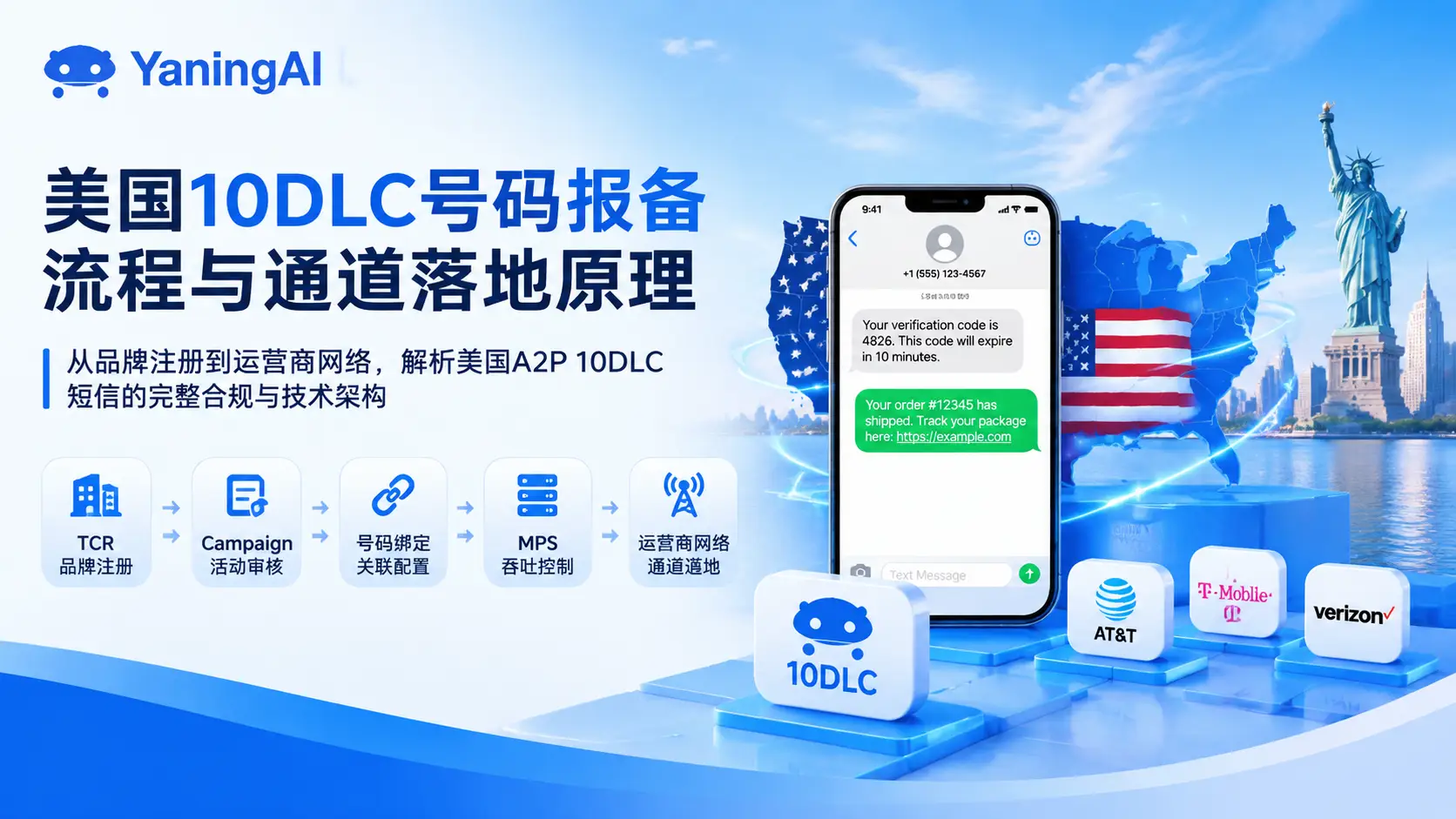
The core process can be understood as:
Brand Registration → Campaign Registration → Number AssociationBrand Registration is the first step of 10DLC registration, mainly used to verify the true identity of the SMS sending enterprise.
The Campaign Registry (TCR) is the core registration authority in the US A2P 10DLC ecosystem, responsible for managing brand and SMS campaign registration information and providing corresponding registration data to carriers and communication service providers.
Enterprises usually need to provide the following materials according to the requirements of the selected provider:
| Registration Item | Main Content |
|---|---|
| Legal Business Name | Legal registered name of the enterprise |
| Business Registration | Business registration or tax identification information |
| Business Type | Entity type of the enterprise |
| Business Address | Registered address of the enterprise |
| Website | Official website of the enterprise |
| Business Vertical | Industry of the enterprise |
| Contact Information | Enterprise contact person and contact email |
For overseas enterprises, it is also necessary to confirm whether the provider supports business registration numbers and tax identification materials for the corresponding country or region.
Brand materials must have a verifiable entity correspondence. For example, the enterprise official website, registered name and submitted identification information should remain consistent to avoid review failure caused by mismatched materials.
After brand review is completed, a corresponding Brand registration record is generated.
Some Standard Brands also involve Secondary Vetting and obtain a Trust Score. This score may affect subsequent SMS throughput capacity, depending on the brand type and carrier rules.
After completing Brand Registration, enterprises also need to register the specific SMS business campaign, namely Campaign Registration.
The core role of a Campaign is to explain what type of SMS the enterprise sends, why it sends to users, and how users authorize receiving SMS.
Common Campaign Use Cases include:
| Campaign Type | Business Scenario |
|---|---|
| 2FA | Login verification codes and identity verification |
| Account Notifications | Account status and business reminders |
| Customer Care | Customer service and after-sales communication |
| Delivery Notifications | Order and logistics status notifications |
| Marketing | Marketing promotion and promotional campaigns |
| Fraud Alert Messaging | Transaction risk and security alerts |
| Mixed | Combined scenarios of multiple business purposes |
The specific available types depend on the categories supported by the current registration platform and carriers.
A Campaign usually requires the following information:
Campaign Description: Business Purpose Description
Explain what business the enterprise conducts through SMS, who the recipients are, and the specific conditions that trigger the SMS. For example, a cross-border e-commerce platform sends account verification information to users by SMS after they complete registration.
Message Samples: SMS Content Samples
Provide SMS templates consistent with actual business. Verification code business should not use marketing campaign templates as review samples, and actual sent content should match the registered business purpose.
Message Flow: SMS Sending Flow
Describe how users enter the SMS receiving flow, for example users enter their phone number on the registration page and actively choose to receive the corresponding type of SMS notifications.
Opt-in / Opt-out: User Authorization and Unsubscription
Explain how users subscribe to SMS, how to stop receiving, and how the system handles unsubscribe requests.
Privacy Policy / Terms: Privacy Policy and Service Terms
Provide the corresponding public policy pages according to the registration platform and applicable rules, ensuring users can understand how phone numbers and SMS authorization data are used.
Special attention is needed here: a user entering a phone number should not be interpreted by default as consent to receive all types of marketing SMS. Marketing campaigns require an authorization basis that complies with applicable laws and carrier rules.
After the Brand and Campaign complete the corresponding review, the actual US 10DLC numbers used still need to be associated with the corresponding SMS campaign.
This step is the key connection point between registration and the actual communication route.
For example, a cross-border e-commerce enterprise has two types of SMS needs: user registration and login verification codes, and order status and marketing notifications.
Enterprises need to plan according to actual business purposes and the Campaign types supported by the registration platform, and ensure numbers are correctly associated with the corresponding SMS campaigns.
On different communication platforms, numbers may be associated through Messaging Service, Number Pool or other number management mechanisms, and the specific configuration depends on the upstream provider.
It should be emphasized that:
Purchasing a US local long number does not mean the number already meets the complete A2P 10DLC sending conditions.
Brand registration, Campaign review, number association and route configuration must form a complete closed loop before production sending can be carried out according to the corresponding registered purpose.
From the perspective of actual platform implementation, 10DLC registration is mainly divided into the following six stages.
The enterprise provides the legal registered name, entity identification information, official website, registered address and contact materials. The platform performs a pre-check on information completeness and consistency to reduce rejections caused by incorrect data entry.
The provider submits the enterprise brand information to the TCR registration system. The system executes the corresponding verification process based on the enterprise entity type. Brands requiring further review may also involve supplementary vetting and Trust Score evaluation.
After the brand passes review, the enterprise further submits SMS campaign information, including business description, use scenarios, SMS templates, user authorization flow and unsubscribe mechanism.
The relevant registration materials enter the corresponding review process. During review, incomplete materials, unclear business descriptions, unverifiable websites and mismatched SMS samples may all affect the review result.
After the Campaign reaches the corresponding registration status, the provider associates the US 10DLC numbers with the corresponding business campaign or messaging service. At the same time, number resources, sending permissions, route mapping and traffic limits are configured.
After configuration is complete, test through the API or SMPP interface to verify number status, SMS submission, upstream response, carrier receipts and inbound message processing.
Only when the registration status, number association and actual sending link all meet the requirements is it suitable to enter the production environment.
The whole process does not imply a unified fixed review duration. The actual cycle is affected by factors such as material completeness, provider processing efficiency, TCR review and carrier requirements.
After number registration is complete, how SMS messages enter the US carrier network from the enterprise business system is another core issue of route implementation.
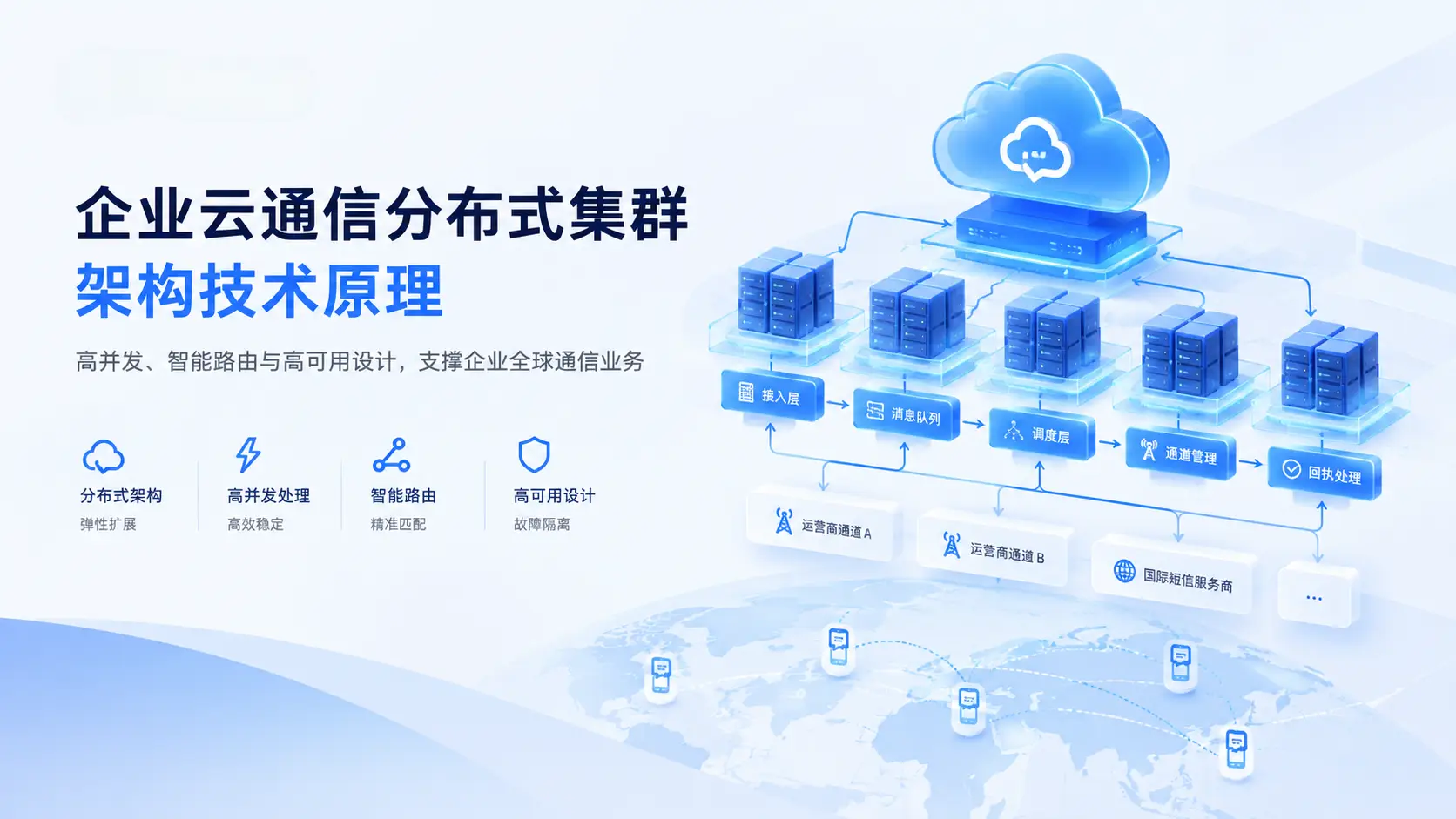
From the perspective of cloud communication platform architecture, complete SMS transmission usually involves six layers.
Enterprises access the SMS platform through HTTP API, REST API or the SMPP protocol. The business system submits data such as the target number, sending number, SMS content and business request.
The platform first performs identity authentication, interface permission validation, number format verification and request parameter checks.
For architectures using a unified messaging service, the association between the Campaign and the number may already be configured on the platform side, and the enterprise does not necessarily need to pass a Campaign ID separately in each API request.
Before SMS enters the sending queue, the system performs compliance checks based on the enterprise account, number and business campaign configuration. Main checks include:
For users who have made a valid unsubscribe request, the platform should promptly update the unsubscribe status and intercept during subsequent sending.
SMS that passes validation enters the message queue. The scheduling system allocates traffic according to sending priority, Campaign configuration, carrier limits and upstream route status.
In high-concurrency scenarios, the queue can buffer instantaneous sending peaks and prevent large numbers of API requests from directly hitting downstream routes.
At the same time, through rate control, failure retry, timeout handling and anomaly isolation mechanisms, the impact of a single upstream anomaly on the overall SMS business is reduced.
The SMS platform submits the processed SMS to the upstream CSP or SMS aggregation platform.
The upstream platform delivers SMS to the target carrier network based on the number, network interconnection relationships and corresponding communication resources.
The actual architecture may include one or more upstream providers, and different resources may differ in coverage, connection methods, rate limits and status receipt capabilities.
After SMS enters the US mobile carrier network, the corresponding network completes further message processing and terminal delivery.
Major US mobile carriers include: AT&T, T-Mobile and Verizon.
Carriers manage messages based on registration status, number and brand reputation, Campaign type, SMS content, user complaints and other network policies.
Therefore, completing 10DLC registration does not mean all SMS can pass carrier filtering unconditionally, nor does it directly equate to final delivery.
After SMS submission, the platform needs to continuously receive status receipts. DLR (Delivery Report) is used to feed back the processing result of the SMS in the downstream link.
It is usually necessary to distinguish:
These statuses are not exactly the same, and successful API submission cannot be directly regarded as the user having received the SMS.
In addition, when users reply with keywords such as STOP or HELP, the message needs to return to the platform through the inbound message link, triggering unsubscribe processing or help information responses.
Complete transmission path:
Enterprise business system
    │
    ▼
HTTP API / SMPP
    │
    ▼
Compliance validation
    │
    ▼
Message queue
    │
    ▼
Smart routing
    │
    ▼
Upstream aggregation platform
    │
    ▼
US carrier network
    │
    ▼
User mobile phone
Reverse link:
User reply → Carrier network → Upstream provider → SMS platform → Webhook → Enterprise business system.
Number registration is only a prerequisite for putting business into operation. Actual operating quality is also affected by brand registration status, Campaign type, SMS content, carrier traffic management and upstream network quality.
Trust Score is an important evaluation indicator in some Standard Brand registration processes.
It is generated based on the enterprise materials submitted by the brand and the corresponding evaluation mechanism, and may affect the default SMS throughput capacity of US A2P 10DLC.
Note that Trust Score is not adopted for all brand types and cannot be used alone as the basis for judging the final SMS delivery rate.
MPS (Messages Per Second) indicates the number of SMS billing segments that can be sent per second.
In the 10DLC system, throughput is affected by brand type, Campaign Use Case, Trust Score and carrier-related limits. For example, one SMS may be split into multiple SMS Segments due to length or character encoding. Therefore:
When planning high-concurrency SMS business, enterprises must schedule according to the actual Campaign and the throughput capacity allowed by carriers, and cannot simply infer total MPS by increasing the number of sending numbers.
DLR is an important technical indicator for judging the operating condition of the SMS route. Key monitoring items are recommended:
For cross-border e-commerce and financial business, DLR not only affects business statistics but is also directly related to business logic such as verification code retry, order reminders and exception alerts.
For enterprise marketing SMS, user authorization management and unsubscribe handling are important components of the communication system.
The platform should record the user authorization source, authorization time, corresponding business campaign and subsequent unsubscribe status.
When a user submits an unsubscribe request, the corresponding suppression list should be updated promptly, and subsequent marketing SMS that does not match the authorization status should be blocked.
This helps meet applicable legal and carrier policy requirements, and also helps control spam complaints and filtering risks.
During actual implementation, Campaign review usually requires more detailed business information than a simple enterprise material submission. The following are relatively common problems.
1. Inconsistent Enterprise Registration Materials
A clear correspondence cannot be established between the legal enterprise name, tax identification information, registered address and the website entity.
2. Unclear Campaign Business Description
Only broad purposes such as Marketing or Notification are filled in, without accurately explaining the SMS recipients, sending purpose and trigger mechanism.
3. Incomplete User Authorization Flow
The website only asks users to enter a phone number but does not clearly explain the SMS sender, SMS type and authorization method.
4. Privacy Policy Does Not Meet Requirements
The privacy policy cannot be publicly accessed, or does not explain the use of phone numbers and SMS authorization data as required by applicable rules.
5. SMS Samples Inconsistent with Actual Business
Verification code business is submitted during registration, but large volumes of marketing content are sent in production, causing a mismatch between the registered purpose and real traffic.
6. Numbers Not Associated with the Corresponding Campaign
The enterprise has purchased US local numbers but has not completed the corresponding number association or messaging service configuration, so actual sending does not meet registration requirements.
7. Sending Traffic Exceeds Configured Limits
The sending program does not rate-limit according to the actual MPS of the Campaign and carrier, submitting a large number of SMS in a short period and causing queue backlog or downstream throttling.
Solving these problems cannot rely only on resubmitting materials; it also requires checks at multiple levels including enterprise entity, business scenario, sending behavior and communication architecture.
For cross-border e-commerce, fintech, overseas gaming and SaaS enterprises, 10DLC route planning needs to consider compliance registration, communication quality and future business expansion at the same time. The following five tasks are recommended:
First, complete enterprise brand material verification in advance.
Before formal application, organize enterprise registration materials, official website, entity identification information and contact materials, ensuring information consistency and compliance with the registration requirements supported by the provider.
Second, plan Campaigns based on real business.
Verification codes, order notifications, customer service and marketing promotion should be classified according to real purposes, and cannot be mixed arbitrarily to reduce registration work.
Third, establish a mapping between numbers and business.
The platform should clearly define the Campaign, business type and usage permissions corresponding to each sending number, avoiding inconsistency between number configuration and actual sending content.
Fourth, design a dynamic traffic scheduling mechanism.
In combination with Campaign MPS, carrier limits and upstream route status, set reasonable concurrency policies, message queues and rate limiting mechanisms.
Fifth, establish a complete communication monitoring system.
Continuously monitor SMS submission status, DLR, inbound messages, unsubscribe information and anomalies of different carriers to form a complete business closed loop.
What enterprises need is not just a US local number, but a complete communication solution from brand registration, SMS campaign review to route access, traffic scheduling and status monitoring.
US 10DLC number registration is essentially a registration mechanism in the US A2P commercial SMS ecosystem that manages the association of enterprise brands, SMS campaigns and sending numbers.
From a technical perspective, complete 10DLC implementation involves multiple links such as TCR brand registration, Campaign review, number association, upstream provider access, carrier network transmission and DLR status monitoring.
Among them, number registration solves the registration problem of the SMS sending entity and business purpose, while route architecture, traffic control, routing scheduling and status receipts determine the operating quality of SMS business in the production environment.
For enterprises conducting long-term US market business, only by combining compliance registration with stable communication infrastructure can they build sustainable, monitorable and scalable international SMS communication capability.
YaningAI Cloud Communication Platform
Focusing on international cloud communication services, providing international SMS and email communication capabilities for enterprise globalization. For enterprise SMS business targeting the US market, YaningAI provides international SMS business planning and technical support across communication access, SMS API, route resource evaluation and status receipts. From number access to business implementation, making global enterprise communication more stable, transparent and controllable.
US 10DLC number registration is a registration process in the US carrier A2P SMS management system. Enterprises sending application-type SMS through US ten-digit local long numbers need to complete brand registration, Campaign registration and number association steps.
It usually includes enterprise material preparation, Brand Registration, Campaign Registration, number association, route configuration and production environment testing. The specific process may vary by communication service provider.
Brand Registration is used to identify the true identity of the SMS sending enterprise; Campaign Registration is used to explain what type of SMS the enterprise specifically sends and how users authorize receiving. Together they establish the correspondence between enterprise identity and business purpose.
It depends on the enterprise registration regions, business entity types and tax identification materials supported by the registration provider. Overseas enterprises should confirm in advance whether the provider accepts business registration documents for the corresponding country or region, and cannot assume all foreign entities can complete review with the same registration materials.
It cannot be simply understood that way. Number purchase, brand registration, Campaign review and number association are different steps. Only when the corresponding registration and carrier sending requirements are met is the number suitable for the corresponding A2P SMS business.
Not necessarily. Registration approval only satisfies the corresponding sending registration requirements and does not guarantee the final delivery rate. SMS content, user authorization, number status, carrier filtering policies, upstream network quality and sending rate all affect final delivery.
MPS stands for Messages Per Second, which is the number of SMS sending segments per second. The quota is affected by Brand type, Campaign type, Trust Score and carrier-related rules. Because a long SMS may be split into multiple Segments, MPS should not be directly equated with the number of API requests.
It cannot be simply assumed that one number can be used for all Campaigns without restriction. The specific number association method, available quantity and configuration limits must be determined according to the registration platform, provider and carrier rules, and the actual sending purpose must also match the corresponding registered business campaign.