
 By Samuyl Joshi
In international SMS business, sending latency is a communication problem enterprises often encounter. Verification codes that fail to arrive in time, order notifications that cannot be delivered promptly, and marketing SMS that misses user active hours all affect user experience and business conversion.
So why is SMS latency high? Is slow international SMS delivery caused by the SMS platform, the route, or the target carrier network?
From the perspective of cloud communication architecture, SMS latency is not determined by a single link, but is jointly affected by multiple factors such as the message queue, SMS gateway, international communication routing, the carrier SMSC (short message service center) and the terminal network status.
To truly solve international SMS latency, it is necessary to start from the end-to-end communication link, analyze the processing time of each node, and carry out targeted optimization through distributed architecture, smart routing and end-to-end monitoring.
Before analyzing the causes of SMS latency, it is necessary to understand the basic transmission process of international SMS.
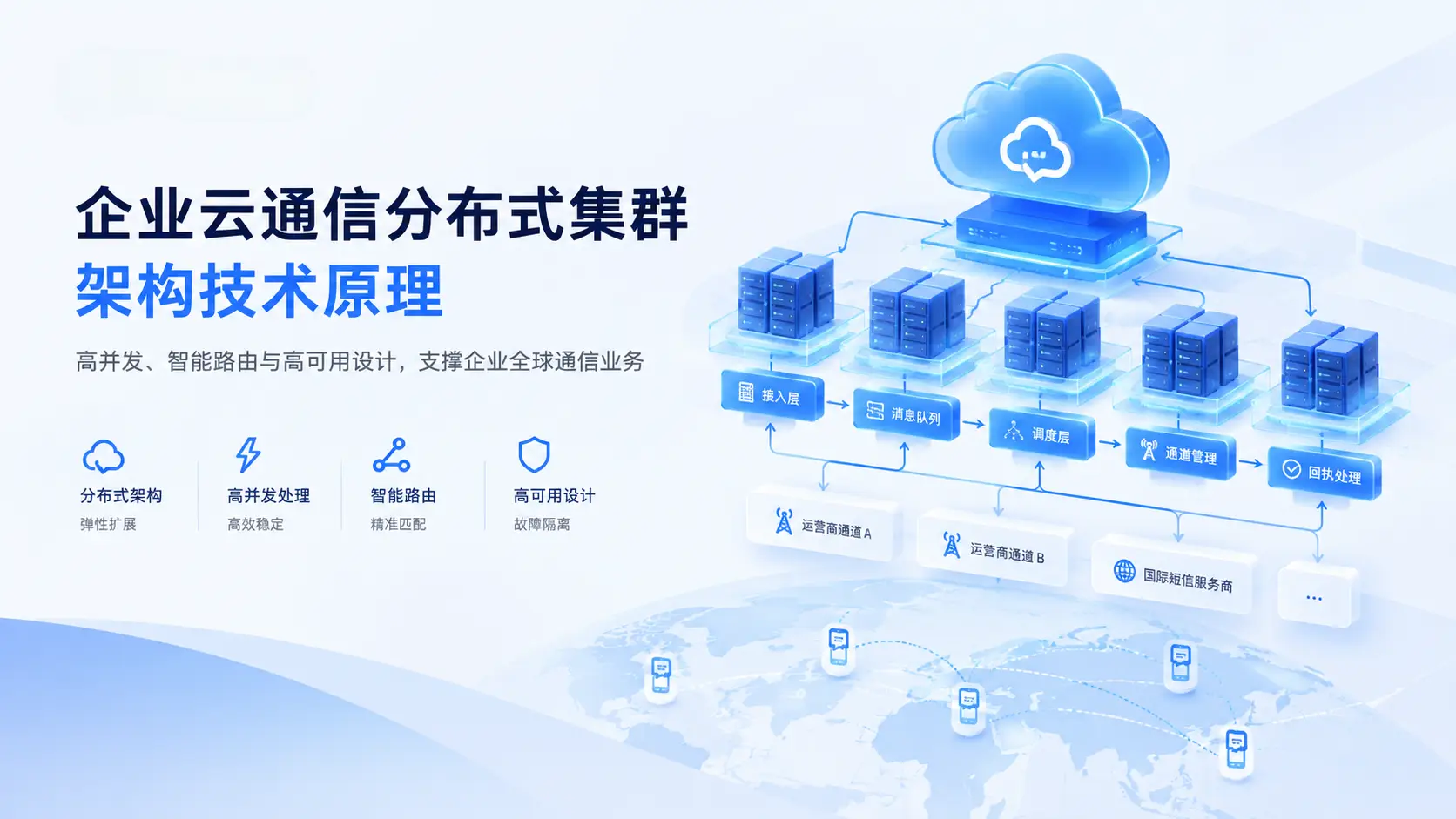
Enterprises submit SMS requests to the cloud communication platform via HTTP API or the SMPP protocol. After identity verification, content validation and message processing, the platform distributes tasks to the corresponding international SMS route through the message queue. Upstream providers and carrier networks then complete the forwarding, and the message finally reaches the target mobile phone.
A typical international SMS transmission process is as follows:
Enterprise business system
    │
    ▼
API / SMPP access gateway
    │
    ▼
Message processing center
    │
    ▼
Message queue
    │
    ▼
Smart routing system
    │
    ▼
International SMS gateway
    │
    ▼
Upstream carriers and SMSC
    │
    ▼
User mobile phone
Communication network architectures differ across countries and regions, and some SMS messages may also pass through international SMS aggregation platforms or multiple network forwarding nodes.
In this chain, queuing, congestion, timeout or processing anomalies at any link may cause SMS sending latency.
It is especially important to note that a successful submission returned by the enterprise platform does not mean the SMS has been delivered to the user mobile phone. Submission confirmation, carrier acceptance and final delivery are different statuses that must be judged together with the delivery status report (DLR).
The message queue is an important infrastructure of the cloud communication platform. It is mainly used to buffer SMS requests, decouple business systems from SMS gateways, and control the downstream message sending speed.
When enterprises send a large number of SMS messages in a short period, such as e-commerce promotions, financial verification code verification or concentrated registration of overseas applications, the instantaneous request volume may exceed the current processing capacity of the system.
If the message production speed remains higher than the processing speed of consumers, a message queue backlog will form.
Common symptoms include:
For example, suppose the SMS platform receives 10,000 SMS requests per second, but current consumers can only process 6,000 per second. Continuous operation will produce a backlog.
Optimization solution:
Adopt a distributed message queue architecture and reasonably divide message tasks by country, business type and route dimensions.
Improve consumption capacity through a multi-consumer parallel processing mechanism, and dynamically adjust resources based on real-time queue length, message waiting time and consumption rate.
For time-sensitive businesses such as verification codes and transaction notifications, independent queues or priority scheduling policies can also be set up to prevent marketing traffic from affecting important messages.
The SMS gateway is an important entry point between enterprise business systems and communication networks.
When enterprises submit SMS via HTTP API or the SMPP protocol, the gateway needs to complete identity verification, number parsing, parameter validation, content encoding, template checking and message distribution.
If the gateway uses a large number of synchronous blocking processing methods, problems such as insufficient thread resources, connection pool exhaustion and database request blocking are likely to occur under high concurrency.
Unreasonable SMPP connection configuration can also affect SMS sending efficiency.
Common problems include:
Optimization solution:
Adopt an asynchronous non-blocking I/O model in the access architecture to improve gateway concurrency processing capacity.
For SMPP connections, reasonably configure persistent Bind connections, connection pools, sending windows and the Enquire_Link heartbeat mechanism according to the provider configuration.
At the same time, reasonably set API rate limiting and sending rate control, and decouple request reception, data validation, message enqueueing and actual downstream sending, so as to prevent the gateway from becoming the main bottleneck of SMS latency during peak hours.
Compared with domestic SMS, international SMS involves network interconnection between different countries, regions and carriers, and the transmission paths are more diverse.
An international SMS may pass through multiple nodes such as the enterprise communication platform, international SMS aggregators, upstream carriers and the target country carrier.
During multi-level forwarding, factors such as node queuing, link congestion and unstable interconnection quality may all increase message transmission time.
Common problems include:
It should be emphasized that SMS route quality cannot be judged simply by the number of intermediate nodes. Actual transmission latency is also affected by carrier interconnection relationships, routing policies, network load and business priority.
Optimization solution:
Establish a smart SMS routing and scheduling system that dynamically selects the appropriate transmission route based on the target country, carrier, real-time route performance and historical data.
For key business markets, prioritize evaluating local carrier direct-connection resources to reduce unnecessary intermediate forwarding.
At the same time, establish a multi-route quality evaluation mechanism to continuously analyze route submission response time, final delivery latency, success rate and failure reasons.
When a route becomes abnormal, switch to a backup route according to business rules.
Note that before switching routes, the submission and acceptance status of the original message should be confirmed to avoid duplicate sending.
The SMSC (short message service center) is an important component of the SMS business in mobile communication networks, undertaking functions such as SMS storage, forwarding and status processing.
In a typical SMS network, when the target user is temporarily unable to receive the SMS, the SMSC can temporarily store the message according to carrier policy and retry delivery when conditions are met later.
Therefore, even if the enterprise SMS platform has successfully submitted the message, it does not mean the target mobile phone has received the SMS.
The following problems may occur on the carrier side:
Optimization solution:
The cloud communication platform should establish a complete upstream status feedback and message tracking mechanism.
Distinguish temporary errors, permanent errors and unknown-result anomalies based on the status codes returned by carriers.
For temporarily unreachable terminals, set a reasonable retry strategy based on carrier feedback and SMS validity period; for unrecoverable states such as invalid numbers or user unsubscription, stop invalid retries.
In addition, independent quality profiles should be established for different countries and carriers to promptly identify carrier network congestion and route quality fluctuations.
SMS content encoding is also a factor affecting international SMS processing efficiency.
Common encoding methods include GSM 7-bit and UCS-2.
GSM 7-bit is mainly used for content within the range supported by its character set, while Chinese and other Unicode characters usually need to use UCS-2 encoding.
Because different encoding methods have different single-SMS carrying capacities, when the SMS content exceeds the single-message capacity limit, long message segmentation is required.
Segmented SMS messages are usually associated through mechanisms such as UDH (user data header), and the receiving terminal combines and displays them according to corresponding rules.
Long message segmentation may bring:
Optimization solution:
Automatically detect the character set, encoding format and number of SMS segments before SMS submission.
For services such as verification codes and login notifications, simplify the content as much as possible, reduce unnecessary special characters, and avoid segmentation caused by overly long templates.
For international markets, design SMS templates reasonably based on the target country language and carrier support, and correctly handle GSM 7-bit, UCS-2 and long message concatenation logic.
During international SMS transmission, network timeouts, abnormal upstream responses or temporary sending failures may occur.
At this time, the communication platform usually needs a retry mechanism to improve the message transmission success rate.
However, if the retry logic is unreasonable, it may produce a retry storm, further aggravating route congestion and platform resource consumption.
For example, when an international SMS route becomes abnormal, the platform repeatedly submits a large number of failed requests in a short period, which may cause both the original route and the backup route to bear additional traffic.
In addition, if the system cannot distinguish between a real sending failure and a response timeout, users may receive duplicate SMS messages.
Optimization solution: adopt a graded retry mechanism:
By properly designing the retry mechanism, SMS transmission reliability can be improved while reducing the impact of abnormal traffic on the overall communication system.
Solving SMS sending latency cannot rely solely on switching routes; comprehensive optimization is required across multiple levels such as communication platform architecture, route resources, message scheduling and carrier networks.
Improve task processing capacity in high-concurrency environments through distributed message queues, multi-node consumption and elastic scaling.
Reasonably allocate message tasks based on country, business type and priority to reduce the processing pressure of a single queue.
At the same time, monitor message waiting time and queue backlog in real time to detect potential bottlenecks promptly.
Network quality varies between different countries and carriers.
The platform needs to dynamically adjust routing policies based on data such as the carrier to which the target number belongs, historical route quality, real-time latency and success rate.
Through multi-route resource management and quality evaluation, long-term dependence on a single route is avoided, improving the stability of international SMS transmission.
For SMPP protocol access, reasonably configure connection pools, Bind connections, message windows, heartbeat detection and concurrent sending parameters.
Carry out rate control in combination with upstream authorized TPS to reduce latency caused by connection rebuilding, request blocking and over-limit sending.
SMS latency optimization must be built on a complete data link.
It is recommended to record time for the following key nodes:
| Monitoring node | Main monitoring metrics |
|---|---|
| API access | Request reception time, API response time |
| Gateway processing | Parameter validation, message processing time |
| Message enqueueing | Time when the message enters the queue |
| Queue consumption | Message waiting time, consumption speed |
| Upstream submission | Submission response time, timeout rate |
| DLR receipt | Upstream status report time, final status |
| Delivery statistics | Time difference between submission and delivery |
Associate different systems and upstream receipts through a unified message ID to form a complete SMS link tracking system.
At the same time, focus on P50, P95 and P99 latency metrics rather than just average latency.
Specifically:
These metrics help identify a small number of long-tail latency problems with obvious impact.
Independent route quality evaluation systems should be established for different countries and carriers.
Focus on:
Through long-term data accumulation and real-time monitoring, abnormal routes can be detected promptly and routing weights adjusted according to business needs.
Note that submission success rate and final delivery rate are two different metrics; successful platform submission cannot be directly equated with final receipt by the user.
When enterprises encounter slower international SMS sending, a preliminary judgment can first be made based on business performance.
Scenario 1: The API responds normally, but the SMS has not been delivered for a long time.
Prioritize checking message queue backlog, upstream submission status and carrier network feedback.
Scenario 2: SMS latency is severe only in some countries.
Focus on checking the international SMS routes of the target countries, carrier interconnection relationships and routing and scheduling policies.
Scenario 3: SMS latency increases significantly during peak hours.
Focus on troubleshooting platform TPS, gateway concurrency, message queue consumption capacity and upstream carrier traffic control.
Scenario 4: The SMS has been submitted successfully, but the DLR receipt has not returned for a long time.
Check the upstream receipt push link, status association and receipt processing service. Receipt latency does not directly prove that the SMS has not been delivered.
By classifying different symptoms, the link where SMS latency occurs can be located more accurately, avoiding blind route switching without a clear cause.
For enterprises with overseas business layouts, the choice of an international SMS platform is not only related to sending costs, but also directly affects the reach efficiency of verification codes, user notifications and marketing business.
When evaluating international SMS service providers, it is recommended to focus on the following capabilities:
1. Global route resources
Whether the target countries and regions are covered, and whether stable local carrier direct-connection routes and multi-route resources are available.
2. Smart routing capability
Whether dynamic routing and scheduling based on country, carrier and route quality is supported.
3. High-concurrency processing capacity
Whether distributed architecture, message queues and elastic scaling capabilities are available to meet sending needs during business peak hours.
4. Complete status receipts
Whether DLR status tracking is supported and whether different statuses such as successful submission, sending failure and final delivery can be distinguished.
5. Technical integration and service capability
Whether access methods such as HTTP API and SMPP are supported, and whether complete technical documentation, a test environment and troubleshooting support are provided.
For international SMS business, what is really worth focusing on is not the simple sending price, but route quality, actual reach performance and long-term service stability.
SMS latency is not a simple network problem, but a comprehensive technical problem involving business systems, communication gateways, message queues, routing and scheduling, carrier SMSCs and user terminals.
Effectively solving SMS latency requires continuous optimization in three aspects:
YaningAI focuses on international cloud communication services, providing enterprises with international SMS and global communication solutions. It supports access methods such as HTTP API and SMPP, helping enterprises optimize cross-border communication links and improve global user reach efficiency.
Whether cross-border e-commerce, fintech, overseas games or internet applications, all need a stable, reliable international SMS infrastructure with continuous optimization capability.
Choose the right international SMS service to make global business communication more stable and efficient.
International SMS latency is usually caused by multiple links together, including message queue backlog on the SMS platform, insufficient SMS gateway processing capacity, unreasonable international routing, carrier SMSC congestion and abnormal user terminal networks. Full-link analysis combining API submission time, upstream response time and DLR status is needed to accurately locate the problem.
A successful sending status on the platform usually only means the SMS request has been accepted by the platform or an upstream provider, and does not necessarily mean the SMS has been delivered to the user mobile phone. Further checks should cover the carrier status report (DLR), final delivery status, target number status and carrier network conditions.
There is no unified standard for international SMS delivery time that applies to all countries and carriers. Actual latency depends on the target country, carrier network, route quality, platform processing capacity and terminal status. Enterprises should evaluate route latency through real sending data for specific countries and carriers rather than relying solely on the provider promises.
Optimization can be carried out in five aspects: improving SMS gateway concurrency processing capacity, reducing message queue backlog, optimizing SMPP connection configuration, establishing a smart routing and scheduling mechanism, and selecting international SMS routes with stable transmission quality. At the same time, actual delivery latency should be continuously analyzed through end-to-end monitoring.
Not necessarily. Direct-connection routes can reduce some intermediate forwarding links, but final transmission efficiency is also affected by carrier interconnection quality, network load, SMSC processing capacity and target terminal status. Evaluation should be based on actual delivery data for specific countries and carriers.
SMS latency usually focuses on the time from enterprise submission to final delivery to the user mobile phone. DLR receipt latency focuses on the time required for the carrier status report to return to the communication platform. The two are not exactly the same; a slow receipt return does not necessarily mean the SMS was actually delivered slowly.
Providing international SMS communication solutions for cross-border e-commerce, fintech, overseas games and internet enterprises.
Global SMS Resources
International SMS services covering multiple countries and regions
Smart Routing and Scheduling
Reasonable communication route selection based on route quality
Flexible API Access
Supporting communication access methods such as HTTP API and SMPP
Looking for a stable international SMS service provider?
Contact YaningAI to learn about route resources in target countries, technical integration and international SMS solutions.
Contact an Expert