The Role of Message Queue in SMS Systems | How MQ Improves SMS Platform Stability and High Concurrency Capability
In SMS systems, what truly determines platform stability is not simply "sending speed", but the overall scheduling capability of the system in high-concurrency scenarios. Especially in businesses such as APP verification code login, overseas user registration, e-commerce marketing notifications, international SMS batch sending, and financial transaction reminders, SMS platforms often face the problem of instantaneous traffic spikes. For example, 300,000 SMS requests triggered within 1 second after an activity starts. If the system adopts a synchronous sending architecture, it will experience API timeouts, channel blocking, database connection exhaustion, carrier TPS saturation, and the entire platform avalanche. Therefore, most mature cloud communication platforms will introduce Message Queue as core infrastructure.
I. What is Message Queue (MQ)?
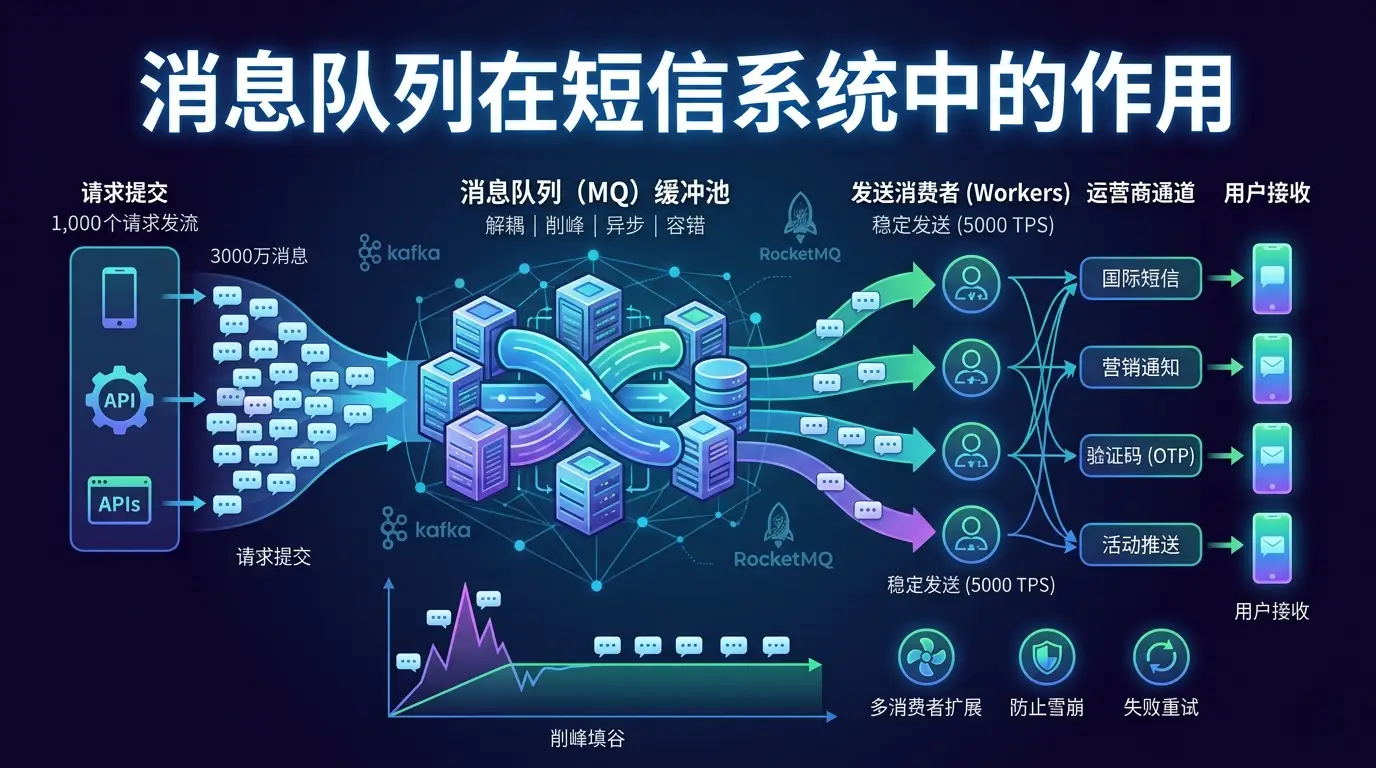
Message Queue (MQ) is a typical asynchronous architecture component. In SMS systems, its core role is to decouple "SMS request reception" from "actual SMS sending". The typical SMS sending chain is as follows: Client/API → Access Layer Gateway → Message Queue MQ → Sending Consumer Worker → SMS Routing System → Carrier Channel → User Mobile Phone. Simply put, MQ is more like a "high-concurrency buffer center", where the system first receives requests and then completes actual sending at a controllable pace.
II. Why Must SMS Systems Use MQ?
1. Peak Shaving and Valley Filling, Solving High Concurrency Problems: This is the most important role of message queues in SMS platforms. For example, a verification code system instantaneously receives 500,000 OTP requests, but the carrier channel actually supports 5000 TPS. If sent directly synchronously, channel congestion, API timeouts, and service unavailability will occur. MQ will first cache requests, and the backend will stably consume at 5000 TPS, so even if the system encounters traffic peaks, it will not instantly crash. This is also the core method for large SMS platforms to achieve high-concurrency architecture. 2. Implementing Asynchronous SMS Sending: SMS sending is not an "instantly completed" action. The actual process usually includes parameter validation, template matching, blacklist filtering, user frequency control, routing calculation, channel selection, submission to communication carriers, and receipt reception. If all executed synchronously, API response time will significantly increase. Therefore, mature SMS platforms usually adopt API fast response + backend asynchronous sending. After user submission, the system can immediately return, and the actual sending action is asynchronously processed by the MQ backend. This model can significantly improve API throughput capability, user experience, and system concurrency performance.
III. How Does MQ Improve SMS Platform Stability?
1. Service Decoupling, Avoiding System Avalanche: SMS platforms usually rely on multiple services, including Redis, MySQL, routing engines, HLR queries, risk control systems, and international carrier interfaces. Any link anomaly may cause the entire chain to block. The role of MQ is to isolate faults. For example, if an international SMS carrier interface times out, the system will not directly crash, but messages will continue to accumulate in MQ waiting for channel recovery. This is also a key design philosophy of high-availability SMS systems. 2. Supporting Failure Retry Mechanism: International SMS scenarios often experience network jitter, Carrier Error, temporary rejection, TPS limit, and channel fluctuations. Therefore, mature SMS platforms usually design Retry Queue. After sending fails, they enter the retry queue for delayed re-sending, thereby improving overall SMS delivery rates. 3. Supporting Horizontal Scaling: With business growth, from daily sending of 1 million to daily sending of 100 million, SMS systems must have horizontal scaling capabilities. MQ can easily achieve from 1 consumer to 10 consumers to 100 consumers, with multiple Workers consuming in parallel. This is an important capability for SMS platforms to achieve large-scale concurrent sending.
IV. Applications of Message Queue in Different SMS Businesses
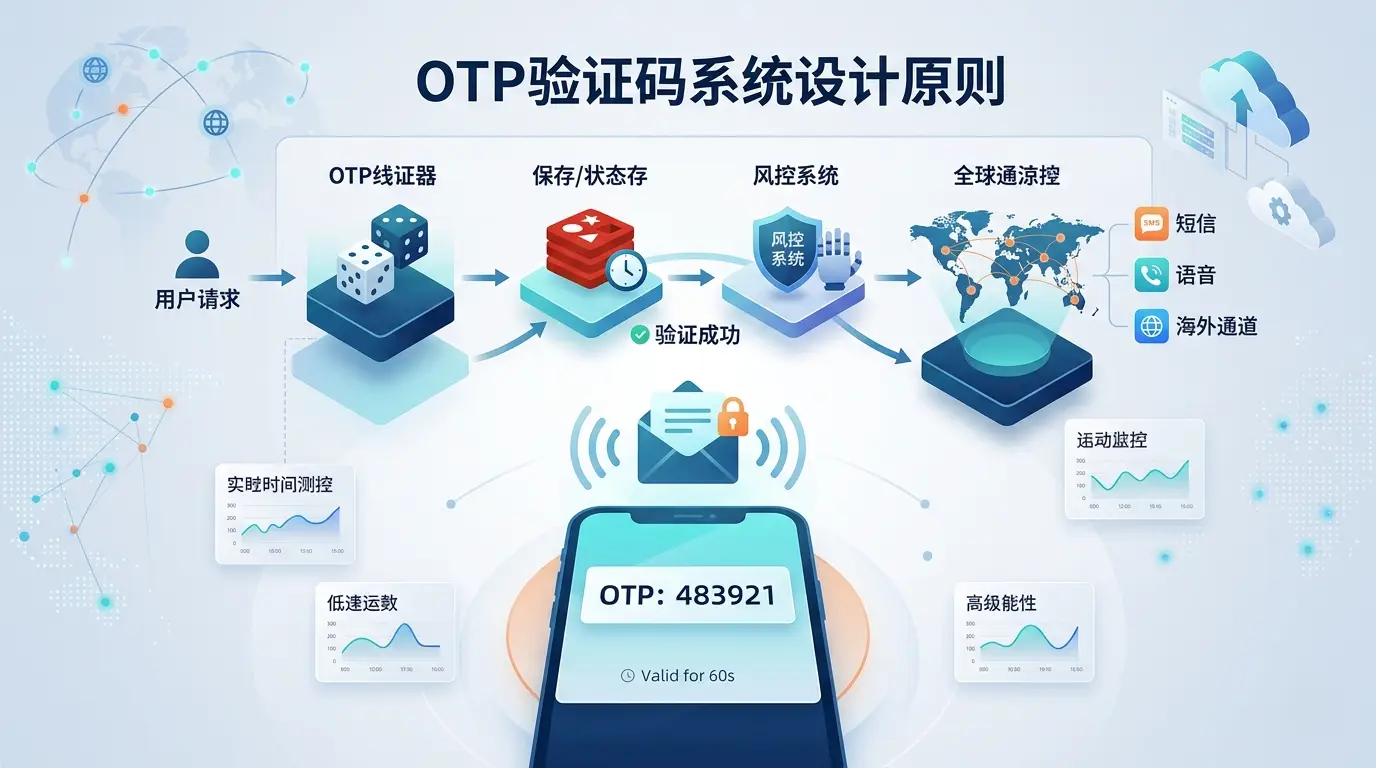
OTP Verification Code SMS System: Characteristics include high real-time, high concurrency, and strong stability. MQ is mainly used for request buffering, rate limiting protection, asynchronous receipts, and peak control. International SMS Platform: International SMS chains are more complex, involving countries, carriers, channels, delivery rates, and costs. MQ can help platforms achieve dynamic routing switching, channel degradation, national-level flow control, and automatic retry. This is also the core reason why international cloud communication platforms widely adopt MQ. Marketing SMS System: Marketing SMS usually has batch sending, long task cycles, and multi-country distribution characteristics. MQ can achieve batch splitting, sending scheduling, channel rate limiting, and phased delivery, avoiding large-scale marketing tasks affecting verification code businesses.
V. Common MQ Technology Selections for SMS Systems
Kafka: Suitable for ultra-large-scale SMS platforms, massive marketing SMS, and real-time log analysis. Characteristics include high throughput, strong distributed capabilities, and support for million-level message streams. RabbitMQ: Suitable for OTP verification code systems, small and medium-sized SMS platforms, and high-reliability asynchronous businesses. Characteristics include mature delay queues, flexible routing capabilities, and high message reliability. RocketMQ: Suitable for enterprise-level cloud communication platforms, financial-grade message systems, and domestic large-scale internet architectures. Characteristics include strong ordered message capabilities, support for transactional messages, and mature high-reliability design.
VI. Advanced MQ Architecture in High-Availability SMS Systems
Mature SMS platforms usually do not have only one queue, but include access queues, sending queues, retry queues, receipt queues, dead letter queues, and monitoring queues. For example, Dead Letter Queue (DLQ): When messages fail multiple times, after Retry 3 times fail, they enter DLQ, and the system can automatically alert, manually investigate, analyze anomalies, and isolate risks. Delay Queue: Suitable for scheduled marketing SMS, phased delivery, and channel flow control. For example, automatically sending marketing SMS at 8 PM can enter MQ in advance and be consumed on schedule.
VII. MQ Is Not a "Universal Solution"
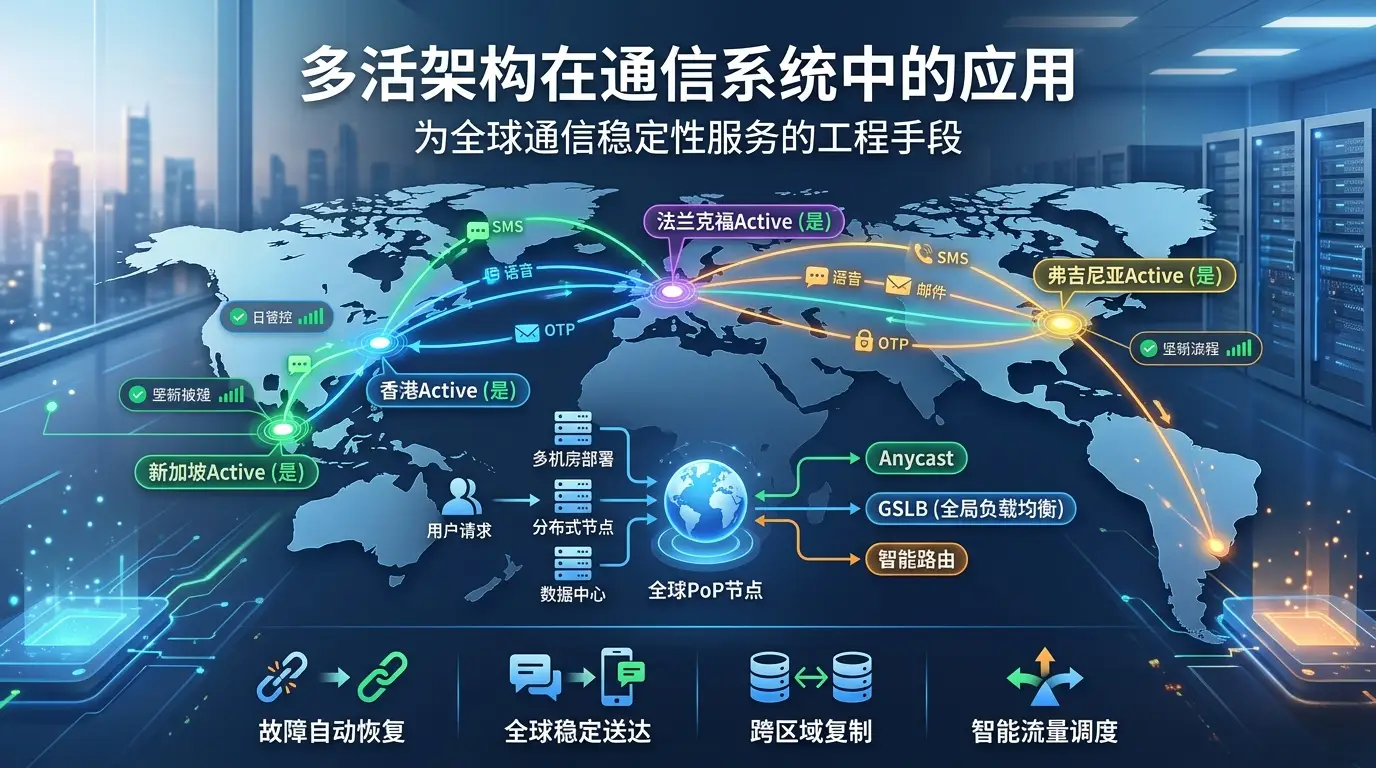
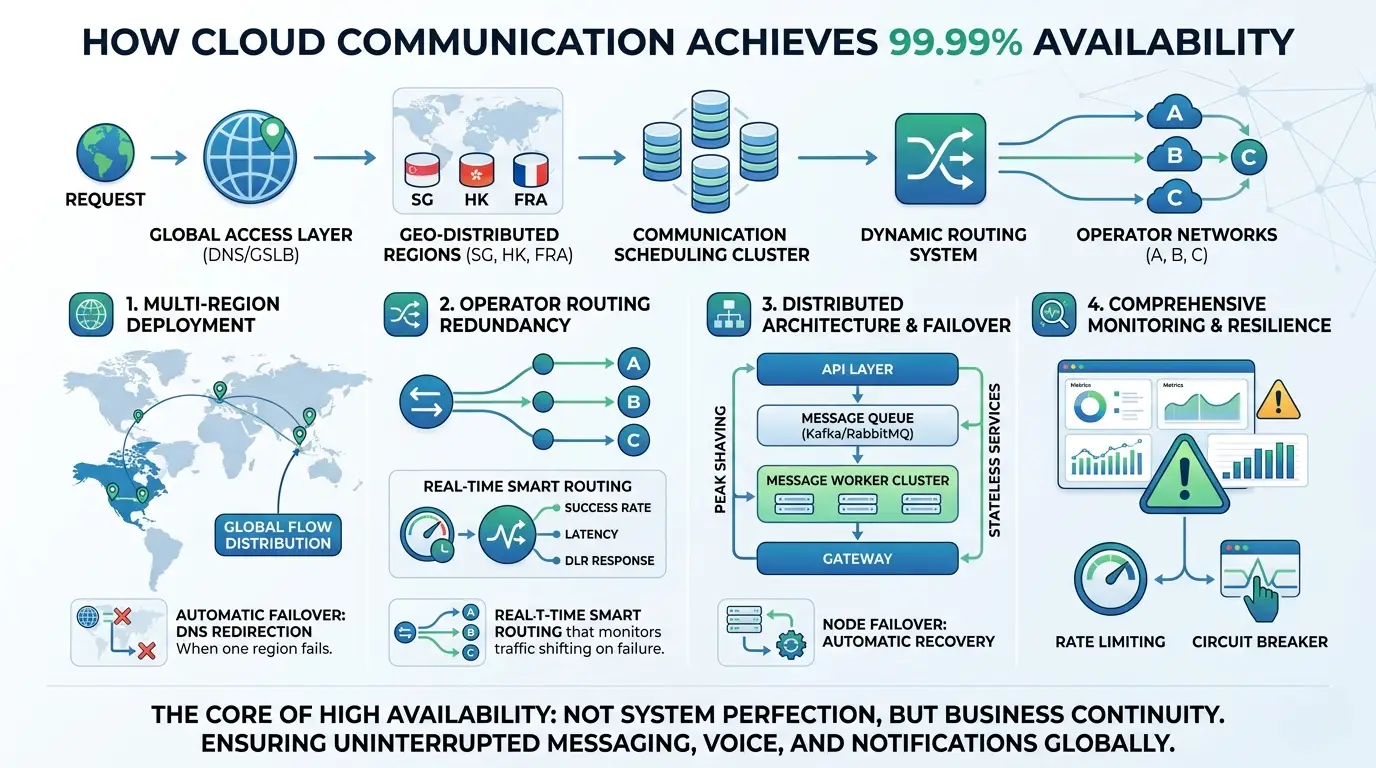
Many enterprises think "using MQ makes the system stable", but this is not actually the case. If the architecture design is unreasonable, MQ itself may also become a bottleneck. Common problems include message accumulation, duplicate consumption, message loss, Broker single point of failure, consumption delay, and order disorder. Therefore, mature SMS platforms also need ACK mechanisms, idempotent design, message persistence, automatic scaling, multi-data center disaster recovery, and rate limiting circuit breaking. MQ is an important part of high-availability architecture, but not the whole.
VIII. Why Do Large Cloud Communication Platforms Heavily Rely on MQ?
Because SMS systems are essentially high concurrency + strong asynchronous + high peak + high reliability. And message queues happen to be the core infrastructure for solving these problems. Without MQ, SMS platforms find it difficult to truly achieve million-level concurrent sending, global SMS scheduling, high delivery rates, second-level scaling, and high-availability disaster recovery. Especially in international cloud communication scenarios, MQ is no longer an "optimization component" but standard infrastructure.
IX. How Do Enterprises Choose the SMS System Architecture Suitable for Them?
If enterprises are building verification code SMS platforms, international SMS systems, overseas marketing platforms, cloud communication platforms, or CPaaS architectures, it is recommended to focus on MQ throughput capabilities, channel scheduling mechanisms, asynchronous architecture design, multi-data center disaster recovery, retry and receipt systems, and global carrier adaptation capabilities. A mature SMS system is not just "able to send SMS", but more importantly, remains stable and controllable in high-concurrency and complex network environments.
X. Want to Build a High-Availability SMS Platform?
We provide international SMS APIs, OTP verification code systems, global carrier direct connections, high-concurrency message scheduling architectures, multi-channel intelligent routing, and enterprise-level cloud communication solutions. Supporting SMS, WhatsApp, Email, Voice, and RCS, covering global business scenarios, helping enterprises build stable, secure, and high-delivery-rate communication capabilities.