2026 International SMS Failure Error Codes: 7 Common Reasons and Solutions | Improve OTP SMS Delivery Rate
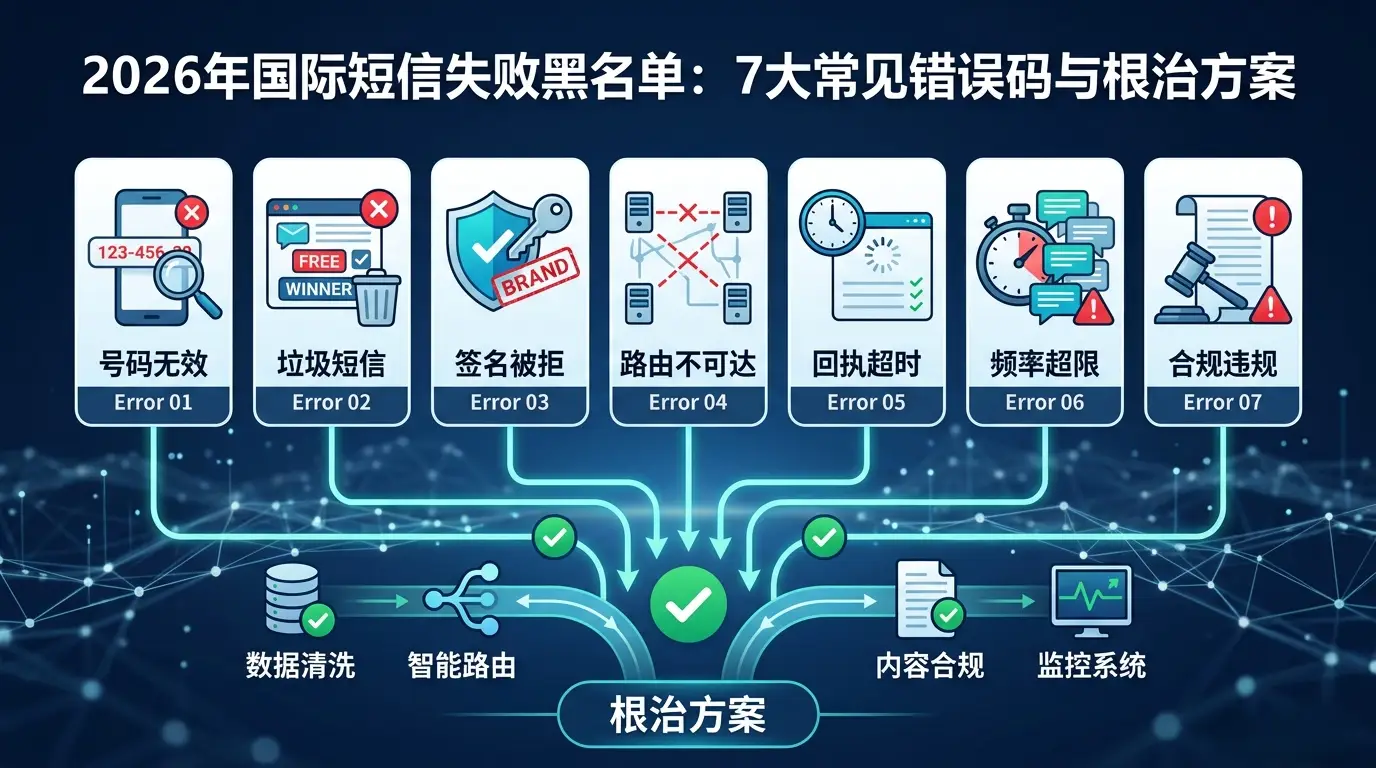
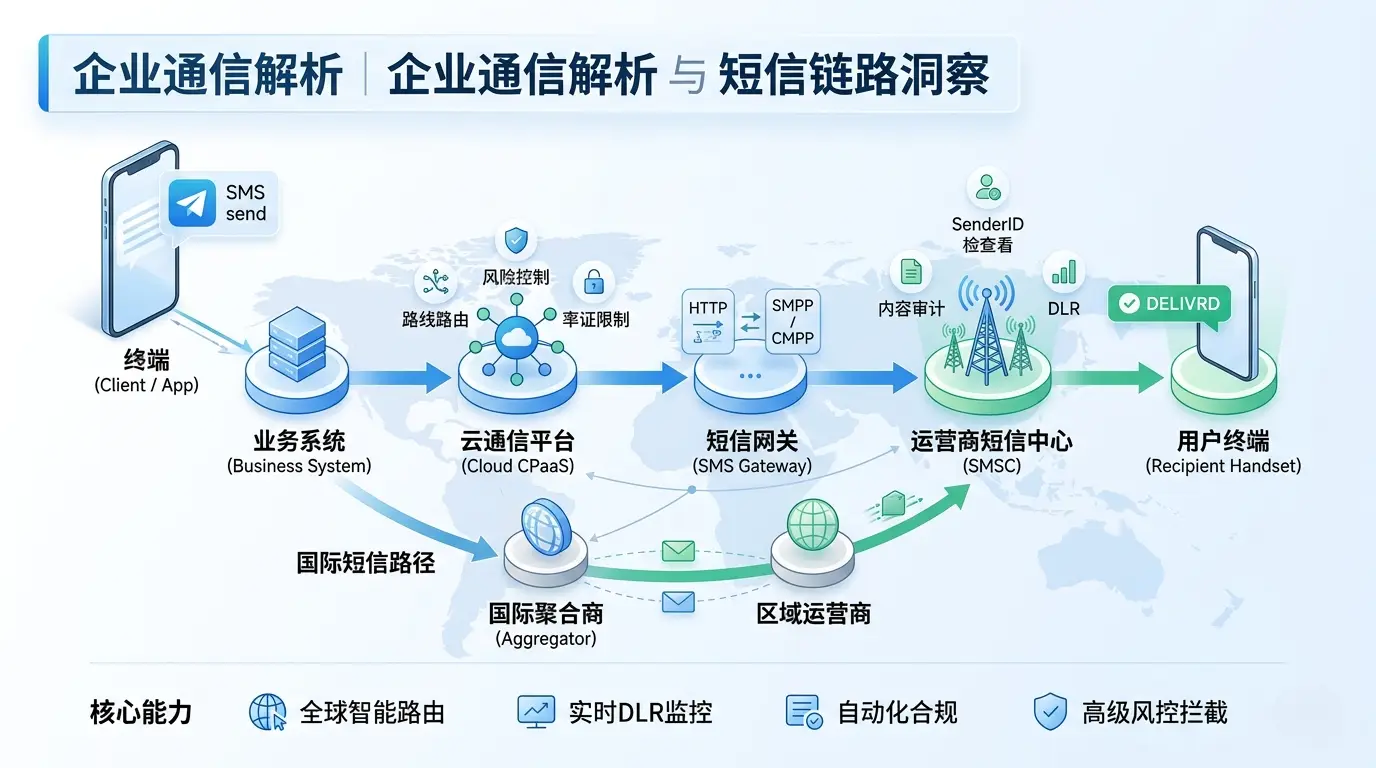
Many enterprises encounter a typical problem after accessing international SMS platforms: the API shows successful sending, but users do not receive the SMS at all. Especially in scenarios such as overseas APP registration, OTP verification code login, international e-commerce notifications, financial risk control verification, and overseas SaaS, SMS failures directly affect user conversion rate, registration success rate, payment success rate, and risk control verification efficiency. But the real problem is: most enterprises only see "sending failed" but do not know which layer failed. The international SMS link involves carriers, international gateways, aggregation channels, Sender ID, content risk control, local compliance, and DLR status receipts. Any abnormal link may cause SMS delivery failure. This article systematically analyzes the 7 most common failure error codes for international SMS in 2026, as well as enterprise-level platform governance solutions.
I. Invalid Number
Common high-frequency error code returns: Invalid MSISDN, Unknown Subscriber, Number Not In Service, Unallocated Number. This is one of the highest proportion problems in international SMS sending failures. Why do international SMS numbers fail? Carriers first verify whether the mobile number exists, complies with international number specifications, supports international SMS, and has been canceled. For example: Wrong format 0912345678, Correct E.164 format +63912345678. Common pitfalls for enterprises: 1. Southeast Asian number formats are not uniform, especially in the Philippines, Indonesia, and Thailand, where users often retain the local leading 0; 2. User data pollution, typical issues include Excel scientific notation, OCR recognition errors, spaces and special characters, and missing country codes. Enterprise-level solutions: It is recommended to establish a number preprocessing system, including E.164 standardization, country code identification, number length verification, HLR Lookup, and blacklist filtering.
II. Spam Rejected
Why is SMS content blocked? Carrier risk control has been fully upgraded in 2026. It is no longer just keyword filtering, but AI content recognition, URL risk scoring, Sender Reputation, and template stability analysis. Especially in India, the United States, Indonesia, and the Middle East, the spam SMS interception rate has increased significantly. High-frequency triggering reasons: Short link risks (such as bit.ly, tinyurl, t.co, many carriers directly consider them high-risk), excessive marketing words (such as FREE, BONUS, WINNER, CASINO), and frequent template changes (carriers increasingly rely on Template Fingerprint, frequent template changes easily trigger risk control). International SMS anti-blocking solutions: It is recommended to establish content review systems, sensitive word filtering, URL reputation detection, link risk control, template hash systems, country strategy databases, and AI Spam Score content risk scoring.
III. Sender ID Rejected
Why is international SMS sender ID rejected? Many countries have implemented Sender real-name registration, SMS signature filing, and whitelist mechanisms. Not all countries allow custom signatures. High-risk countries: India (DLT registration), United States (10DLC), Singapore (Sender Registry), United Arab Emirates (Sender whitelist). Common failure scenarios: Unregistered signatures (such as PAYPAL, BANK, AMAZON, carriers usually reject them directly), signatures inconsistent with content (such as signature SHOPXX, content bank verification code, easily judged as fraudulent SMS). Enterprise-level governance solutions: It is recommended to establish a Sender ID lifecycle management system, including country rule management, Sender review, template binding, and channel routing binding.
IV. Route Unavailable
Why does international SMS "show success but not delivered"? Because the real international SMS link is far more complex than imagined. Real path: Enterprise system → SMS API platform → International aggregator → Regional carrier Hub → Local carrier → User mobile phone. Any node failure may cause delays, packet loss, DLR loss, and SMS failure. Common return status: UNDELIV, EXPIRED, ROUTE FAILED. Enterprise-level solutions: The core capability is not "number of channels", but dynamic intelligent routing capability. Mature platforms will monitor Route success rate, latency, DLR return rate, country-level failure rate, and channel stability in real-time to achieve automatic route switching.
V. DLR Timeout
What is DLR? DLR (Delivery Report) is the SMS delivery status receipt. But many platforms: API Success ≠ SMS delivered successfully. Core reasons for DLR timeout: Carriers do not return status (especially in Africa and some Middle East carriers with high DLR loss rates), Callback failures (such as HTTPS TLS exceptions, firewall blocks, callback timeouts, asynchronous queue congestion). Real link: Carrier → MQ → Callback Worker → Business system. Enterprise-level governance suggestions: Do not rely solely on DLR. Mature platforms usually combine TTL detection, user behavior feedback, OTP verification success rate, and multi-dimensional status aggregation. The real core indicator: OTP Verify Success Rate.
VI. Rate Limit Exceeded
Why do carriers limit SMS sending frequency? Because verification code bombing, Spam attacks, and OTP storms have become key governance targets for global carriers. High-frequency limitation dimensions: Single number limit (5 messages per minute), Single IP limit (TPS limit), Sender limit (peak limit), Country limit (local regulations). How can enterprises avoid being rate-limited? It is recommended to establish a multi-dimensional rate limiting system, including user-level, device-level, IP-level, country-level, and Sender-level rate limiting. Technically, Token Bucket, Leaky Bucket, and dynamic TPS adjustment are recommended.
VII. Content Compliance Violation
Why is international SMS paying more attention to compliance? Global regulation has significantly strengthened in 2026. Key industries: Finance, gambling, virtual currency, healthcare, adult content have entered the era of AI compliance review. High-risk regions: India (DLT strong regulation), EU (GDPR), United States (TCPA), Singapore (PDPA). Common overlooked issues by enterprises: Unauthorized user consent (sending marketing SMS without user consent is a high-risk violation), sensitive industry content (such as investment returns, gambling, cryptocurrency, medical promises, easily blocked by carriers). Enterprise-level solutions: It is recommended to establish a global SMS compliance center, including Consent Management, content review, country regulation engine, audit logs, and risk scoring system.
What is the core capability of international SMS platforms?
When choosing international SMS service providers, many enterprises only look at price and number of channels. But what really affects business is OTP delivery rate, user conversion, DLR stability, real delivery, Route switching capability, global stability, risk control capability, anti-blocking, compliance capability, and anti-blocking. A truly mature international SMS platform is not just about "being able to send", but "knowing why it failed and being able to fix the failure in real-time".
Why do enterprises need professional international SMS platforms?
If your business involves overseas APPs, cross-border e-commerce, international OTP verification codes, global user notifications, and overseas marketing SMS, it is recommended to focus on: Global carrier coverage, Intelligent dynamic routing, High OTP delivery rate, DLR status tracking, Sender ID filing, Country compliance support, Spam risk control system, API stability.
Optimize your international SMS delivery rate now
If you are experiencing international SMS not received, OTP verification code failures, overseas SMS delays, international SMS blocked, Sender ID rejected, or DLR abnormalities, it is recommended to establish global routing monitoring, SMS risk control system, content compliance mechanism, and dynamic scheduling capability as soon as possible. The international SMS industry has entered a systematic operation competition from "resource competition". What really determines the delivery rate is no longer "having channels", but whether it has global communication governance capabilities.