What is Email API? Enterprise Email API Platform Principles, Advantages and Application Scenarios
For modern internet systems, email is no longer just a tool for "sending notifications". Registration verification, password reset, order notifications, marketing outreach, user recall, security risk control... Almost all online businesses rely on email for user communication. And the core that supports these automated email capabilities is Email API.
I. What is Email API?
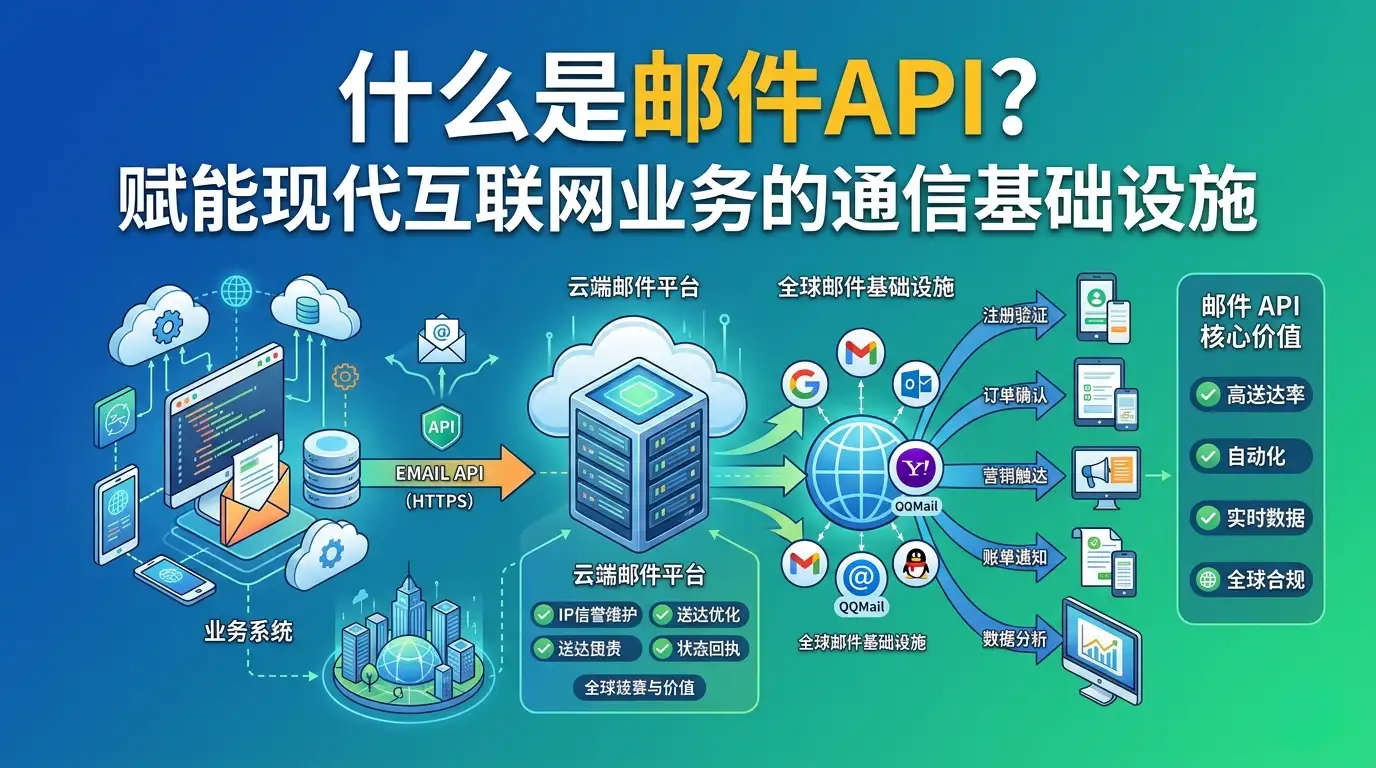
Simply put: Email API is a capability that allows developers to call email sending services through HTTP interfaces. Enterprises do not need to build complex SMTP email servers themselves, and can quickly achieve global email sending.
II. Why are more and more enterprises using Email API?
Traditional email systems mainly rely on SMTP protocol. But as business scales expand, enterprises will find: emails easily enter spam folders, low delivery rates to Gmail/Outlook, complex email server maintenance, insufficient high concurrency capabilities, lack of data statistics and receipt capabilities, and poor international email delivery stability. Therefore, more and more enterprises are adopting professional Email API platforms. Especially for SaaS platforms, AI products, cross-border e-commerce, fintech, overseas applications, and user growth platforms, Email API has become a standard communication infrastructure.
III. Core Working Principles of Email API
A standard Email API platform typically includes the following core modules: Business System → Email API Interface → Task Queue System → Template Rendering Engine → Risk Control and Rate Limiting System → SMTP Delivery Cluster → Gmail/Outlook/Yahoo → User Email. The entire process is essentially: the enterprise system submits email requests through API, and the email platform is responsible for subsequent global delivery.
IV. What is the Difference Between Email API and SMTP?
This is the most confusing question for enterprises. SMTP is a mail protocol that requires SMTP configuration, has high development complexity, average global delivery rate, limited real-time receipts, no Webhook support, weak high concurrency capability, limited data analysis, and high operation and maintenance costs. Email API is a cloud communication interface that accesses through HTTP API, has low development complexity, higher global delivery rate, complete support for real-time receipts and Webhooks, strong high concurrency capability, complete statistical analysis, and low operation and maintenance costs. Simply put: SMTP is more like an underlying protocol, while Email API is more like a modern email cloud service.
V. What are the Typical Application Scenarios of Email API?
1. Verification Code Email API
Typical scenarios: registration verification codes, login verification, MFA multi-factor authentication, password reset. Core requirements: seconds-level delivery, high stability, high arrival rate.
2. Notification Email System
For example: order confirmation, payment success, invoice notification, logistics reminder. Features: strong reliability, template-based sending, automated triggering.
3. Marketing Email Platform
For example: Newsletter, EDM marketing, user recall, campaign promotion. Core capabilities: large-scale mass sending, user tags, open rate analysis, click rate statistics.
4. Enterprise System Alert Email
For example: security alerts, system anomalies, risk notifications. Features: high priority, high real-time performance, multi-channel linkage.
VI. Why do Enterprises Focus More on "Delivery Rate"?
Many enterprises mistakenly believe: "If an email is sent, it is successful." In fact, the real difficulty is whether it can enter the inbox, whether it is blocked by Gmail, whether it enters spam, whether it is rate-limited by ISPs, and whether it triggers anti-spam rules. Therefore, professional Email API platforms will focus on optimizing IP reputation systems (including Shared IP, Dedicated IP, IP warming, Reputation management), domain authentication mechanisms (including SPF, DKIM, DMARC), and global ISP delivery optimization.
IP Reputation System
Including Shared IP, Dedicated IP, IP warming, and Reputation management.
Domain Authentication Mechanism
Including SPF, DKIM, DMARC. These configurations directly affect email credibility.
Global ISP Delivery Optimization
Different email service providers have different rules: Gmail, Outlook, Yahoo, QQ Mail, enterprise email. Mature email platforms will establish multi-region nodes, intelligent routing, dynamic IP scheduling, and ISP strategy optimization to improve global email delivery rates.
VII. What Capabilities Do Email API Platforms Typically Have?
Modern enterprise email platforms are not just about "sending emails", but a complete email communication system.
API Interface Capability
For example POST /send-email, supporting REST API, SDK, batch sending, template variables, and attachment sending.
Webhook Receipt System
Typical events include Delivered, Opened, Clicked, Bounced, Spam Complaint, and Unsubscribe. These data can be directly used for user operations, automated marketing, risk control analysis, and user behavior analysis.
Template System
Supports dynamic rendering, for example, rendering "Hello Jacky, Your verification code is 483921" through {"name": "Jacky", "code": "483921"} to achieve template-based management.
High Concurrency Asynchronous Sending
During large-scale business peaks, the process of API request → message queue → asynchronous Worker → SMTP sending avoids blocking the business system.
VIII. How Should Enterprises Choose an Email API Platform?
When selecting an Email API platform, what really matters is not "the lowest price", but the email infrastructure capabilities. It is recommended to focus on the following indicators.
1. Global Delivery Rate
Key indicators: Inbox Rate, Bounce Rate, Complaint Rate.
2. API Stability
Including SLA, QPS capability, multi-region architecture, Failover mechanism, and automatic retry.
3. Data Analysis Capability
Modern email systems increasingly rely on data: open rate, click rate, user behavior, delivery analysis. Webhook and BI capabilities are very important.
4. Compliance and Security Capability
International businesses must consider GDPR, CAN-SPAM, data encryption, and user unsubscribe mechanisms.
IX. Why is Email API Becoming Enterprise Communication Infrastructure?
In the past, email was just a "notification tool". Now, email has become part of user identity verification systems, growth marketing systems, risk control notification systems, automated operation systems, and global user reach systems. Especially for overseas businesses, Email API is no longer just a "sending capability", but enterprise global communication infrastructure.
X. Enterprise Email API Solutions
If your business needs global email sending, high delivery rate email systems, verification code email API, marketing email platforms, enterprise notification email systems, and multi-region email scheduling capabilities, you can deploy a professional Email API platform to achieve global email reach, high stability delivery, automated email operations, and enterprise-level communication capabilities.
Conclusion
The essence of Email API is not simply "sending emails". The real core is global delivery capability, high delivery rate, automated operation, user behavior tracking, and scalable communication architecture. With the globalization of internet business, Email API has gradually evolved from a tool to an important part of enterprise communication infrastructure.