SMS Delivery Chain Analysis: Terminal → SMS Gateway → Carrier SMSC Complete Process
Many enterprises assume that calling an API equals successful SMS delivery to users. However, the reality is far more complex. A single SMS from business system to user's mobile phone passes through: API access layer, cloud communication platform, SMS gateway, carrier SMSC, wireless core network, and mobile terminal. Any fluctuation at any node may cause: verification code delay, international SMS failure, decreased delivery rate, DLR anomalies, or users not receiving SMS. Therefore, SMS systems are essentially not simple interface services, but typical global communication infrastructure. This article will comprehensively analyze the core mechanisms of SMS delivery chains from an enterprise-level cloud communication architecture perspective.
I. What is SMS Delivery Chain?
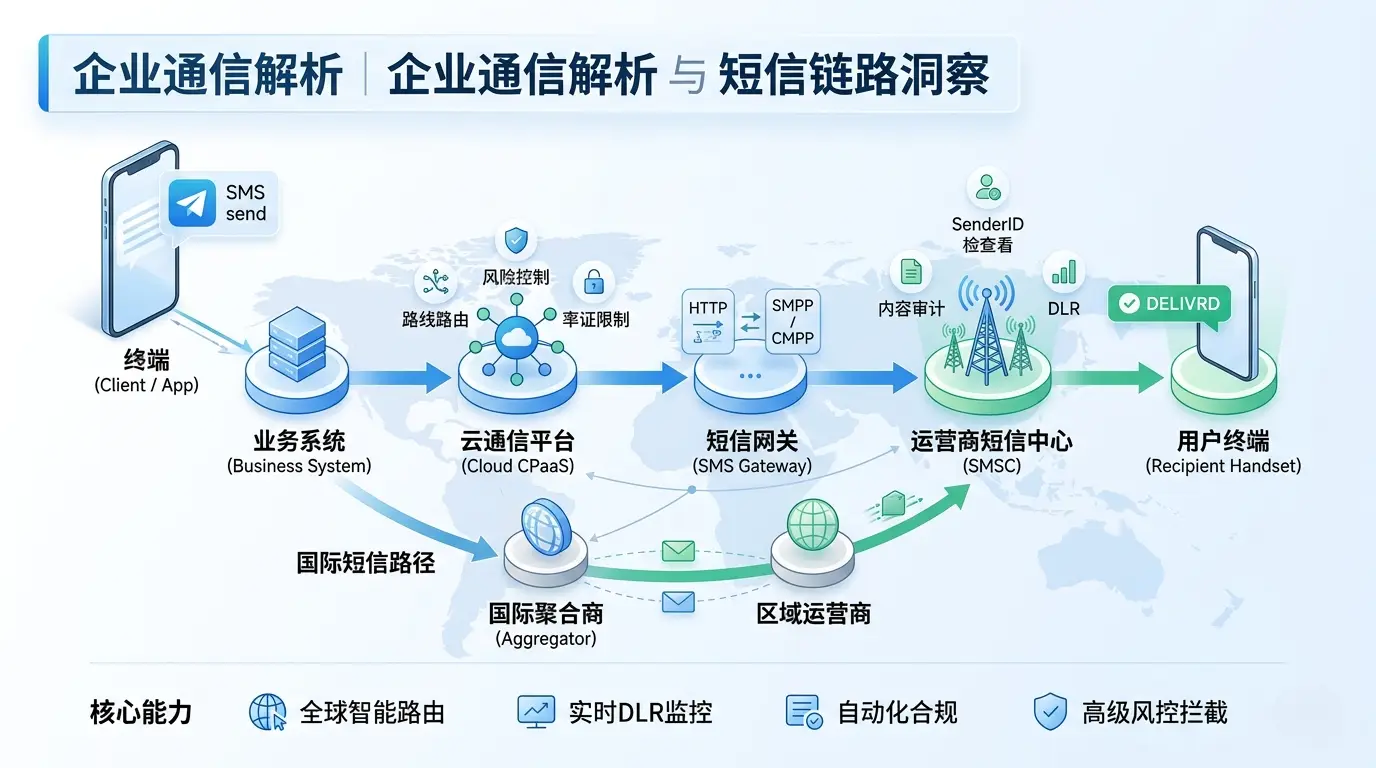
SMS Delivery Chain refers to the complete communication path of an SMS from business system to user's mobile phone. The standard chain includes: Business System/App → SMS API/SDK → Cloud Communication Platform (CPaaS) → SMS Gateway → Carrier SMS Center (SMSC) → Wireless Core Network → User Mobile Phone. International SMS scenarios usually add international aggregators and overseas carriers, which is why international SMS has higher latency, more complex stability, and more compliance requirements.
II. First Layer of SMS Delivery: Business System and SMS API
Enterprises typically submit requests to cloud communication platforms via REST API, SDK, Webhook, or SMPP interface when sending SMS. This layer focuses on API authentication, rate limiting, idempotency control, risk control systems, and blacklist filtering. Many enterprises overlook that the SMS interface layer is actually a high-risk entry point, such as verification code attacks, virtual number brushing, international number arbitrage, and batch registration attacks. Mature SMS platforms usually add real-time risk control systems at the API Gateway layer.
III. Core Role of SMS Platform (CPaaS)
Cloud Communication Platform (CPaaS) is the real SMS dispatch center. It is not only responsible for "sending", but also for routing dispatch, channel management, global carrier access, DLR receipts, risk control, and high availability guarantee. The core architecture typically includes: API Gateway → Message Queue → Routing System → SMS Gateway → Carrier Channels.
IV. What is SMS Gateway?
SMS Gateway is essentially a protocol conversion system. Because enterprises use HTTP/HTTPS API, while carriers use protocols like SMPP, CMPP, SGIP, SMGP, and SIP MESSAGE. SMS Gateway needs to perform protocol conversion (HTTP→SMPP), long SMS splitting, encoding conversion (UTF-8→UCS2), TCP long connection management, ACK confirmation, and automatic retry. This layer determines communication stability, channel throughput, concurrency capability, and international compatibility.
V. What is Carrier SMSC?
SMSC (Short Message Service Center) is the carrier's SMS center, responsible for actual SMS delivery. Many enterprises mistakenly believe that API returning success means the user has received the SMS. In fact, API Success ≠ SMSC Accepted ≠ Delivered. The complete process is usually: Platform receives SMS → Submits to carrier SMSC → Carrier review → Wireless network delivery → Terminal confirmation → DLR status receipt.
VI. Why Does SMS Delivery Rate Decrease?
There are many factors affecting SMS delivery rate. 1. Carrier rate limiting: Carriers typically limit single number frequency, single Sender sending volume, and single IP request volume. 2. Content risk control: SMS content containing marketing sensitive words, illegal links, or high-risk short links may be directly blocked. 3. International link fluctuations: International SMS may pass through multiple aggregators, multiple carriers, and multiple country nodes. The longer the link, the higher the latency and uncertainty. 4. Terminal issues: User mobile phones with no signal, flight mode, roaming anomalies, or SIM card failures may cause SMS delays.
VII. What is DLR (Delivery Report)?
DLR (Delivery Report) is the SMS delivery status returned by the carrier. Mature platforms will real-time analyze DLR success rate, channel health, country-level fluctuations, carrier anomalies, and latency trends, and automatically switch to the optimal channel. Therefore, the DLR system is the core of SMS platform stability.
VIII. Why is International SMS More Complex?
International SMS is not just "cross-border sending". It involves global carrier interconnection, national communication regulations, SenderID mechanisms, local real-name systems, and template filing. For example, India requires DLT registration, Indonesia requires Sender real-name, UAE requires content review, and Saudi Arabia requires template filing. Therefore, the real threshold for international SMS lies in global carrier compliance access capabilities, not just "having channels".
IX. What Capabilities Should a High-Quality SMS Platform Have?
When choosing an SMS service provider, enterprises should focus on: Global carrier coverage (multiple countries, multiple carriers, multi-region nodes), intelligent routing system (dynamic routing, automatic switching, channel circuit breaking, real-time scheduling), real-time monitoring capabilities (DLR monitoring, latency monitoring, country-level monitoring, channel-level monitoring), and high availability architecture (multi-active deployment + queue peak shaving + carrier redundancy + automatic failover). The goal is to ensure high delivery rate, low latency, and stable global sending.
X. Why are Modern SMS Platforms Becoming More Like "Communication Infrastructure"?
Traditionally, SMS platforms were considered as just API interfaces. However, modern cloud communication platforms are more like global message dispatch systems, distributed communication networks, real-time routing systems, compliance control platforms, and risk control platforms. Real technical barriers include global carrier resources, intelligent routing algorithms, high availability architecture, global compliance systems, and real-time monitoring systems. This is why there are huge differences in delivery rate, stability, cost control, and international capabilities among different SMS platforms.
Conclusion
Although SMS delivery chains seem simple, they are actually complex global communication systems. From Business System → API → SMS Gateway → SMSC → Wireless Network → Mobile Terminal, each layer determines delivery rate, latency, stability, and user experience. For enterprises, what really matters is never "whether SMS can be sent", but whether it can be stably delivered globally, whether it has carrier-level dispatch capabilities, whether it meets international compliance requirements, and whether it can operate stably for a long time. This is the core value of modern cloud communication platforms.