Cross-border E-commerce Platform Communication System Construction Solution
In cross-border e-commerce business, the communication system is not just a "message sending tool", but a core infrastructure connecting user growth, risk control systems, and transaction conversion. From registration verification, order notifications to marketing reach, communication capabilities directly affect user experience and business conversion efficiency. A mature cross-border e-commerce communication system needs to balance global reachability, stability, compliance, and cost control. This article systematically outlines a practical cross-border e-commerce communication system construction solution from an engineering perspective.
I. Business Drivers: Core Scenario Breakdown of Communication Systems
Cross-border e-commerce communication needs are mainly concentrated in three categories of scenarios:
1. User Identity Verification
- Registration / Login OTP (SMS, Voice)
- Two-factor Authentication (2FA)
- High-risk Behavior Verification (Account Binding, Payment)
Characteristics:
- Strong real-time (second-level delivery)
- High success rate requirement
- Strong risk control coupling
2. Transaction Notifications
- Order confirmation, shipping, logistics status
- Payment result notifications
- After-sales/refund reminders
Characteristics:
- High reliability (must be delivered)
- Multi-channel redundancy (SMS + Email)
3. Marketing Reach
- Event promotions (EDM, SMS marketing)
- User reactivation (dormant users)
- Personalized recommendations
Characteristics:
- Cost sensitive
- Need to support batch sending and strategy scheduling
- High compliance requirements (unsubscribe, frequency control)
II. Overall System Architecture Design
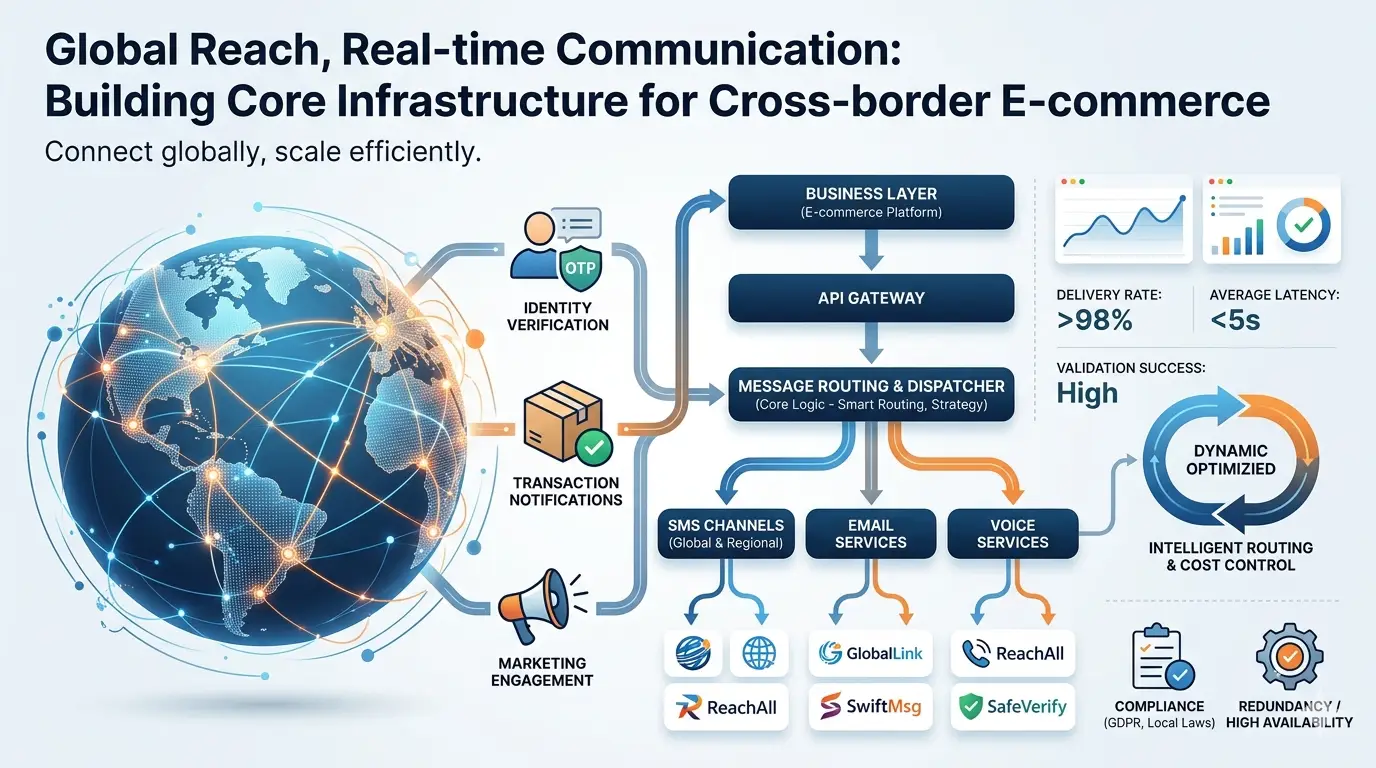
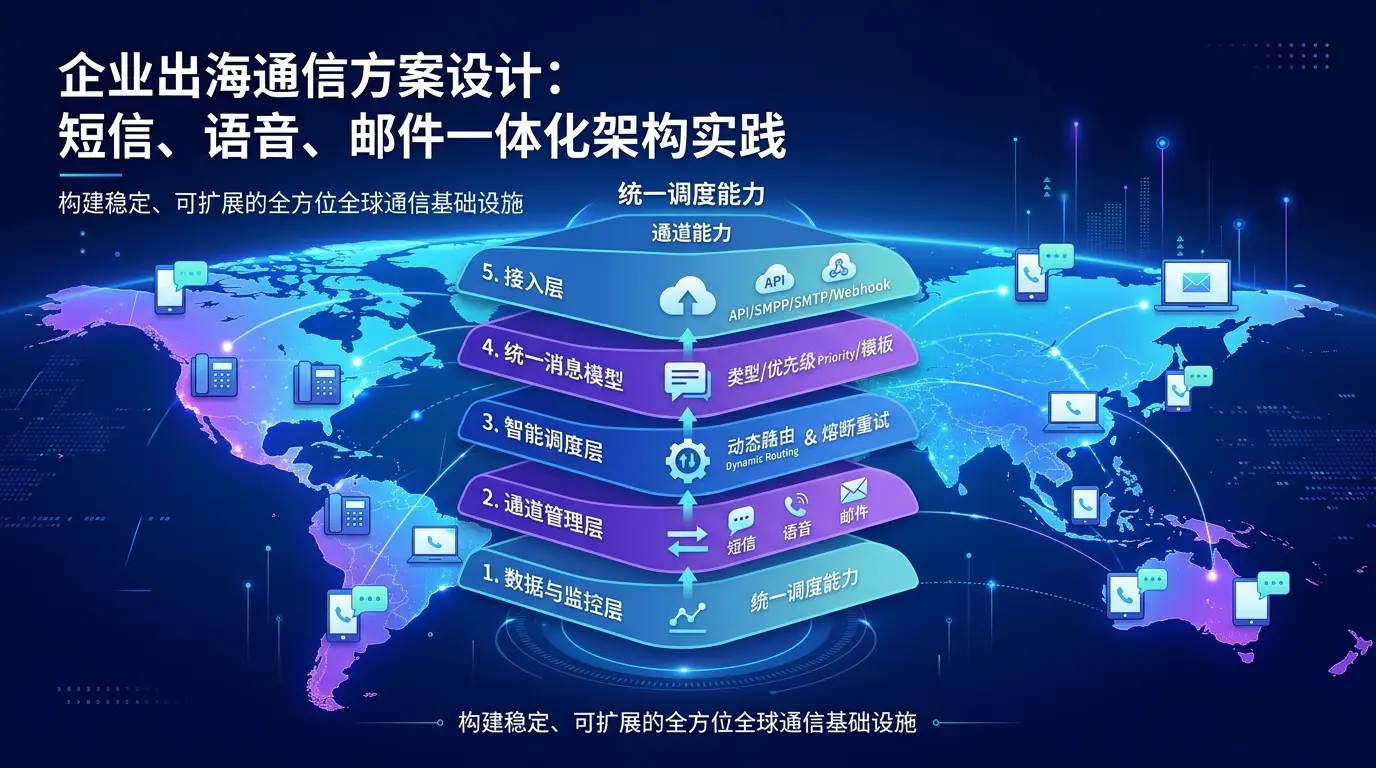
Cross-border communication systems typically adopt a layered decoupled architecture:
Business Layer (E-commerce Platform) → Communication Access Layer (API Gateway) → Message Scheduling Layer (Routing & Strategy) → Channel Adapter Layer (Channel Adapter) → Global Carriers / Email Service Providers
1. Communication Access Layer (API Gateway)
Responsibilities:
- Provide unified sending interfaces (SMS / Email / Voice)
- Support RESTful API + SDK
- Authentication (Token / IP whitelist)
- Rate limiting and anti-scraping
Key Design:
- Idempotency mechanism (avoid duplicate sending)
- Request degradation (peak protection)
2. Message Scheduling Layer (Core Hub)
This is the "decision-making brain" of the system, responsible for:
Routing Strategy
- Select optimal channel by country/region
- Support primary/backup channel switching
- Dynamic weight allocation (based on success rate, latency)
Sending Strategy
- OTP prioritizes low-latency channels
- Marketing prioritizes low-cost channels
- Intelligent retry (automatic failover)
Queue Design
- Kafka / RabbitMQ async decoupling
- Peak shaving and valley filling (handle promotional traffic)
3. Channel Adapter Layer (Channel Layer)
Core function: Interface with different suppliers and provide unified abstraction
Supported Protocols:
- SMPP (mainstream for international SMS)
- HTTP API (lightweight suppliers)
- SMTP (Email)
- SIP (Voice)
Key Capabilities:
- Multi-supplier integration (avoid single point dependency)
- Protocol standardization (unified response structure)
- Error code normalization (facilitate scheduling decisions)
III. Global Coverage and Routing Strategy Design
The biggest challenge in cross-border communication is "global delivery capability".
1. Multi-supplier Architecture
Recommended to integrate at least:
- Tier 1 direct carrier connections
- Regional aggregators
- Backup channels
Avoid:
- Single supplier dependency
- Single region over-concentration
2. Intelligent Routing Strategy
Dynamic decision based on the following dimensions:
- Country / MCCMNC
- Historical success rate
- Real-time latency
- Price
- Carrier restrictions (e.g., India DLT)
Can adopt:
- Weighted Round Robin
- Real-time feedback scheduling (Feedback Loop)
3. Localization Optimization
Key countries need specialized optimization:
- India: DLT template and real-name registration
- Indonesia: Strict content review
- Brazil: Strong carrier filtering
- Middle East: Sender ID restrictions
IV. Stability and High Availability Design
1. Multi-active Architecture
- Multi-region deployment (e.g., Singapore + Europe)
- DNS or GSLB scheduling
2. Channel Health Monitoring
- Real-time success rate monitoring
- Latency metric collection
- Automatic circuit breaker
3. Message Retry Mechanism
- Tiered retry (different channels)
- Avoid duplicate sending (ID deduplication)
V. Cost Control Model
Communication costs account for a significant proportion in cross-border e-commerce.
Optimization Methods:
1. Routing Cost Optimization
- Non-critical messages use low-cost channels
- Country-level cost model
2. Channel Layering
- OTP: Prioritize stability
- Marketing: Prioritize price
3. Alternative Solutions
- Use voice verification codes for high-cost countries
- Email replaces some notifications
VI. Compliance and Security Design
Cross-border communication must comply with regulations of various countries:
1. Data Compliance
- GDPR (Europe)
- PDPA (Singapore)
- Data minimization principle
2. User Consent Mechanism
- Opt-in / Opt-out
- Marketing unsubscribe mechanism
3. Content Compliance
- Sensitive word filtering
- Template registration (e.g., India DLT)
VII. Monitoring and Data Closed-loop
Communication systems must have "observability".
Core Metrics:
- Delivery Rate
- DLR (Delivery Receipt)
- Average Latency
- Conversion Rate (OTP verification success)
Data Closed-loop:
- Channel quality scoring
- Automatic routing weight adjustment
- A/B testing different strategies
VIII. Advanced Capabilities: Intelligence and Platformization
Mature systems will further evolve:
1. Intelligent Scheduling
- Machine learning-based channel success rate prediction
- Dynamic optimal path selection
2. Engagement Orchestration
- SMS + Email + Push combination strategy
- User lifecycle reach
3. Communication PaaS Platformization
- Provide visual console
- Template management, report analysis
- API open to internal/external systems
Conclusion
The essence of cross-border e-commerce communication systems is not "sending SMS", but building a communication infrastructure with global reach capability, dynamic optimization, and sustainable expansion.
From an engineering perspective, the real competitiveness lies not in "how many channels are connected", but in:
- Whether routing is intelligent
- Whether architecture is stable
- Whether cost is controllable
- Whether data is closed-loop
For e-commerce platforms going global, the earlier they build standardized, platform-based communication capabilities, the more long-term advantages they will form in user growth and operational efficiency.