Enterprise Overseas Communication Solution Design: Integrated Architecture Practice for SMS, Voice, and Email
In the context of rapidly advancing globalization, communication capabilities have evolved from a "tool" to "infrastructure". Whether for cross-border e-commerce, fintech, or overseas apps, SMS verification codes, voice notifications, and email reach directly impact user conversion rates and business stability. However, the reality is that fragmented channels, unstable routing, and complex compliance continue to cause enterprises to "stumble" in global communications. Drawing on frontline practices, this article systematically dissects the design thinking behind integrated communication architecture, helping enterprises build stable and scalable overseas communication capabilities.
I. Why is Integrated Communication Necessary?
Traditional solutions often involve "one provider for SMS, one platform for email, and another system for voice". While deployment is quick in the short term, problems rapidly amplify as business grows: Fragmented channels: Data from different channels cannot be integrated, making it difficult to unify user outreach strategies; Weak scheduling capabilities: Unable to perform intelligent multi-channel switching based on real-time status; Uncontrollable costs: Lack of global optimization makes it difficult to balance price and quality; High compliance risks: Significant differences in regulations across countries make decentralized management difficult to cover. The core value of integrated communication lies in upgrading "sending capabilities" to "scheduling capabilities".
II. Overall Architecture Design: From Channel-Driven to Scheduling-Driven
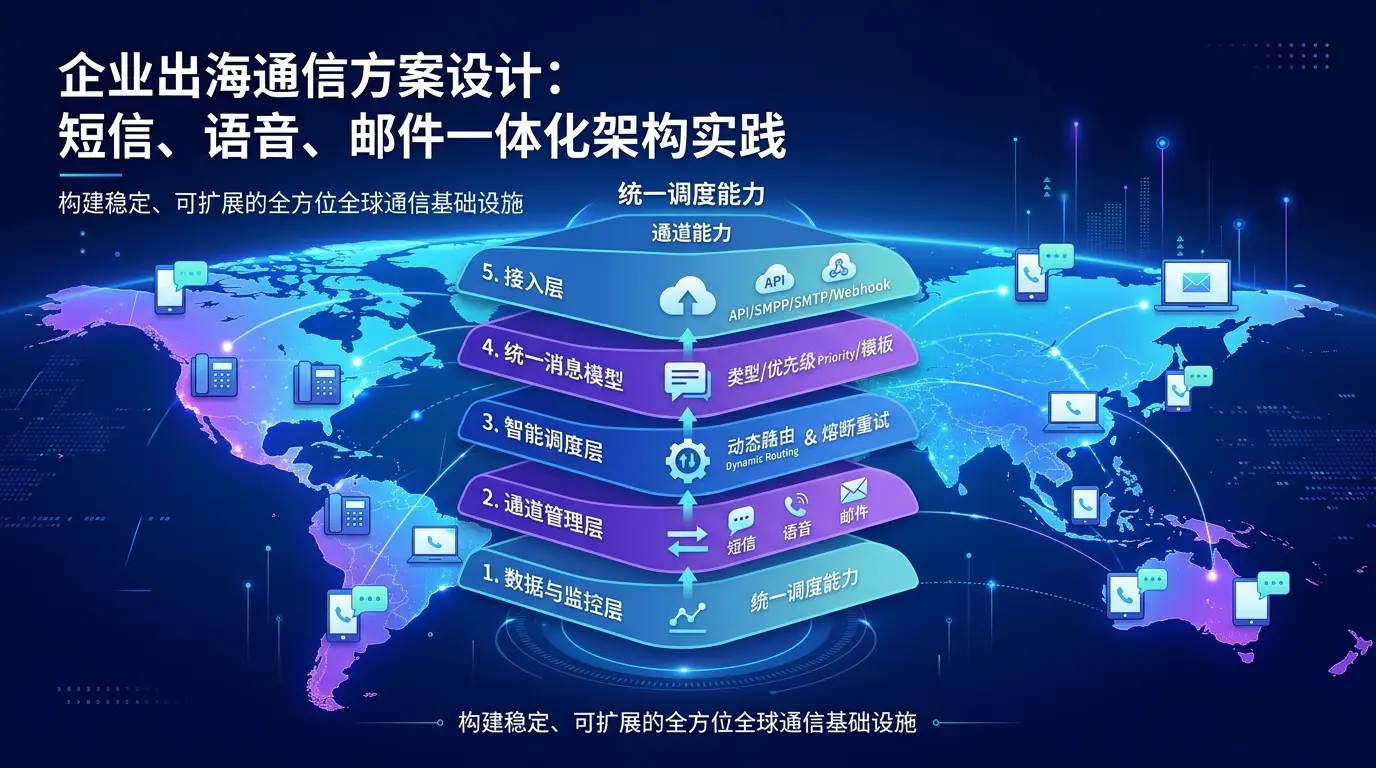
A mature overseas communication platform typically consists of five core layers:
1. Access Layer
Responsible for providing unified API interfaces externally, supporting: HTTP/HTTPS, SMPP (high-throughput SMS channel), SMTP (email sending protocol), Webhook/Callback (status callback); Design points: Multi-tenant isolation (supporting different business lines/customers), rate limiting and authentication (preventing abuse), high-availability load balancing.
2. Message Abstraction Layer
Uniformly abstract SMS, voice, and email into "message objects", with core fields including: destination address (phone number/email), message type (OTP, marketing, notification), priority (high/medium/low), template ID and variables; Key value: Shield underlying channel differences, support cross-channel policy scheduling (e.g., SMS failure → voice compensation).
3. Routing & Dispatch Layer
This is the "central hub" of the entire system, determining how messages are sent. (1) Multi-dimensional routing strategies: country/region dimension, carrier dimension, message type dimension; (2) Dynamic weight scheduling: Automatically adjust channel weights based on real-time data: Delivery Rate, Latency, Cost; (3) Disaster recovery and retry mechanisms: Automatic switch to backup channel upon primary channel failure, multi-channel concurrent sending (critical scenarios), exponential backoff retry strategy.
4. Channel Layer
Connect to various global communication resources: SMS: Direct carrier connection/aggregated channels; Voice: SIP/VoIP/callback systems; Email: SMTP service providers/self-built email sending systems. Design focus: Channel health monitoring, automatic circuit breaking and recovery, SLA hierarchical management.
5. Data & Observability Layer
Communication system optimization relies on data-driven approaches: Real-time sending logs (Message Log), status receipts (DLR/Open/Click), visualized reports (country, carrier, channel dimensions); Key capabilities: Real-time alerts (e.g., abnormal delivery rates in certain countries), A/B testing (comparison of different channels), cost analysis and optimization.
III. Multi-Channel Collaboration Strategy Design
The true value of integrated architecture lies in "combination strategies".
1. OTP Verification Code Scenario
Typical strategy: 1. Primary channel: SMS (local direct connection); 2. Failure compensation: Voice verification code (TTS); 3. Extreme scenarios: Email fallback; Optimization focus: Second-level delivery, delivery rate > 98%.
2. Marketing Outreach Scenario
Recommended strategy: 1. First outreach: Email (low cost); 2. High-value users: SMS supplementary outreach; 3. Critical campaigns: SMS + Voice combination; Optimization focus: Cost control, user experience (avoid harassment).
3. Notification Messages (Transaction/Risk Control)
Recommended strategy: High-priority SMS, multi-channel concurrency (SMS + Voice), mandatory delivery confirmation; Optimization focus: Stability > Cost, compliance first.
IV. Global Compliance and Localization Design
Compliance issues are unavoidable in overseas communications:
1. SMS Compliance
Sender ID restrictions, DLT registration (e.g., India), user consent mechanisms (Opt-in).
2. Email Compliance
SPF/DKIM/DMARC configuration, anti-spam strategies.
3. Data Compliance
GDPR (Europe), data localization storage.
Architecture Recommendations:
Compliance rules engine (dynamically load by country), template audit mechanism (automatic + manual).
V. High Availability and Scalability Design
1. High Concurrency Processing
Message queues (Kafka/RabbitMQ), asynchronous processing model, batch sending optimization.
2. Distributed Architecture
Multi-region deployment (Asia-Pacific/Europe-Americas/Middle East), proximity access (reduce latency), cross-region disaster recovery.
3. Elastic Scaling
Microservice decomposition (sending/dispatching/statistics), automatic scaling (based on traffic).
VI. Practical Experience and Implementation Recommendations
1. Prioritize building the scheduling system rather than accumulating channels; 2. Deep dive into core countries, avoid blind global expansion; 3. Use data-driven optimization rather than empirical judgment; 4. Reserve multi-channel capabilities to cope with unexpected bans.
Conclusion
The essence of overseas communication is not "sending messages out", but rather: delivering messages to users at the right time and in the most appropriate way. The core of integrated communication architecture lies in the combination of scheduling capabilities, data capabilities, and compliance capabilities. Only by building a unified communication middle platform can enterprises achieve stable growth and refined operations in the global market. If you are planning an overseas communication system, it is recommended to start with the following three points: unified message model, intelligent scheduling system, and multi-channel collaboration mechanisms, gradually building your own global communication infrastructure.