International Communication Market Structure: An Underestimated Global Infrastructure Network
In the eyes of many, international communication is nothing more than "sending an SMS, making a phone call", but from an industrial perspective, it is essentially a highly complex, clearly layered, and regulation-driven global infrastructure network. Whether it is cross-border e-commerce, fintech, or game expansion, it cannot be separated from the support of this system behind the scenes. This article attempts to dismantle the international communication market from the perspective of industrial structure.
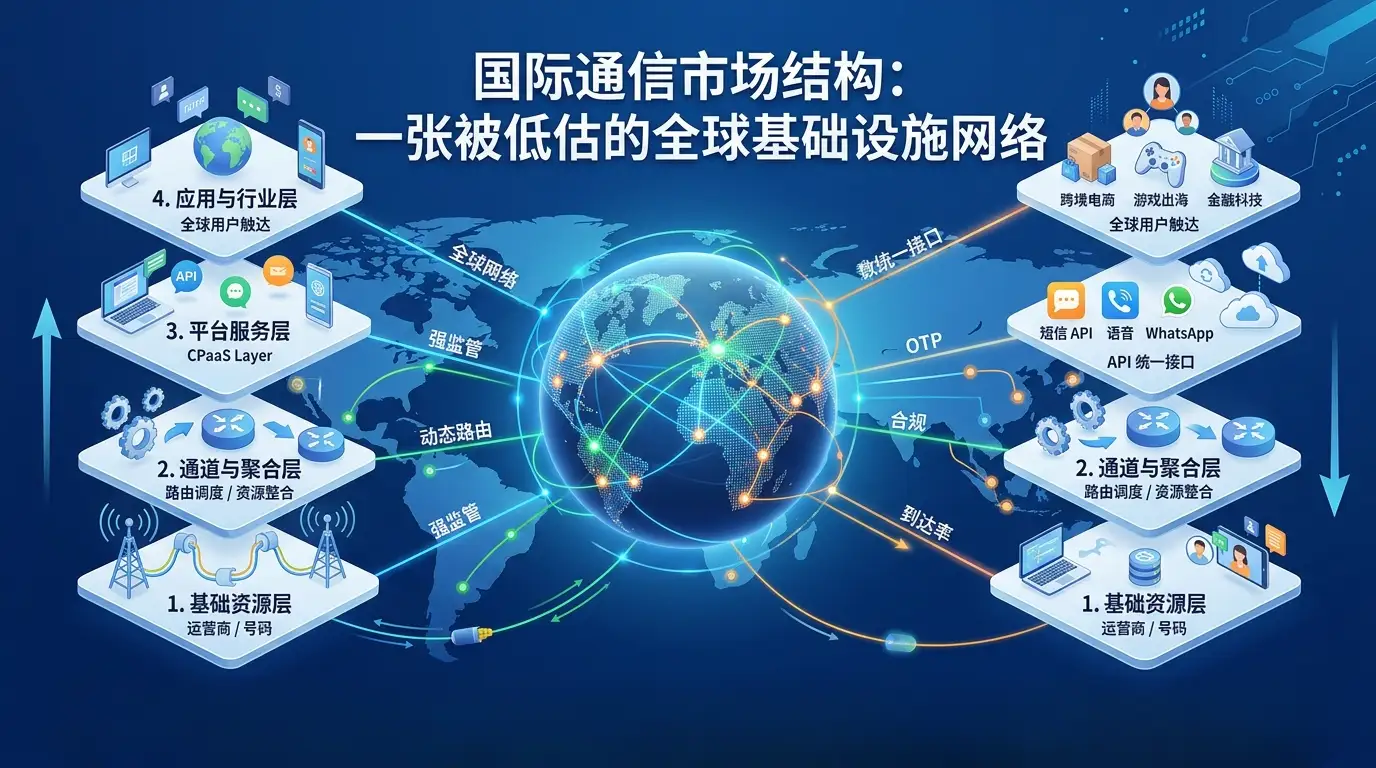
I. Overall Market Structure: Four-Layer Model
The international communication market can be abstracted into four core layers:
1) Basic Resource Layer (Carrier Layer)
This layer is the "foundation" of the entire market, mainly composed of global carriers:
- Local carriers (MNO): such as China Mobile, Vodafone, AT&T
- Virtual carriers (MVNO)
- International carriers/wholesalers (International Carriers)
Core resources include:
- Number resources (MSISDN)
- Signaling network (SS7 / Diameter)
- SMS center (SMSC)
- Voice switching network (VoIP / PSTN)
The characteristics of this layer are: strong regulation + heavy assets + obvious regional monopoly.
2) Channel and Aggregation Layer (Aggregator Layer)
This layer is the "bridge" connecting global carriers and upper-layer applications, and is also the most competitive layer.
Main participants include:
- Tier-1 Aggregator (direct connection to carriers)
- Tier-2 / Tier-3 channel providers (multi-level resale)
- Regional aggregation platforms (Southeast Asia, Middle East, Africa, etc.)
Core capabilities:
- Multi-channel routing (Routing)
- Price and quality optimization (Cost vs Delivery)
- Gray switching and disaster recovery (Failover)
- Compliance filtering (content, templates)
The essence of this layer is: the competition of "resource integration + routing scheduling" capabilities.
3) Platform Service Layer (CPaaS Layer)
This is what we often call cloud communication platform (CPaaS).
Typical capabilities include:
- SMS API (OTP / marketing SMS)
- Voice (voice notification, IVR, call center)
- Email (SMTP / API)
- Instant messaging (RCS / WhatsApp Business)
Core value lies in:
- Abstracting underlying complexity (shielding carrier differences)
- Providing unified interfaces (HTTP / SMPP / Webhook)
- Providing global coverage capabilities
The key to competition in this layer is: "product capability × channel quality × global compliance capability"
4) Application and Industry Layer (Application Layer)
Industries that ultimately use international communication capabilities:
- Cross-border e-commerce (verification codes, logistics notifications)
- Game expansion (registration verification, user recall)
- Fintech (risk control, OTP)
- Social/tool apps (account system)
- Offline enterprises (global customer reach)
The core demands of this layer are:
- Delivery rate (Delivery Rate)
- Latency (Latency)
- Cost (Cost)
- Compliance (Compliance)
II. Three Key Characteristics of the Market
1) Strong Regional Nature: No True "Global Unified Market"
International communication is not a completely unified market, but: "global puzzle + local rules"
For example:
- India: strict DLT template regulation
- Indonesia: strong local whitelist mechanism
- UAE: high content review threshold
This means: 👉 Global capability ≠ simply connecting to multiple countries, but deep localized operations
2) Long-term Coexistence of Grey and Formal Paths
In the SMS field, there have long been two paths: formal A2P routing (Operator Direct) and grey channels (SIM Box / unauthorized routing).
Differences:
| Dimension |
Formal routing |
Grey channel |
| Cost |
High |
Low |
| Delivery rate |
Stable |
Fluctuating |
| Compliance |
Strong |
High risk |
| Lifecycle |
Long-term |
Unstable |
The trend in recent years is very clear: carriers are comprehensively cleaning up grey channels, and A2P formalization has become mainstream
3) From "Channel-Driven" to "Product-Driven"
The core of early market competition was: who has cheaper channels
Now it gradually becomes: who can provide more complete communication solutions
Typical changes:
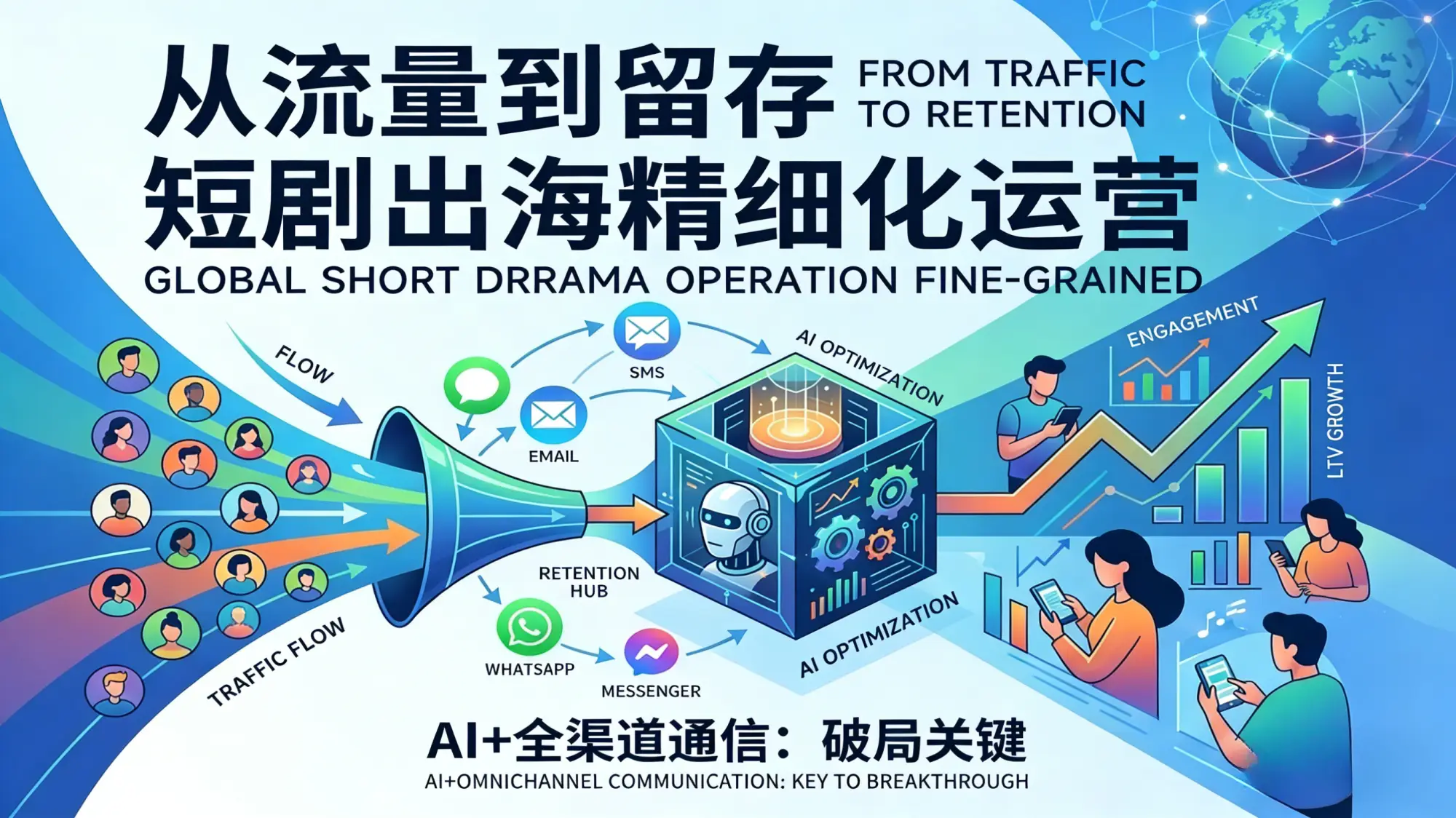
- Single SMS → multi-channel integration (SMS + WhatsApp + Email)
- Single-point sending → full-link reach (registration→verification→recall→marketing)
- Passive sending → intelligent scheduling (AI Routing / intelligent retry)
III. Where Are the Core Competitive Barriers?
International communication is not a "pure technology" industry, nor a "pure resource" industry, but a combination of the three:
1) Channel Resource Capability
- Number of direct carrier connections
- Whether Tier-1 resources are available
- Depth of country coverage (not breadth)
2) Scheduling and System Capability
- Dynamic routing algorithms
- Real-time quality monitoring (DLR / RTT)
- High concurrency processing capability (million-level TPS)
3) Compliance Capability (Increasingly Critical)
- Understanding of policies in various countries
- Sender ID / template management
- Data compliance (GDPR, local regulations)
The future watershed will become increasingly obvious: "companies that can operate globally with compliance have long-term value"
IV. Judgment of Market Development Trends
Combined with industry changes in recent years, several clear trends can be seen:
1) A2P SMS Becoming Fully Platform-Based
Carriers are gradually: unifying A2P access, raising prices, strengthening control
This means: 👉 low-price arbitrage space is becoming smaller and smaller
2) OTT Channels Continue to Erode SMS
Such as:
- WhatsApp Business
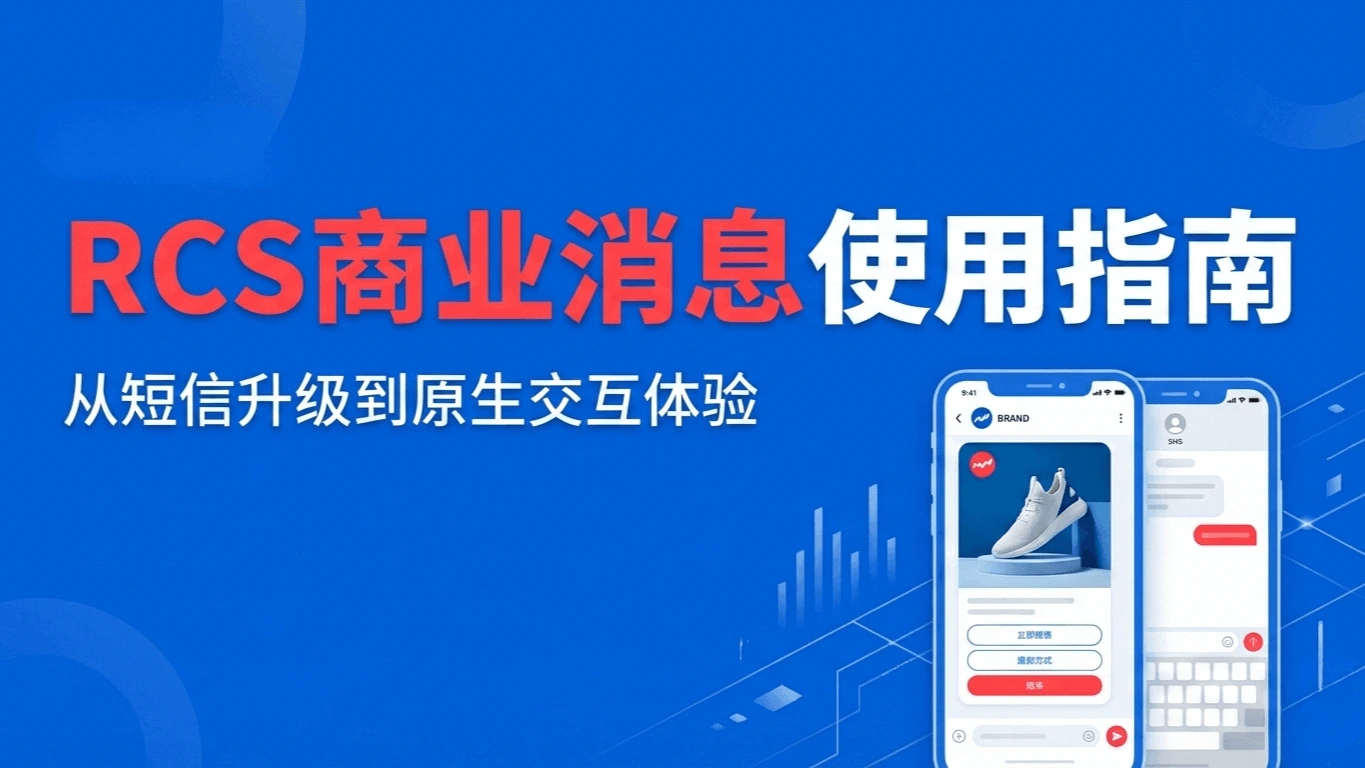
- RCS (carrier-led)
- Telegram / Messenger
But SMS will not disappear because: OTP scenarios still strongly rely on SMS's "terminal coverage capability"
3) Communication Capability Becoming "Infrastructure"
Future international communication will be more like: cloud computing (AWS), payment (Stripe)
Becoming: one of the standard infrastructures for enterprise expansion
V. In Conclusion
If we summarize the structure of the international communication market in one sentence: it is not a simple "message sending market", but a global connection network jointly built by carriers, channel providers, platforms, and applications.
For practitioners, the real difficulty is never "whether it can be sent out", but:
- Sending compliantly in different countries
- Sending stably in complex routing
- Finding the optimal solution between cost and experience
This is also why this industry seems to have a low threshold, but there are very few players who can truly go deep and last long.