Why Do SMS Prices Vary Greatly Across Countries? An Analysis of International SMS Pricing Mechanisms
For enterprises expanding globally, international SMS (Short Message Service) remains a crucial channel for user registration, identity verification, notifications, and marketing outreach.
However, many enterprises encounter a common issue when purchasing international SMS services: Why do SMS prices vary so significantly across different countries?
In some countries, the unit price can be as low as a fraction of a cent, while in others, SMS costs can be several times or even ten times higher.
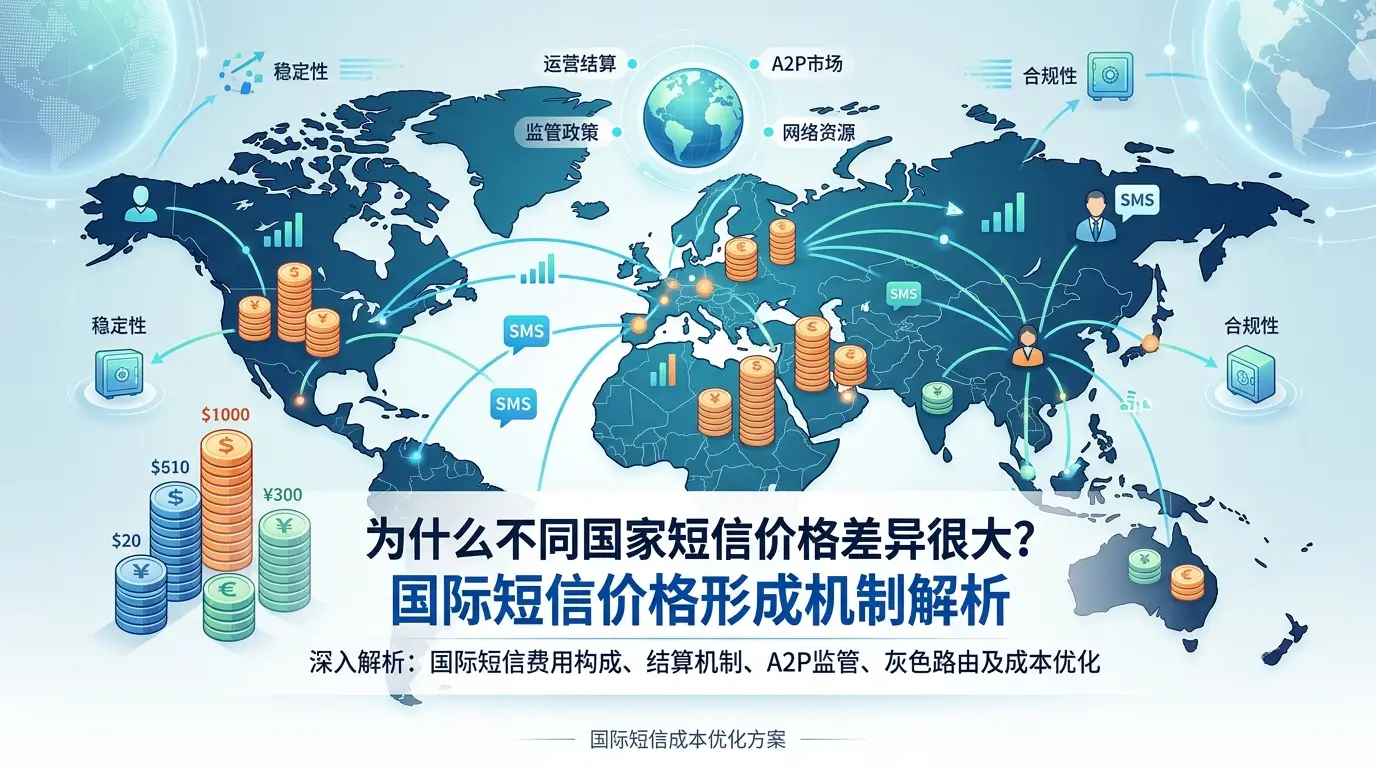
In fact, international SMS prices are not simply set by service providers, but are determined by multiple factors including operator settlements, regulatory policies, market competition, and network resources.
How Are International SMS Prices Formed?
An international SMS sent from a platform to a user's mobile phone typically goes through: Enterprise System → SMS Platform → International Operator Network → Local Mobile Operator → User Terminal
During the entire transmission process, each link generates corresponding costs, thus forming different SMS prices for different countries.
The factors affecting international SMS costs mainly include the following aspects.
1. Operator Termination Fees Determine Basic Costs
International SMS must ultimately be delivered to users through local mobile operators. The Termination Fees charged by operators in different countries vary significantly, directly affecting SMS prices.
Countries with Relatively Low Prices
- India
- Indonesia
- Philippines
- Vietnam
Due to intense operator competition, termination costs are relatively low.
Countries with Higher Prices
- United Arab Emirates
- Saudi Arabia
- Nigeria
- South Africa
These markets have higher operator concentration, so SMS fees are usually higher.
2. Market Competition Affects Global SMS Prices
The more operators there are, the more transparent international SMS prices usually become.
Highly Competitive Markets
- United Kingdom
- Germany
- India
- Thailand
Rich operator resources with relatively stable prices.
Monopoly Markets
- Qatar
- United Arab Emirates
- Ethiopia
International SMS must go through designated channels, resulting in higher costs.
3. A2P SMS Regulatory Policies Are Becoming Stricter
In recent years, many countries around the world have strengthened A2P SMS (Application-to-Person) regulation. Common mechanisms include:
Sender ID Registration
Enterprise brand signatures need to be filed in advance.
Template Review
SMS content must be reviewed by operators.
DLT Platform Certification
India requires enterprises to complete signature, template, and entity registration.
Whitelist Mechanism
Some countries require enterprises to complete real-name registration.
While these compliance requirements improve delivery rates, they also increase operational costs.
4. Official Channels vs Grey Routes Have Different Prices
There are mainly two routing modes in the international SMS market.
Official Operator Channels
Advantages:
- High delivery rate;
- Supports status receipts;
- Long-term stability;
- Strong compliance.
Relatively higher price.
Grey Route
Characteristics:
- Lower cost;
- Unstable;
- Easily blocked;
- Fluctuating delivery rates.
As operators worldwide strengthen governance, more traffic is returning to official channels, which is also an important reason for the recent increase in international SMS prices.
5. Anti-spam Mechanisms Increase Operational Costs
To reduce spam SMS and OTP fraud, operators worldwide continue to upgrade their security systems. For example:
United States
10DLC registration system.
India
DLT platform regulation.
Brazil
Anti-spam SMS mechanism.
United Arab Emirates
Real-name verification system.
These investments will eventually be reflected in international SMS fees.
6. Country Size and Network Resources Affect SMS Costs
There are significant differences in the basic communication environment across different countries.
Large Mature Markets
For example:
- United States
- United Kingdom
- Germany
Rich operator resources with stable networks.
Niche Markets
For example:
- Island countries
- Parts of Africa
Due to limited user scale and complex interconnection, unit SMS prices are often higher.
7. Exchange Rates and Taxes Also Affect International SMS Prices
International SMS is usually settled in US dollars.
The following factors affect the final quotation:
- Exchange rate fluctuations;
- VAT;
- Telecommunications regulatory fees;
- International settlement costs.
Therefore, SMS prices in the same country may also adjust with market changes.
How to Reduce International SMS Costs?
When choosing an international SMS platform, enterprises should not only focus on unit prices, but should focus on:
Global Coverage
Whether it supports 200+ countries and regions.
Delivery Rate
Whether delivery in core markets is stable.
Smart Routing System
Whether it can dynamically select the optimal operator path.
Compliance Capability
- Sender ID;
- 10DLC;
- DLT;
- WhatsApp Business;
- RCS Messaging.
Real-time Status Receipts
Whether it can monitor SMS delivery status.
Cost Optimization Capability
Whether it supports intelligent switching between multiple operators.
Why the Lowest Price Doesn't Necessarily Mean the Lowest Cost?
Many enterprises only focus on quotes when purchasing international SMS.
In reality:
- Low-cost routes may result in lower delivery rates;
- Users not receiving verification codes will affect registration conversion;
- Resending will increase overall costs;
- Grey routes carry blocking risks.
Therefore, stability, delivery rate, and compliance are often more important than simply pursuing low prices.
FAQ
Why are SMS prices higher in the US than in Southeast Asia?
The US adopts the 10DLC registration mechanism, and operator reviews are strict, so overall costs are higher than in some Southeast Asian countries.
Why do different platforms quote different prices for the same country?
Different SMS platforms have different operator resources and routing quality, so prices may vary.
Will international SMS prices continue to rise?
With the strengthening of global A2P compliance regulations and the increase in official channel proportions, SMS prices in some countries show an upward trend.
How to reduce international SMS costs?
Through multi-operator intelligent routing, real-time quality monitoring, and global resource optimization, overall communication costs can be reduced while ensuring delivery rates.