Social App Registration Risk Control Communication Design: Verification Code Risk Control System and Global SMS Verification Solutions
With the globalization of social applications, the registration entry has become one of the most concentrated areas for black market attacks. Malicious registration, SMS bombing, virtual numbers, and batch account farming not only increase SMS costs but also affect platform ecosystem and user experience.
Therefore, establishing a comprehensive social app registration risk control system has become important infrastructure for overseas social platforms and instant messaging applications.
Why Do Social Apps Need Registration Risk Control Systems?
Compared to other industries, social platforms have:
- High registration volume
- Fast user growth
- Frequent black market attacks
- High value of batch accounts
- Complex global carrier environment
Without effective verification code risk control mechanisms, platforms may face:
- Continuously rising SMS costs
- Declining OTP delivery rates
- Influx of large numbers of bot accounts
- Reduced user quality
- Affected marketing conversion rates
Therefore, SMS verification systems not only serve identity verification functions but are also an important component of the user security system.
Social App Registration Risk Control System Architecture
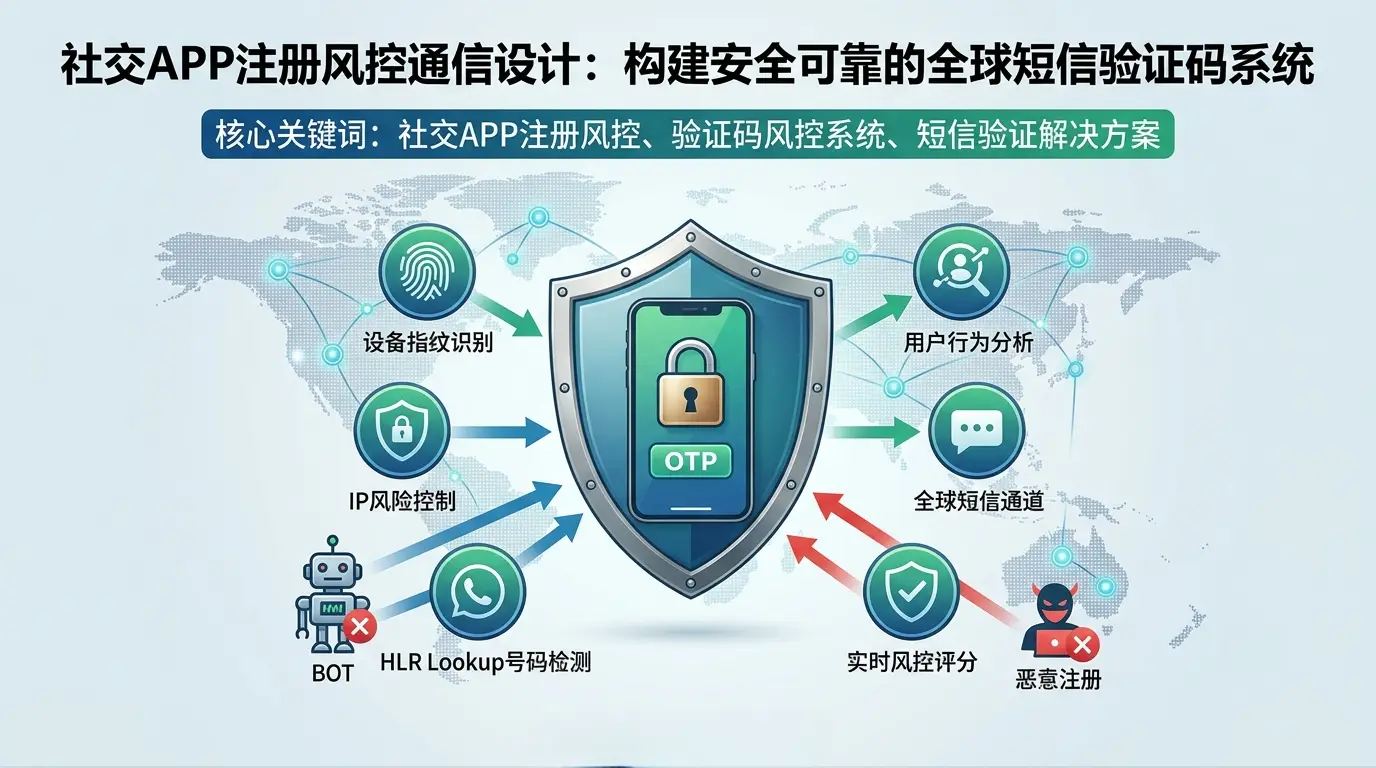
A mature verification code risk control system typically includes:
- API Gateway - Unified access to registration requests
- Risk Control Engine - Real-time analysis of user risk
- Device Fingerprint System - Identify multiple numbers on one device and batch devices
- IP Reputation Detection - Detect proxy IPs, VPNs, and data center IPs
- HLR Lookup Number Detection - Verify number authenticity and carrier information
- Real-time Scoring Model - Dynamically assess user risk levels
- Global SMS Platform - Complete OTP verification code sending through intelligent routing
Through multi-layer protection mechanisms, achieve a balance between security and registration experience.
Core Design of Verification Code Risk Control System
1. Phone Number Risk Identification
Keywords: HLR Lookup, international SMS verification code, virtual number detection
Identify through number detection system:
- VoIP numbers
- Disposable Numbers
- Temporary numbers
- Invalid numbers
Filtering high-risk numbers in advance can reduce SMS resource waste and improve OTP delivery rates.
2. IP Risk Control
Keywords: IP risk control, registration risk control system
Focus on detecting:
- VPNs
- Proxies
- TOR nodes
- Cloud server IPs
- Data center IPs
Abnormal IPs can trigger:
- Slider verification
- CAPTCHA
- Registration rate limiting
- Delayed sending
3. Device Fingerprinting
Keywords: Device Fingerprint, device fingerprint system
Identify:
- Multiple numbers on one device
- Multi-device switching
- Batch registration behavior
- Emulator environments
Establish long-term risk databases through device profiling to improve black market identification capabilities.
4. Behavior Analysis System
Keywords: AI risk control, user behavior analysis
Monitor:
- Input speed
- Page dwell time
- Click trajectories
- Operation frequency
Combine machine learning models to achieve dynamic risk assessment.
Global SMS Verification Code Platform Design
Multi-Channel Routing
Keywords: global SMS platform, international SMS verification code
System based on:
- Country
- Carrier
- Success rate
- Latency
- Cost
- Dynamically select optimal SMS channel
Advantages include:
- Improve verification code delivery rate
- Reduce sending costs
- Enhance user experience
- Avoid single point of failure
OTP Verification Code Rate Limiting Mechanism
Keywords: OTP verification, SMS verification code system
Recommended strategy:
Phone number rate limiting
- 1 time per minute
- 5 times per hour
- 10 times per 24 hours
IP rate limiting
- 3 times per 5 minutes
- 20 times per hour
Device rate limiting
- Maximum 5 account registrations per 24 hours
Effectively prevent SMS bombing attacks through rate limiting mechanisms.
AI-Driven Intelligent Risk Control System
Future social app registration risk control is upgrading from rule engines to AI models.
AI models can comprehensively analyze:
- IP profiles
- Device profiles
- Behavioral characteristics
- Historical data
- Attack patterns
Achieve:
- Real-time risk scoring
- Dynamic policy adjustment
- Adaptive rate limiting
- Abnormal account identification
- Black market attack prediction
Help platforms improve security capabilities while reducing false positive rates.
Social App Registration Risk Control System Construction Recommendations
For overseas social platforms, it is recommended to focus on:
- High-delivery-rate international SMS platform to ensure stable OTP verification code delivery
- HLR Lookup number detection capability to reduce invalid sending
- Intelligent routing system to optimize success rates and costs
- AI risk control engine to improve black market identification capabilities
- Multi-node high-availability architecture to support large-scale user growth
FAQ
Why are social apps vulnerable to malicious registration?
Since accounts have high commercial value, black market actors typically use virtual numbers, proxy IPs, and automated scripts to batch create accounts, making the registration process the most frequently attacked entry point.
What core capabilities does a registration risk control system need?
Mainly includes: HLR number detection, IP risk control, device fingerprinting, behavior analysis, risk scoring models, OTP verification code rate limiting, and global SMS intelligent routing.
How to improve international SMS verification code delivery rates?
Recommended: multi-operator resource pools, intelligent routing systems, local Sender IDs, template optimization, and real-time quality monitoring.
What advantages does AI risk control have over traditional rules?
AI models can continuously learn attack behaviors, improve recognition accuracy, and reduce false positive rates, making them more suitable for large-scale social platform scenarios.