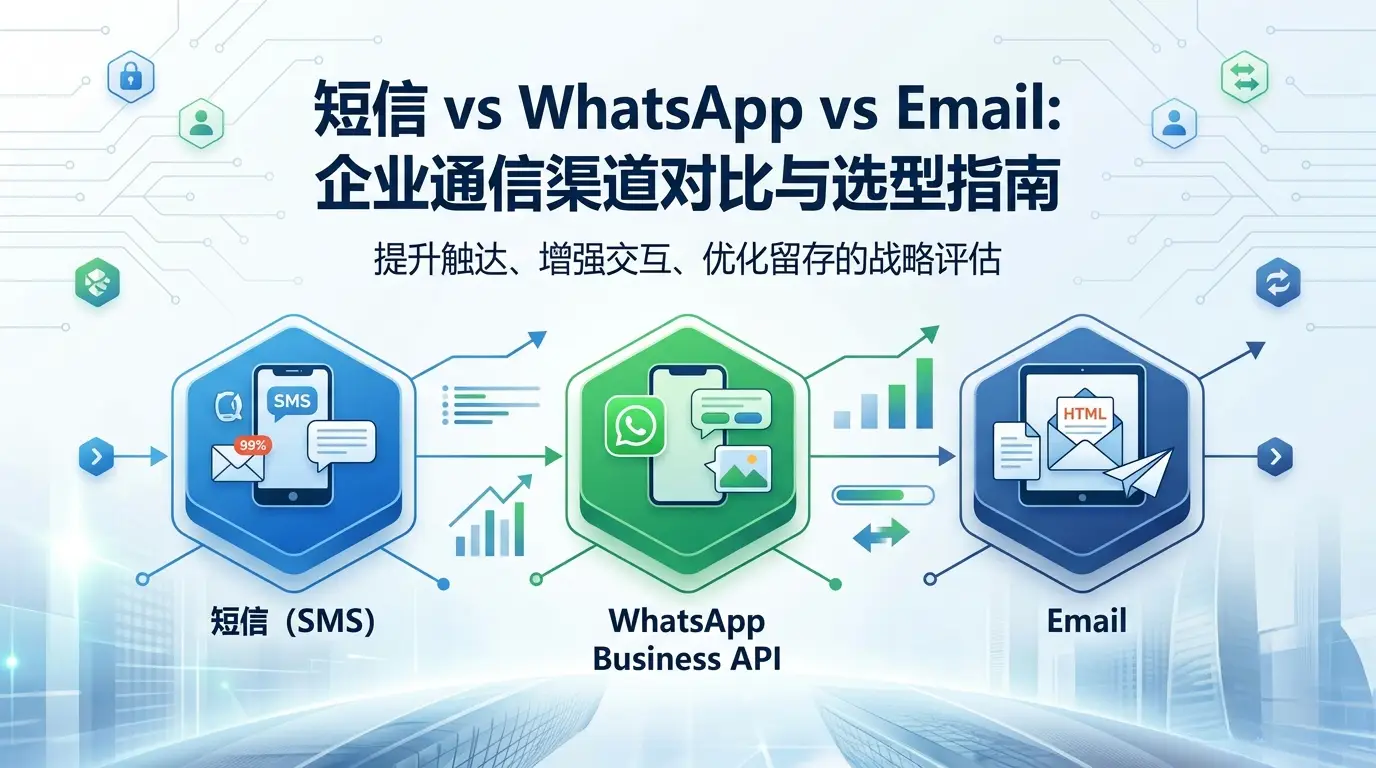
Reach, Conversion and Retention: Enterprise Application Strategy Assessment for SMS, WhatsApp and Email
In today's era of deep digital transformation, communication channels between enterprises and users are no longer simple "single-choice questions". As the three pillars of enterprise communication, SMS (Short Message Service), WhatsApp (and similar instant messaging tools), and Email each carry different business functions and user interaction scenarios.
As cloud communication practitioners, we are often asked by clients: "Which channel has the highest conversion rate?"
The fact is, there is no absolute "best channel", only the "best combination" for specific business processes.
This article will provide an in-depth comparison of these three channels from both technical characteristics and business value perspectives.
1. Overview of Core Feature Comparison
| Feature |
SMS |
WhatsApp |
Email |
| Instantaneity |
Very High (Second-level Delivery) |
Very High (Real-time Interaction) |
Low (Asynchronous Communication) |
| Media Support |
Plain Text/Links |
Rich Media (Images, Buttons, Documents) |
Deep Content (Long-form, HTML) |
| Interaction Capability |
Low (Primarily One-way Notifications) |
High (Two-way Conversation) |
Medium (Click-through Links) |
| Delivery Rate/Visibility |
Very High (Network Independent) |
High (Network & App Dependent) |
Medium (Affected by Spam Filters) |
| Use Cases |
Strong Notifications, Security Verification |
Customer Service, Marketing Conversion |
Deep Reading, Long-term Retention |
2. In-depth Strategy Analysis of Three Major Channels - SMS
The greatest advantage of SMS lies in its universality. It does not depend on smartphone system versions or internet connections, thus having a natural "immunity" in critical business scenarios.
Its minimalist nature ensures visibility on the lock screen, serving as the bottom line for maintaining business security closed-loop.
Best Practice Scenarios:
- Two-factor Authentication (OTP)
- Logistics Tracking Updates
- Emergency System Announcements
Enterprise Consideration: When business logic involves scenarios where "reach is mandatory regardless of user connectivity", SMS is the only choice.
3. In-depth Strategy Analysis of Three Major Channels - WhatsApp
Instant messaging platforms like WhatsApp have changed the granularity of business interactions.
It is not only a reach tool but also an engine for interactive customer experience (CX).
Best Practice Scenarios:
- Order Inquiries
- After-sales Support
- Personalized Product Recommendations
- Cart Abandonment Recovery
Enterprise Consideration: WhatsApp allows guiding users to complete purchase closed-loops through structured messages (interactive buttons, lists), rather than simply redirecting to web pages. For e-commerce, finance, and service industries that value user stickiness and high conversion rates, WhatsApp's conversational nature can effectively reduce churn rates and improve customer service efficiency.
4. In-depth Strategy Analysis of Three Major Channels - Email
Although Email is often discussed for its reach efficiency, its position in supporting long-form content and high-value information precipitation remains solid.
Best Practice Scenarios:
- Deep Whitepaper Distribution
- Monthly Statements
- Industry Newsletters
- Long-term Nurturing Programs
Enterprise Consideration: In B2B fields or when dealing with complex product logic, Email is the best space for logical persuasion. It can carry long articles, reports, and complex brand visuals, making it an important channel for building professional trust with users.
5. From "Channel Competition" to "Omni-channel Collaboration"
In cloud communication practice, we recommend enterprises avoid managing these three channels in isolation. The optimal communication strategy should be "channel collaboration":
Scenario 1:
Use SMS to send instant order confirmation reminders;
Scenario 2:
Use WhatsApp to take over subsequent after-sales conversations, resolving user objections through real-time responses;
Scenario 3:
Use Email to carry complete invoices, warranty instructions, or long-term brand membership benefits for the transaction.
Decision Recommendation:
Enterprises should not blindly pursue "coverage rate" of a single channel, but should configure channel weights based on user behavior paths. The key evaluation points are: Which stage of the purchase journey are your users currently in? What method do they prefer for quick feedback?
Building a unified cloud communication platform that organically combines the stability of SMS, the interactivity of WhatsApp, and the deep content capability of Email is the inevitable path for enterprises to stand out in today's complex communication environment.