AI-Driven Customer Service Transformation: 2026 Customer Experience Trends and Intelligent Customer Service Solutions
Foreword: Customer Service Enters the "Intelligent Operation Era"
Over the past decade, customer service has evolved from phone support, online support to mobile support.
In 2026, with the maturity of large models, generative AI, and automation technologies, customer service is transitioning from traditional human-driven models to AI-driven models.
More and more enterprises are realizing: Customer service is not just a cost center, but an important engine for customer experience, user retention, and business growth.
For cross-border e-commerce, internet platforms, fintech enterprises, and SaaS providers, building intelligent customer service systems has become an important topic in digital transformation.
This article will deeply analyze the development trends of customer service in 2026, and how AI and cloud communication technologies are reshaping enterprise customer experience.
Why is AI Restructuring Customer Service Systems?
Traditional customer service systems generally face the following challenges:
- Service costs continue to rise
- Difficulty recruiting human customer service
- Response speed cannot meet user expectations
- Multi-channel service management is complex
- Service quality is difficult to standardize
At the same time, customer expectations are constantly increasing. Modern consumers expect:
- 7×24 service support
- Second-level response speed
- Personalized communication experience
- Seamless cross-channel service
The emergence of AI enables enterprises to provide high-quality services at scale for the first time.
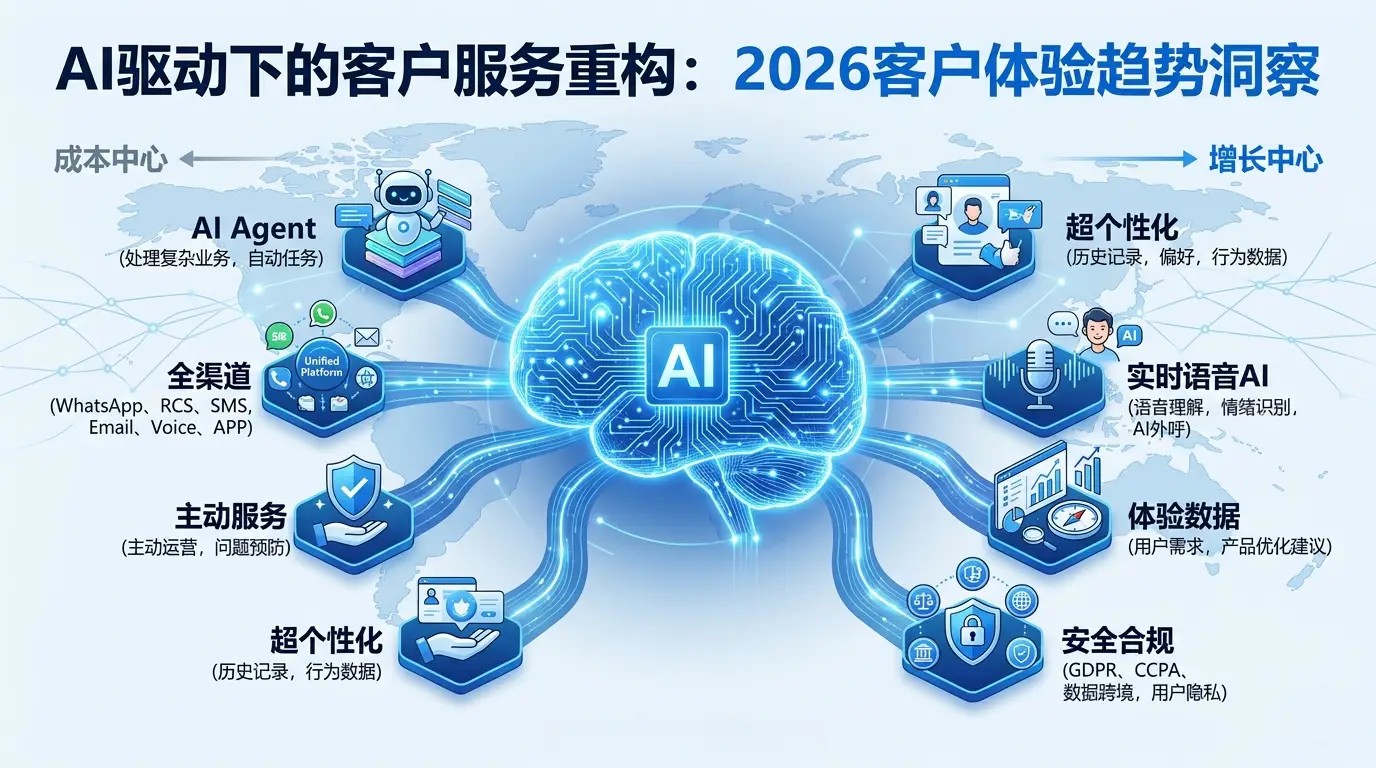
Trend 1: AI Agent Becomes the Core Entry Point for Customer Service
What is AI Agent?
AI Agent is not a traditional customer service robot.
Compared to keyword-matching robots, AI Agent has:
- Natural language understanding ability
- Multi-turn conversation ability
- Context memory ability
- Task execution ability
- System collaboration ability
For example, user asks: "When will my order arrive?"
Traditional robots can only return logistics links.
While AI Agent can:
- Query order status
- Get logistics information
- Analyze abnormal reasons
- Proactively provide solutions
Future customer service will upgrade from "auto-reply" to "auto-process".
Trend 2: Omnichannel Customer Service Becomes Enterprise Standard
Customer touch channels are growing rapidly. Main channels include:
- International SMS
- WhatsApp Business
- RCS Business Messaging
- Email
- Online Chat
- APP Push Notifications
- Social Media
The problem is: Many enterprises have scattered customer data across different systems.
Service records cannot be synchronized
Users need to repeat problem descriptions
Service efficiency decreases
Therefore, omnichannel customer service platforms have become important infrastructure for enterprises to improve customer experience.
Core Value of Omnichannel Service
Unified User Identity
Regardless of which channel the user contacts the enterprise through, they can be identified as the same customer.
Unified Session Records
Complete service history retention.
Intelligent Channel Switching
Automatically select the best communication method based on user habits.
Trend 3: Proactive Service Replaces Passive Response
Traditional service model:
User asks question → Enterprise solves problem
Future service model:
Enterprise discovers problem → Solves problem proactively
AI can be based on:
- User behavior data
- Risk models
- Historical service records
- Order data
Achieve proactive customer service.
Typical Application Scenarios
Cross-border E-commerce
Automatically notify users of logistics delays.
SaaS Enterprises
Detect declining customer activity and automatically trigger operational actions.
Financial Institutions
Identify abnormal transaction behavior and proactively remind users.
Proactive service is becoming an important part of customer experience.
Trend 4: Personalized Customer Experience Becomes Core Competitiveness
Standardized responses can no longer meet modern consumer needs.
AI can combine:
- User profiles
- Historical purchase behavior
- Product preferences
- Geographic location
Dynamically generate personalized service content.
For example: New users receive welcome guidance. VIP users receive exclusive service notifications.
This precise communication mode can significantly improve:
- User satisfaction
- Conversion rate
- Retention rate
Trend 5: AI Voice Customer Service Rapidly Popularizes
With the development of speech recognition technology and large models, AI voice customer service is rapidly replacing traditional IVR systems.
Main application scenarios include:
Intelligent Hotline Customer Service
Automatically complete:
- Business inquiries
- Account verification
- Ticket creation
AI Voice Outbound
Applicable to:
- User follow-ups
- Satisfaction surveys
- Activity notifications
- Payment reminders
Compared with traditional voice systems, AI voice customer service has a more natural interaction experience.
Trend 6: Customer Experience Data Becomes Enterprise Growth Asset
Customer service systems generate a large amount of valuable data every day, including:
- User feedback
- Product issues
- Service records
- User emotions
AI can automatically analyze this data.
Help enterprises discover:
- Product improvement opportunities
- User churn risks
- Customer demand changes
Future customer service platforms will not only be service tools but also business decision-making platforms.
Trend 7: Security and Compliance Become Basic Customer Service Capabilities
With the strengthening of global data regulation, enterprises need to pay more attention to customer data security, especially in cross-border business scenarios.
Enterprises must comply with:
and other international data protection requirements.
At the same time, establish:
- Identity authentication mechanism
- Data encryption mechanism
- Communication security mechanism
- Permission control system
Security capabilities will become an important part of future customer experience.
How Cloud Communication Empowers AI Customer Service?
Behind AI customer service lies stable and reliable communication infrastructure.
Modern cloud communication platforms can provide:
Global Message Reach
Supports:
- International SMS
- WhatsApp Business API
- RCS Messaging
- Email Service
- International Voice
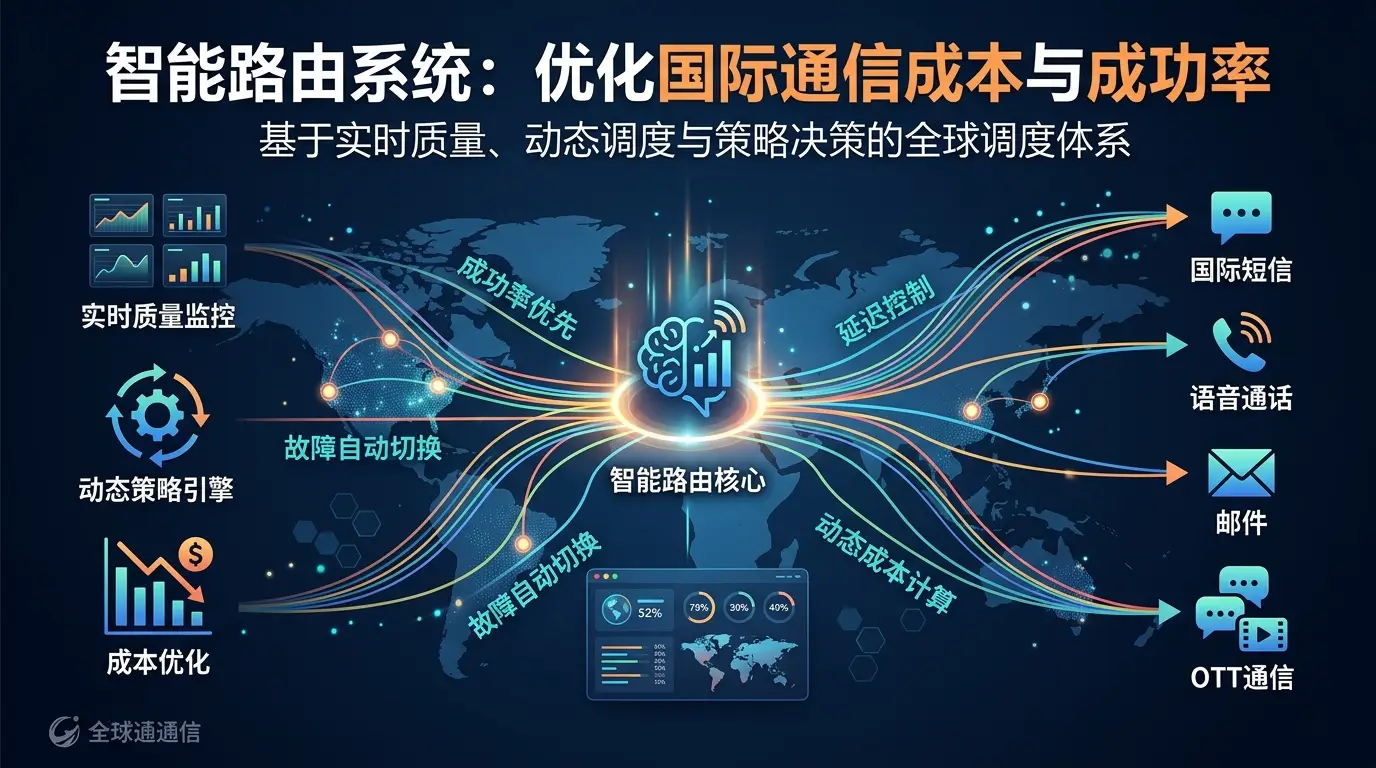
Intelligent Routing Capability
Automatically optimizes:
- Delivery rate
- Cost
- Timeliness
AI Capability Integration
Supports:
- AI Customer Service Robot
- AI Voice Robot
- Automated Marketing
- Intelligent Workflow
Helps enterprises build a complete customer experience closed-loop.
How Can Enterprises Build Next-Generation Customer Service Systems?
It is recommended to proceed according to the following path:
Phase 1
Unify customer communication channels
Phase 2
Deploy AI customer service system
Phase 3
Build Customer Data Platform (CDP)
Phase 4
Implement automated service processes
Phase 5
Build AI-driven customer operation system
FAQ Common Questions
What is AI customer service?
AI customer service is a new service model that uses artificial intelligence technology to automatically complete customer inquiries, service responses, problem handling, and customer operations.
What is the difference between AI Agent and traditional customer service robots?
Traditional robots rely on rule matching, while AI Agent can understand semantics, remember context, and handle complex tasks.
Will AI customer service replace human customer service?
No. In the future, it will be more like: AI handles standardized problems; humans handle complex business and high-value customer needs.
What infrastructure do enterprises need to deploy AI customer service systems?
Usually includes: CRM system, knowledge base, cloud communication platform, AI model capabilities, and data analysis platform.
How does cloud communication platform improve customer experience?
Through omnichannel capabilities such as SMS, email, voice, and WhatsApp, it achieves rapid reach, unified service, and intelligent operations.