What is a Privacy Number? Enterprise Privacy Number Service Principles, Application Scenarios, and Selection Guide
With the rapid development of digital business, communication needs between enterprises and users are constantly increasing.
Whether it is a ride-hailing driver contacting passengers, e-commerce customer service handling after-sales, or logistics personnel conducting delivery communication, mobile phone numbers are frequently used for business connections.
However, there is an obvious problem with traditional communication methods: enterprises need to contact users, but cannot expose users' real mobile numbers for a long time.
Privacy number technology emerged in this context, providing number protection capabilities through cloud communication platforms to achieve secure and efficient communication connections between enterprises and users.
1. What is a Privacy Number?
A privacy number is a number protection service based on cloud communication platforms, also known as:
- Virtual number;
- Intermediate number;
- AXB number protection;
- Mobile phone number protection service.
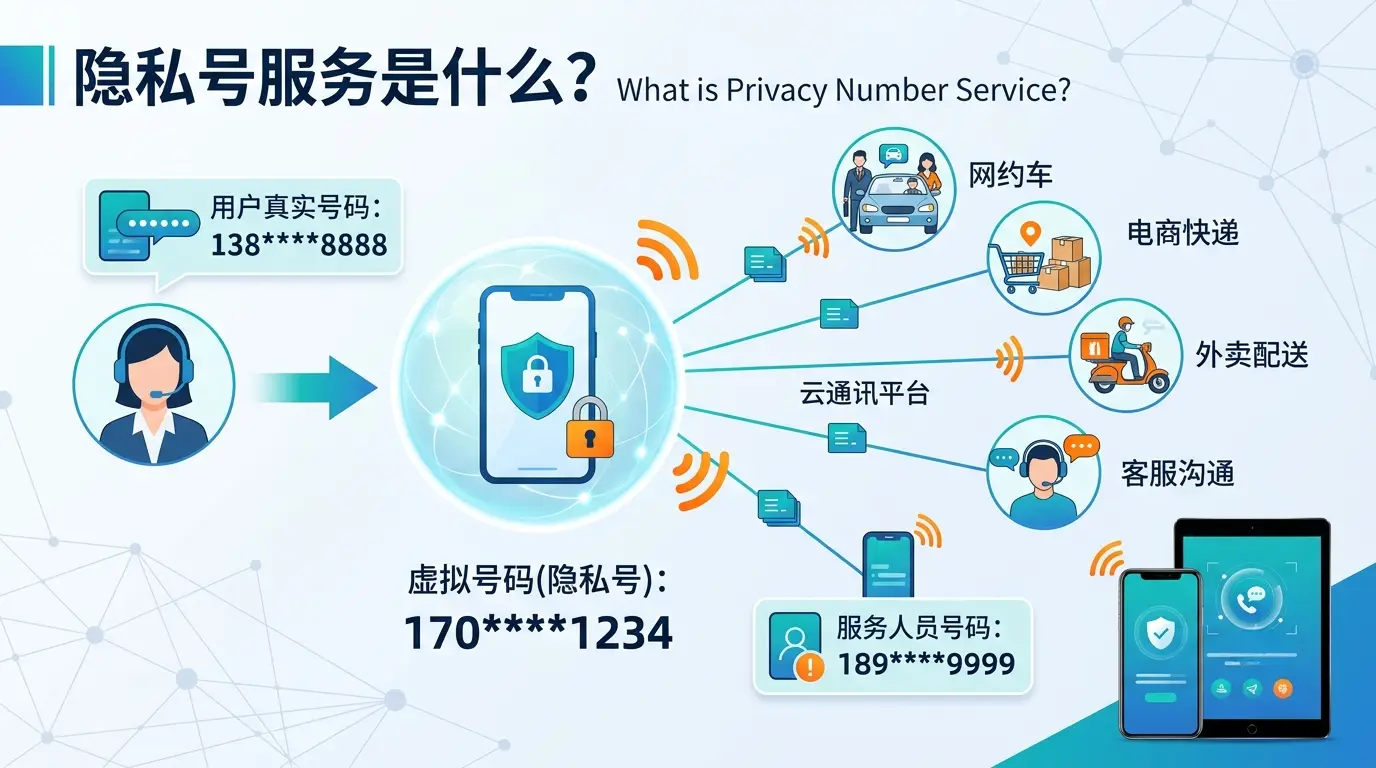
It establishes a number mapping relationship through the communication platform, isolating users' real mobile numbers from enterprise service numbers.
The typical communication flow is as follows:
User mobile number
↓
Privacy number
↓
Enterprise customer service / Service personnel
Both parties communicate through privacy numbers without directly obtaining the other party's real numbers.
For example:
User mobile number: 138****8888
Enterprise customer service number: 400****6666
System assigned privacy number: 170****1234
After the user calls the privacy number, the cloud communication platform automatically completes number routing to achieve normal calls between both parties.
2. Why Do Enterprises Need Privacy Number Services?
1. Protect user privacy and reduce information leakage risks
In traditional business models:
- Delivery personnel can see customer numbers;
- Customer service personnel can save user contact information;
- Users may still receive harassment after the service ends.
Through the number isolation mechanism, privacy numbers:
- Hide real mobile numbers;
- Restrict long-term exposure of numbers;
- Support automatic unbinding after business completion.
Help enterprises improve user data security capabilities.
2. Improve enterprise communication management capabilities
Privacy numbers not only provide number hiding functions, but also combined with cloud communication platforms, can achieve:
- Call record management;
- Call status query;
- Call recording;
- Data statistical analysis;
- Abnormal call monitoring;
- Blacklist management.
Enterprises can uniformly manage customer communication processes and improve operational efficiency.
3. Meet enterprise compliance communication requirements
With the strengthening of data security supervision, enterprises are paying more and more attention to user privacy protection.
Privacy number services can help enterprises reduce:
- Risk of user mobile number leakage;
- Employees privately saving customer information;
- Unauthorized contact behavior.
Suitable for platform enterprises that require a large number of user service connections.
3. Which Enterprises Are Suitable for Privacy Numbers?
1. Travel platforms
Typical scenarios:
- Ride-hailing;
- Car rental platforms;
- Designated driving services.
Drivers need to contact passengers, but do not need to know the passengers' real mobile numbers.
Through privacy numbers:
- Protect passenger privacy;
- Improve order communication efficiency;
- Reduce complaint risks.
2. E-commerce enterprises
E-commerce businesses generate a large amount of customer communication needs every day:
- Order consultation;
- After-sales service;
- Delivery contact;
- Return and exchange processing.
Through privacy number services, enterprises can allow customer service to stay in touch with customers while avoiding customer number exposure.
3. Cross-border e-commerce and overseas business enterprises
For overseas enterprises, user communication security is becoming increasingly important.
Combined with international cloud communication capabilities, privacy numbers can help enterprises:
- Manage overseas customer contacts;
- Reduce data leakage risks;
- Establish a unified communication entry.
4. Logistics and delivery enterprises
The logistics industry involves a large number of:
- Recipients;
- Delivery personnel;
- Merchants.
Privacy numbers can avoid directly exposing both parties' mobile numbers during delivery, achieving secure contact.
5. Finance, insurance, and customer service industries
The financial service industry involves a large amount of customer information.
Through enterprise privacy numbers:
- Customer service does not need to obtain customers' real numbers;
- Enterprises uniformly manage outbound call processes;
- Improve customer service security.
4. How is the Privacy Number System Implemented?
Enterprise-level privacy number services typically consist of the following modules:
1. Number pool management
The cloud communication platform provides a large number of available number resources, dynamically allocated according to business needs.
2. Number mapping system
Establish binding relationships between: user number → privacy number → enterprise number.
3. Intelligent routing system
According to:
- User location;
- Enterprise business rules;
- Network status;
Select the best communication path to improve connection rate.
4. API interface capabilities
Enterprises can quickly integrate through API:
- CRM systems;
- APP;
- E-commerce platforms;
- Customer service systems.
Achieve automatic number binding and unbinding.
5. What is the Difference Between Privacy Numbers and Regular Mobile Numbers?
| Comparison Dimension |
Regular Mobile Number |
Enterprise Privacy Number |
| User number display |
Real number |
Virtual number |
| Privacy protection |
Lower |
Higher |
| Enterprise management |
Decentralized |
Unified management |
| Data analysis capability |
Limited |
Support statistical analysis |
| Business expansion |
Weaker |
Support API integration |
For high-frequency user service enterprises, privacy numbers are more in line with modern enterprise communication needs.
6. What Should Enterprises Pay Attention to When Choosing Privacy Number Service Providers?
1. Communication resource capabilities
Excellent privacy number service providers need to have:
- Stable number resources;
- Operator communication capabilities;
- High concurrency processing capability.
2. Platform stability
Enterprises need to pay attention to:
- System availability;
- Call success rate;
- Failure recovery capability;
- Monitoring system.
3. API openness capability
For internet enterprises, API integration capability is crucial.
Complete platforms usually support:
- REST API;
- SDK integration;
- Status callback;
- Data query interface.
Help enterprises quickly complete business integration.
7. How Can Cloud Communication Platforms Help Enterprises Achieve Privacy Number Capabilities?
Enterprise-level cloud communication platforms can provide:
- Privacy number service;
- Enterprise SMS interface;
- Voice communication service;
- International SMS service;
- API communication capability.
Through unified communication infrastructure, help enterprises build secure, efficient, and stable customer connection systems.
Conclusion: Privacy Numbers Are an Important Basic Capability for Enterprise Digital Communication
As enterprises increasingly rely on online businesses to connect users, mobile phone number privacy protection has become an important requirement.
Privacy numbers provide enterprises with more secure and efficient communication methods through technologies such as number isolation, intelligent routing, and API integration.
For e-commerce, logistics, travel, finance, customer service, and global business enterprises, deploying privacy number services can not only protect user privacy, but also improve enterprise communication management capabilities.
Choosing a cloud communication service provider with communication resources, technical capabilities, and compliance systems can help enterprises build long-term stable communication infrastructure.