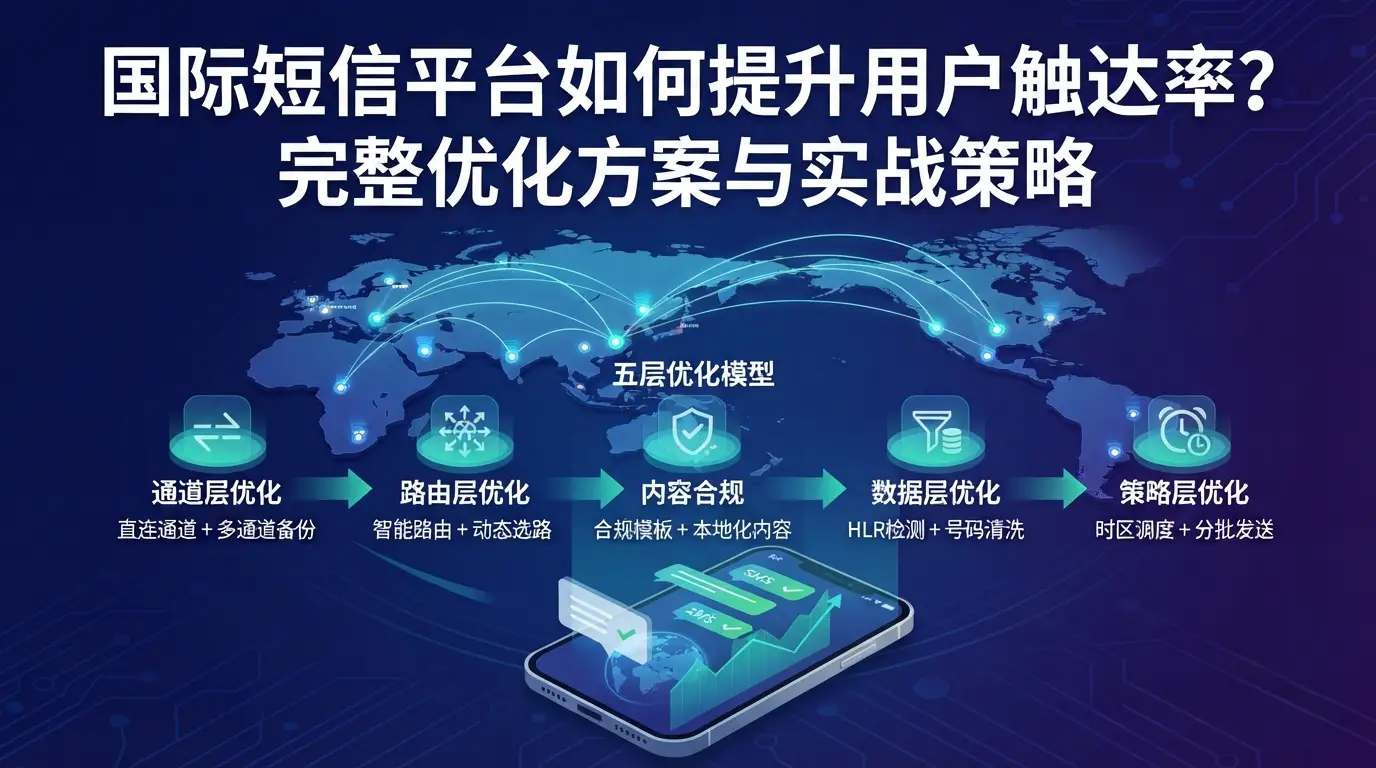
Cloud Communication Platform Architecture Analysis: How High-Concurrency Messaging Systems Support Hundreds of Millions of Traffic?
With enterprise digital transformation and global business expansion, communication needs such as SMS verification codes, notification messages, email marketing, and voice services are growing rapidly. For cross-border e-commerce, fintech, online education, gaming overseas, and social application enterprises, communication capabilities are no longer just simple information sending functions, but important infrastructure affecting user registration, transaction confirmation, security verification, and customer reach. Therefore, a mature cloud communication platform must have: hundreds of millions of message processing capability, high-concurrency request bearing capability, global communication network access capability, intelligent message routing capability, and high-reliability high-availability operation capability.
1. What is a Cloud Communication Platform?
A cloud communication platform is a service platform based on cloud computing architecture that provides enterprises with open communication capabilities. Enterprises do not need to build their own SMS centers, email servers, or voice systems. They only need to call communication capabilities through API interfaces.
- International SMS Sending
- SMS Verification Code Service
- Enterprise Email Sending
- Voice Notification
- WhatsApp Business API
- RCS Rich Media Messaging
From a technical architecture perspective, a cloud communication platform is essentially: communication capability open platform + message processing system + global operator connection network.
2. What Technical Challenges Do High-Concurrency Messaging Systems Face?
1. Massive Requests Influx
- E-commerce Promotion Activities
- APP User Registration Peak
- Financial Login Verification
- Global Game Launch
Millions of message requests may be generated within a short time.
Slow service response
- Slow service response
- High database pressure
- Message accumulation
- System unavailability
2. Complex Global Communication Network
International communication is different from ordinary Internet requests. Message sending needs to consider:
- National policies
- Operator rules
- Sender ID requirements
- Channel quality
- Network latency
Therefore, international SMS platforms must have intelligent scheduling capabilities.
3. Overall Architecture Design of Cloud Communication Platform
An enterprise-level cloud communication platform typically adopts a layered architecture: Enterprise Business System → API Access Layer → Message Processing Layer → Message Queue → Intelligent Routing Scheduling → Protocol Gateway → Global Operator Network → User Terminal
API Interface Layer
- API Interface Layer
- Message Processing Center
- Message Queue System
- Intelligent Routing System
- Communication Protocol Gateway
- Data Monitoring System
4. API Access Layer: Bearing Enterprise Communication Requests
The API access layer is the entry point for enterprise systems to connect to the cloud communication platform.
- HTTP API
- REST API
- SMPP API
- SMTP Interface
- Webhook Callback
Load Balancing: Adopt multi-node deployment to achieve request distribution, failover, and horizontal scaling.
Traffic Control: Through QPS limits, user-level rate limiting, IP restrictions, and dynamic resource allocation, prevent a single business from occupying all system resources.
5. Message Queue System: Solving Hundreds of Millions of Message Pressure
In a high-concurrency messaging system, the message queue is the core component.
Traditional Model: User Request → Immediate Sending → Waiting for Operator Response, which easily causes system blocking.
Enterprise Architecture: User Request → Message Queue MQ → Message Consumption Service → Sending Gateway → Operator
1. Traffic Peak Shaving
Facing instantaneous millions of requests: The message queue can cache tasks and allow the system to process them smoothly.
2. Service Decoupling
Business systems do not need to care about channel status, operator response, or failure retry, improving overall stability.
6. Intelligent Routing System: Improving International SMS Delivery Rate
For international SMS platforms, the routing system is the core competitiveness.
Country Strategy: Different countries have different operators, compliance requirements, and channel strategies.
Channel Quality Scoring: The system real-time analyzes success rate, latency, failure reasons, and receipt status to automatically select the best route.
Automatic Failure Switching: When a route is abnormal, the system automatically switches to a backup route to ensure business continuity.
7. Multi-Protocol Communication Architecture Design
Cloud communication platforms need to connect to different communication networks and therefore need to support multiple protocols.
SMPP Protocol
- International SMS
- Operator Connection
- SMS Center Communication
- High Throughput
- Long Connection
- Supports Status Receipt
HTTP API
Suitable for SaaS enterprises and rapid business access.
SMTP Protocol
- Enterprise Email
- Marketing Email
- Transactional Email
SIP Protocol
- Cloud Calling
- Enterprise Voice Communication
8. High Availability Architecture: Ensuring 99.99% Communication Stability
One of the most important indicators for enterprise communication platforms is stability.
Cluster Deployment: Avoid single point of failure.
Multi-Region Deployment: Asia nodes, Europe nodes, North America nodes, reducing global access latency.
Disaster Recovery Mechanism: Including data backup, service migration, automatic recovery, and fault isolation.
9. Cloud Communication Platform Monitoring System Design
Hundreds of millions of messaging systems must have complete monitoring capabilities.
Message Metrics
- Sending Volume
- Success Rate
- Delivery Rate
- Average Latency
System Metrics
- CPU
- Memory
- Network
- MQ Backlog
Channel Metrics
- Operator Success Rate
- Error Codes
- Channel Response Time
Through data monitoring, communication quality can be continuously optimized.
10. Why Do Enterprises Need a Professional Cloud Communication Platform?
Compared with building communication systems in-house, cloud communication platforms have obvious advantages:
- Construction Cost: In-house High vs Cloud Platform Low
- Global Coverage: In-house Complex vs Cloud Platform Quick Access
- Technical Maintenance: In-house Enterprise Responsible vs Cloud Platform Platform Maintained
- Elastic Scaling: In-house Difficult vs Cloud Platform Auto Scaling
- Communication Quality: In-house Limited Optimization vs Cloud Platform Intelligent Scheduling
For enterprises needing global business growth, choosing a professional cloud communication platform can quickly obtain stable, secure, and high-quality communication capabilities.
Conclusion: Cloud Communication Platform is the Important Foundation for Enterprise Global Connection Capability
A cloud communication platform that can support hundreds of millions of message traffic is not just a simple information sending tool, but a complex global communication infrastructure. Its core capabilities come from: distributed system architecture, message queue technology, intelligent routing algorithms, multi-protocol communication capabilities, high-availability deployment systems, and full-link monitoring systems.
With enterprise globalization development, cloud communication platforms will become important digital infrastructure connecting enterprises with global users.
Upgrade Enterprise Communication Capabilities, Start with Stable Connection
If your enterprise is deploying:
- International SMS verification codes
- Global message reach
- Enterprise email systems
- Voice communication services
- Overseas business communication infrastructure
A professional cloud communication platform can help your enterprise quickly access global communication networks, improving message delivery rate and business stability.
Consult Now,Get Enterprise Global Communication Solution。