How is International SMS Sent? International SMS Sending Process + Success Rate Improvement Case Analysis
1. International SMS Sending Principle (Enterprise-level Communication Architecture)
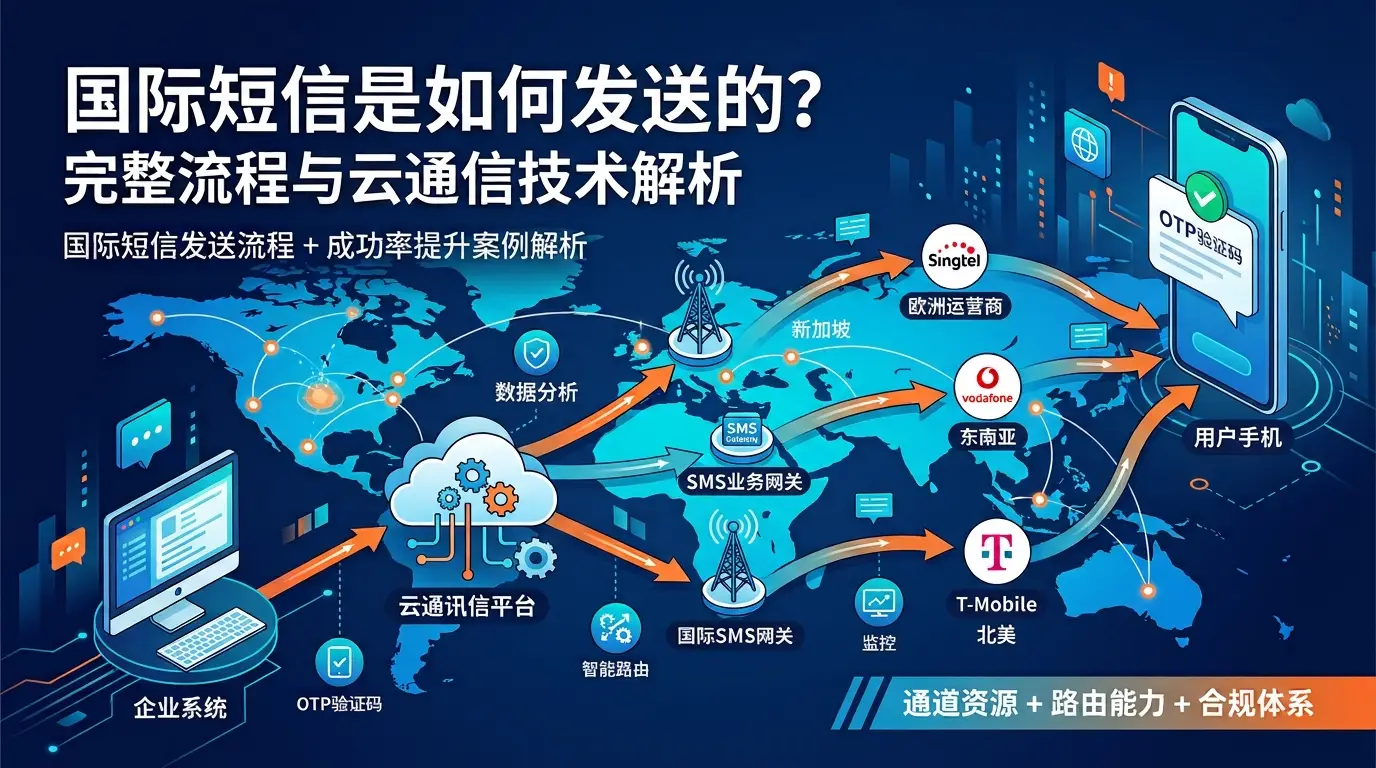
International SMS is not sent directly, but completes multi-level routing through the global communication network:
Enterprise System → Cloud Communication Platform → International SMS Channel → Overseas Carrier → User Mobile
This process relies on the global carrier interconnection network and cloud communication scheduling system.
2. International SMS Sending Process (Full Link Analysis)
1. Enterprise System Triggers SMS (API Call)
Typical business scenarios:
- User registration verification code (OTP)
- Login security verification
- Order notification
- Marketing outreach
📌 Data Reference (Industry Average): OTP verification SMS accounts for about 65%-75% of total international SMS, with e-commerce and finance industries accounting for over 50%.
2. Cloud Communication Platform Smart Routing (Core Capability)
The system calculates in real-time based on multiple dimensions:
- Country and region
- Carrier identification
- Channel success rate (real-time SLA)
- Cost and latency
- Risk control strategy
📌 Industry Data (Typical CPaaS Platform): Smart routing can improve overall success rate by 8%-25%, and dynamic channel switching can reduce failure retry rate by over 30%.
3. International SMS Channel Transmission (Global Network)
SMS is transmitted through:
- Carrier direct connection channel (Direct Route)
- Tier-1 global SMS network
- Regional aggregation channel
📌 Industry Comparison Data: Direct Route delivery rate 95%-99%, latency 1-5s; Aggregation Channel delivery rate 85%-95%, latency 3-15s; Indirect Forwarding delivery rate 70%-85%, latency 5-30s.
4. Overseas Carrier Processing (Last Mile)
SMS enters local carrier SMSC, such as: Singtel (Singapore), Vodafone (Europe), T-Mobile (USA)
📌 Key Mechanisms: Content filtering (Spam Detection), Sender ID verification, Sending rate limit
5. User Terminal Reception
Normal: 1-8 seconds delivery
Cross-border congestion: 10-60 seconds delay
Abnormal: Retry or failure
3. Real Industry Case Data
Case 1: Cross-border E-commerce Platform (Southeast Asia Market)
Problem: Registration verification code success rate only 82%, severe user loss (about 18% loss at registration stage)
Optimization Plan: Access direct international SMS channels, enable smart routing optimization, configure Sender ID by country
Result: OTP success rate increased to 97.6%, registration conversion rate increased by 12.3%, SMS latency reduced by about 60%.
Case 2: Fintech APP (Latin America Region)
Problem: High verification SMS latency (average 18 seconds), failure rate over 20% in some countries
Optimization Plan: Deploy multi-channel redundancy mechanism, introduce carrier priority direct routes, enhance risk control filtering strategy
Result: Delivery rate increased to 98.1%, average latency reduced to 3.2 seconds, failure retry rate decreased by 42%.
Case 3: Global Social APP (Middle East Market)
Problem: SMS congestion during registration peak, high OTP SMS loss rate
Optimization Plan: Dynamic smart routing scheduling, country-based traffic control (Throttling), multi-node disaster recovery channels
Result: Peak stability improved by 35%, SMS loss rate reduced to below 1.5%, user registration success rate increased by 9.8%.
4. Key Factors Affecting International SMS Success Rate
1. Channel Quality
Whether carrier direct connection, whether multi-level jump exists
2. Carrier Rules
Filter strategy differences, whitelist mechanism
3. Content Compliance
Marketing restrictions, Sender ID specifications
4. Number Quality
Whether real user, whether high-risk number segment
5. Sending Strategy
Sending frequency control, traffic peak scheduling
📌 Industry Conclusion: Channel quality and routing capability determine over 70% of delivery rate performance
5. How Enterprises Can Improve International SMS Success Rate
- 1. Use carrier direct connection channels: Avoid losses from multi-level forwarding
- 2. Smart routing optimization: Real-time selection of optimal channels
- 3. Multi-channel redundancy mechanism: Ensure high availability
- 4. Content and Sender ID compliance optimization: Reduce carrier blocking
- 5. Real-time monitoring + retry mechanism: Reduce impact of occasional failures
6. Typical International SMS Application Scenarios
- Cross-border e-commerce OTP verification SMS
- Overseas APP registration and login verification
- Financial transaction security notification
- Social platform account protection
- Game overseas user outreach
- Global marketing SMS
7. Value of Cloud Communication Platform
A mature international SMS platform is not just a "sending tool", but:
- Global carrier network access capability
- High-reliability SMS API system
- Smart routing and load scheduling
- Real-time monitoring and risk control system
- Multi-channel disaster recovery architecture
👉 Essentially, it is the enterprise's "global communication infrastructure"
8. Conclusion
The essence of international SMS is not "sending a message", but building a stable communication system across countries and carriers.
In actual business, the core determining success rate is not the sending action itself, but: Channel resources + Routing capability + Compliance system
If your business is facing:
- International SMS delivery rate below 90%
- OTP verification code delay or loss
- Decline in overseas user registration conversion
- High SMS costs
We can provide:
- Carrier direct international SMS channels
- Enterprise-level OTP verification code optimization solution
- Smart routing scheduling system
- Global SMS API access and test environment
📩 Request to obtain "International SMS Channel Optimization Report (including industry benchmark data comparison)" or free test channel access